The instability that is transforming the Middle East and North Africa at various levels has left business in its largest economy largely unscathed. Generous spending plans announced by the Kingdom of Saudi Arabia in February and March have helped strengthen its stability. According to the last Regional Economic Outlook published by the International Monetary Fund in October, the economy of Saudi Arabia will grow by 6.5% in 2011, the second highest rate after Qatar's.
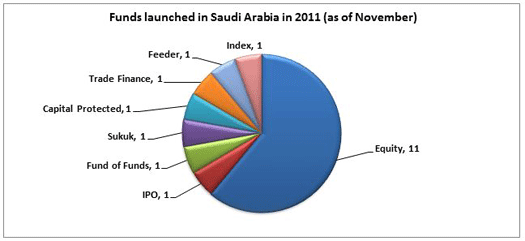
In harmony with the country's leading position in terms of GDP, the kingdom is home to the largest mutual funds industry in the MENA region. As of 3Q-2011, 239 mutual funds (including real estate and closed-ended funds) where domiciled in Saudi Arabia, down from 243 funds during the previous two quarters, according to the Quarterly Statistical Bulletin published by the Saudi Arabian Monetary Agency. Assets under management declined to USD 22.78 billion from USD 23.70 billion during the first two quarters of 2011. This was after AUM remained unchanged from the first quarter to the second.
Source: Zawya Funds Monitor
Volatile Performance
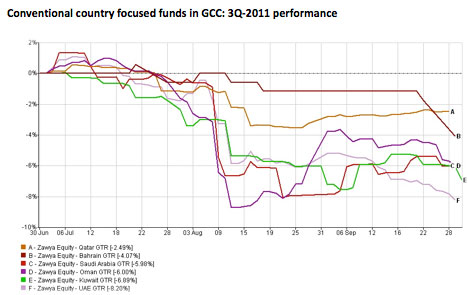
During the third quarter of 2011, Saudi equity funds, whether Shariah-compliant or conventional, were volatile just as in previous quarters. After starting the first days of July with positive returns, the global financial storm that hit emerging markets the following month had a deep effect on the region's markets which lost USD 32 billion in just 20 days. As a result, Saudi equity funds suffered from losses exceeding 8% compared to the end of June figures.
They managed to recover slightly over the following month without being able erase all losses accumulated during the quarter and ended September with negative returns of 5.98% for conventional funds and a negative 4.90% for their Islamic peers.
After scoring very high returns during the second quarter of 2011, IPO funds and especially conventional ones suffered heavy losses during the third quarter as they plunged 9.85% by the end of August compared to June but reduced it to a negative 5.57% by the end of September. Islamic IPO funds performed better, sustaining losses limited to 3.73% at the peak of the crisis in August and then managing to eliminate all negatives by the end of the quarter.
IPO funds along with sector funds focused on cement and construction companies managed to generate positive year-to-date performances as opposed to the other equity funds in Saudi Arabia. Balanced income funds, which are all Shariah-compliant, had a similar trend in their performance chart to their equity peers, showing the highest dip in mid-August before climbing again by the end of the quarter. They scored returns of a negative 3.25% quarter-on-quarter as at the end of September 2011.
Source: Zawya Funds Monitor
Apart from equity funds, trade finance funds and money market funds hold the majority of the assets of Saudi Arabia-domiciled funds. As many as 29 trade finance and 10 money market funds, which invest in short term and highly liquid fixed income instruments, managed assets worth close to USD 13.1 billion by the end of 3Q-2011, with the bigger share being Islamic. The Saudi sukuk funds are limited to two which could be attributed to limited number of sukuk issues in the kingdom compared to the GCC.
A Positive Outlook
The fourth quarter of 2011 kicked off with many funds on the launch list, a clear indicator that the local stock market still holds real growth potential in various sectors. News that the Tadawul, the Saudi stock exchange, may be open to foreigners has the potential to increase liquidity on the market and reduce volatility significantly. That in turn will have a direct consequence on the performance of mutual funds and end the paradox of strong fundamentals and high volatility existing side-by-side.
Opening the bourse to foreign participation will also make the Saudi market eligible for Emerging Market status by MSCI considering its size, which stands at about USD 323.7 billion. This classification will attract the majority of fund managers who track the MSCI Emerging Markets Index and increase the flow of assets into local funds.
Of 141 listed companies that disclosed their financials as of the third quarter of 2011, 86 witnessed increasing profits compared to the same period last year, according to data collated by the Kuwait and Middle East Investment Company; 53 saw profits decline. The biggest advances were registered in the banking and finance, petrochemicals, cement, and retail sectors, while the biggest drops were in the insurance, telecoms, and transportation sectors. Overall results grew by 24% for all 141 companies, a clear indication of the strong fundamentals of the Saudi economy. This is expected to attract a large number of foreign institutional investors if the Tadawul is opened up to them, as they are eager to find a fast-growing stable economy amid the increasing uncertainty in other parts of the world.
Saudi mutual funds could play a leading role in this process, and there is every possibility that the industry will witness a boom in terms of the number of funds and AUM in coming years.
Zawya 2011