Gold walked up the stairs and came down the elevator. And as chatter of a global recession rises, the 'safe haven' may not be the place to be parking your funds, says BarCap.
How the mighty have fallen. From calls of $2,000 to $2,500 before the end of the year, gold pundits are scrambling to scale back their forecast for the yellow metal as talks of recession become more widespread.
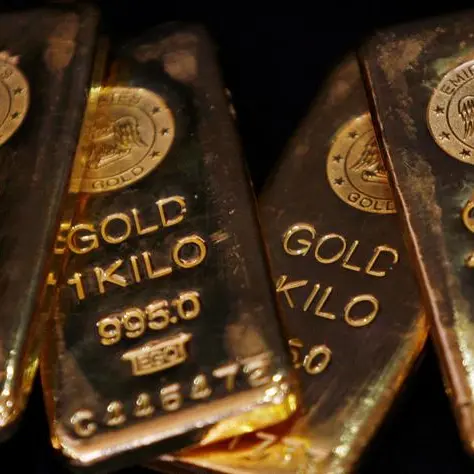
What happened to gold? As one analyst from CNBC put it, gold walked up the stairs and came down the elevator. From crossing the $1,900 per troy ounce to losing close to $400 within a few days, gold appears to have lost its lustre.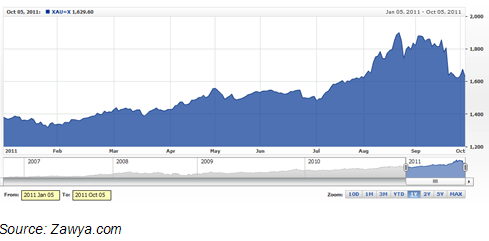
It's a fact that bamboozles most gold bugs who thought if the world's economy ever careened into a big black hole of sovereign debt, gold will be the one thing to stock up on. This was going to be especially true as other safe havens - the Swiss franc and the Japanese yen - were being propped up by their regulators to keep the speculators out. This was gold's cue to race to $2,000 without breaking a sweat.
Related Stories: Gold's Honest Price $10,000, Says Societe Generale
Well, the world does appear to be heading into a big black hole, but gold prices have tanked.
More bad news
A Barclays Capital research notes that gold prices are vulnerable to a recession - more so than some of the other commodities. In the last recession of 2008, gold prices appreciated the least among precious metals.
This time however, gold prices have not considerably softened before an impending recession - as it did in 2008.
Of all commodities, gold is placed as the eighth most vulnerable in a recession, according to the BarCap study, which took into account inventory levels, correlation to emerging markets and their performance in the crisis of 2008.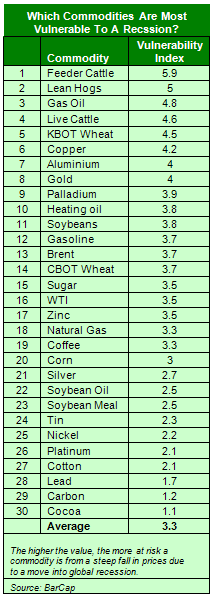
"Gold's fairly high ranking (8th out of 30) is interesting because it performed relatively well in 2008-09," notes the BarCap research. "However, this time around, gold prices have been stronger than they were prior to September 2008, whilst speculative positioning is also a little higher.
Gold's strong performance in previous economic downturns is a positive, but not enough to offset these other negatives. It is important to note, however, that gold's high ranking is also a function of fundamental factors such as costs and emerging market exposure, which are arguably less important in influencing gold prices than they are for other commodities.
In addition, gold-supportive factors that are less important for other commodities, such as being a hedge of economic and financial uncertainty, have not been taken into account in the BarCap research.
"Therefore, the implication of gold's high ranking needs to be hedged somewhat. Nevertheless, it does suggest that if the financial factors that have supported physical investment buying were to fade, then gold prices could start to look very precarious indeed."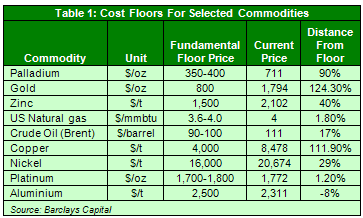
Table 1 also highlights gold's vulnerability, especially if recessionary winds blow across the global economy. The yellow metal is 124% above its floor price, followed by copper, which is another overdone commodity.
Meanwhile, aluminium - a key product among Gulf states - appears to be below its floor price, but suffers from high inventory levels, which may not save it in a recession.
rude should hold up
The BarCap research ranks crude vulnerability at midlevel, primarily due to low inventory levels
"A relatively low level of inventories globally is supportive, but linkage to emerging markets is relatively low, whilst it has an above-average linkage to global growth and speculative interest is relatively high. Brent crude prices appear more vulnerable to a sharp slowdown in growth and oil demand than WTI, mainly because WTI oil prices have already fallen much further," notes the report.
Crude prices have benefited from disruptive supplies from Libya to Iraq, Yemen, Syria, North Sea crude and underperformance in oil production in Russia, China, Canada and Nigeria.
"Crude oil spare capacity is very low. At an estimated 2-3m bpd, most of it held by Saudi Arabia and made up of more sour, heavy crude types, the global oil supply industry has very little slack in its system," notes BarCap.
"This means that, as was the case in 2008, OPEC should have little difficulty in cutting output significantly if required. The combination of low inventories and limited spare capacity suggests a high degree of support for crude oil prices even if demand conditions deteriorate significantly."
Read Related Stories From the Recession Series: China's Hard Landing And Its Impact On Mideast Markets
Global Recession: What The Analysts Say
© alifarabia.com 2011