Ousting Moammer Gaddhafi may have been the easy part as the National Transitional Council mulls over the next steps to restore domestic stability and investor confidence back into the state.
The slate has not exactly been wiped clean, but it is the dawn of a new era in Libya. With Colonel Moammer Gaddhafi a fugitive in the country he ran with an iron fist for 42 years, the Libyan rebels' National Transitional Council (NTC) has quickly emerged as the legitimate group running the country in the interim.
Not that the NTC does not have its fair share of problems. While the various groups and tribes that form the uneasy alliance are currently united in their quest to rid the country of Gaddhafi, there are likely to be rifts emerging as it picks up the pieces.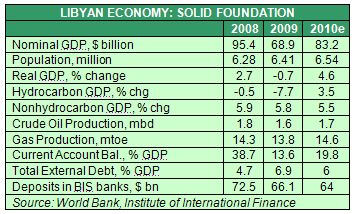
The European Union (EU), which led the international offensive against Gaddhafi under the auspicies of NATO, is now expecting to benefit the most from the Libyan economy.
"This is a potentially rich country. They have oil. They have resources frozen around the world. If we could find a way to move over to a democratic better-governed Libya, this could actually be a prosperous country," Swedish Prime Minister Fredrik Reinfeldt told the media in Paris where "Friends of Libya" stamped their approval over the TNC and released much needed funds that had been frozen since the civil war erupted in the country six months ago. Close to 70 countries now recognise the TNC as the legitimate representatives of the Libyan people.
The EU recently lifted its asset freeze on 28 Libyan entities, according to a statement. "Our goal is to provide resources to the interim government and the Libyan people and help to make the economy function again... decision concerns in particular Libyan ports, as well as the energy and banking sectors," noted the EU.
"The EU has acted swiftly in the light of the developments on the ground....this is a clear sign of the EU's determination to do its utmost to support the people of Libya and the interim authorities during the transition. The EU will remain a strong and committed partner for the Libyan people and will continue to examine all possible measures in support of Libya."
Given Europe's hunger for energy, Libya's hydrocarbon infrastructure have been the primary focus even in these early stages of transition. A natural gas pipeline linking Italy to Libya has been reportedly repaired and is supplying the pump stations and the Mellitah (gas processing) refinery. The pipeline, half-owned by Italian giant Eni, forms 10% of Italy's oil imports and was shut down in February as oil companies fled Libya.
Other countries are also looking to return. Suncor, the Canadian energy giant, is also closely following proceedings, while Austria's OMV and France's Total should also benefit from EU's close relationship with the TNC.
BP, which evacuated its staff from the country in February, has confirmed that it will resume activities and "return to the country when conditions allow." Risk consultant Maplecroft notes that oil and gas services company Petrofac has also indicated that it was keen to send employees to the country by the end of 2012 to examine business options in the country.
To the victors go the spoils. While European and Middle East oil companies may find favour among TNC, Russian and Chinese companies may be frozen out given their lack of support to the rebels.
"China, which has increased its engagement with Libyan rebels over recent months, has iterated its support for the Libyan people. It previously abstained from voting for UNSC Resolution 1973, however. Rebel leaders have promised to honour all the business contracts that were signed between investors and the Gaddafi regime in Libya and even requested Beijing's assistance in the reconstruction process," says Maplecroft. "Yet Mustafa Abdel Jalil maintains that the NTC would favour governments which extended their support to the rebel movement over those which did not, placing China and Russia in an ambiguous position."
Maplecroft's Business Integrity and Corruption Index ranks Libya as an extreme risk country with a score of 2.08 out of 10, where scores closer to zero indicate higher risk. The NTC's Mustafa Abdel Jalil said in July that all agreements and contracts signed with the previous government would be respected on the condition that they "have nothing to do with corrupt schemes." Companies that have engaged in corrupt practices or have engaged with corrupt partners risk losing their foothold in the country. At a minimum they are likely to be subjected to negative publicity.
Qatar, which was most vocal in its support of the Libyan rebels and other Gulf states will no doubt play a role in rebuilding the country. The GCC has been actively offering financial support to Egypt and Tunisia - the two states that have successful rid itself of their respective dictators - and the Gulf sovereign wealth funds and national companies will no doubt be scouting for opportunities in the country.
All About Oil
Libya holds 46.4 billion of oil reserves, the largest in Africa. Its close proximity to the energy-intensive European Union meant that the global community continued to engage with the North African country all these years despite its despotic leader.
Before the civil war, Libya was the 17th largest producer of oil. An important OPEC member producing 1.8 million barrels of oil, Libya exported nearly 1.5 million barrels per day, of which 80% went to European markets. All that changed in February when international oil companies' staff fled amid mounting unrest. The rebels now expect oil supplies to reach 500,000 to 750,000 barrels per day within a few months.
It is important to note that Libya's full production capacity of 1.8 million was still modest compared to its peak of three million barrels per day in the 1960s. The potential, clearly, is enormous and the world knows it.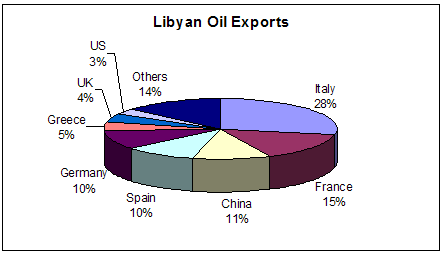
Frozen Assets
Around $150-billion of Libyan assets have been frozen by governments along with 143.8 tonnes of gold held by the Libyan Central Bank.
To date:
- Close to $15 billion has been released by the Friends of Libya Council
- the EU has lifted its asset freeze on 28 Libyan entities including Libyan ports, energy and banking sectors
- the United States released $1.5 billion Libyan funds
- the United Kingdom has released $1.55 billion of Libyan bank notes.
- France recently released $2.16 billion of Libyan assets
- Italy is unfreezing close to $500 million of Libyan funds in Italian banks,
- Spain is looking to unfreeze 350 million euros for Libya
In addition:
- Austria has nearly 1.2-billion euros Libyan assets frozen
- the United kingdom has $19.2 billion in Libyan assts
- Canada holds $2.4-billion assets reportedly belonging to the former Libyan regime.
- French banks hold $11 billion euros of Libyan deposits.
-Germany has 7 billion euros.
- Italy has $8-billion of Libyan assets
- Switzerland has $827 million of known Libyan assets
- the United States has $34-billion in frozen Libyan assets.
- the Libyan Investment Authority (LIA) has $70-billion in assets according to Sovereign Wealth Fund Institute.
LIA has stakes in Pearson (3.01%) which publishes the Financial Times, Italian car giant Fiat (2.60%), Unicredit Banca Di Roma (2.59%), Russia's Rusal (1.43%), Eni and Verenex Energy in Canada, according to Zawya.
the LIA also controls a number of entities via its Libya Africa Investment Portfolio and Libyan Arab Foreign Investment Company, which control a number of entities in Egypt, Morocco, Bahrain, the United Kingdom, Sudan and Algeria.
- Libya reportedly had 143.8 tonnes of gold, the 24th largest sovereign gold reserve, according to the World Gold Council.
Political Mechanics
While the world's energy companies and other international companies are salivating at the prospect of an open, freer Libya, the country is far from stable.
Moammer Gaddhafi and his son Saif Al Islam remain in hiding and may yet be capable of disrupting stability in the country, or at least create an air of uncertainty and sabotage. The TNC can not focus on the job at hand if the spectre of a Gaddhafi disruption looms in the country. The new government needs to capture the ousted ruler in order to find closure and draw a line under the episode, in order to move on to the greater task of rebuilding the country and finding cohesion and structure in a very unruly domestic set up.
"Tribal, ethnic, ideological and religious rivalries and divisions constitute a large risk for Libya as members of the opposition movement seek to take over the reins of control," says Maplecroft.
"In addition to Berbers and Arabs, the rebel movement includes a disparate mix of liberal secularists, Islamists, socialists, former regime loyalists and long-time opposition figures.... A large-scale fallout between different groups followed by sustained or escalating violence could also precipitate the eventual break-up of Libya."
While the world has embraced the TNC as Libya's new hope, it is important to note that key members of the new government were prominent in the previous Libyan regime. Mustafa Abdel Jalil, the chairman of TNC, was a justice minister under Gaddhafi. It is not clear whether all the rebel fighters are comfortable with members of the previous regime in prominent position in the new Libya.
"Abdel Jalil was considered to be one of the least beholden to the regime when serving as minister and commands the respect of many rebels and non-combatants," notes Maplecroft.
"Yet, his former position in Gaddafi's inner circle means that he will continue to be mistrusted by other members of the rebel movement. The lack of a central figure around which different tribes, clans and ethnic groups can gather in solidarity remains an ongoing concern."
Prominent Libyan tribes such as Warfalla, Magarha, Warshafana and Tarhuna will all be vying for positions and stakes in the new Libya, and given that they influence significant portions of the country, their cohesion and compromise is crucial to the prosperity of the new Libya. The presence of Al-Qaeda and other militants may also appeal to those worried about the new 'colonisation' of Libya by Western countries and institutions.
Conclusion
For all its troubles - and there are many - Libyans can reset the button on their destiny. With considerable resources at its disposal, and Gaddhafi's return to power impossible, the TNC now finds itself with a weight of expectations to create an inclusive government, create jobs and economic growth and return Libya to the international community without being beholden to western powers.
Clearly, there are lessons from Iraq which plunged into domestic chaos after Saddam Hussein's ouster, and the TNC will need to walk a tight rope to satisfy the various stakeholders.
But at least now Libyans can hope to chart their own destiny with their own hands, rather be subjected to the whims of a despotic and deranged dictator. That alone gives reason for hope.
© alifarabia.com 2011