Egypt's economy has received a much-needed boost with the promise of aid and loans from the international community. Still the onus of recovery rests with the Egyptian authorities to ensure that the economy goes through this transitional period, without too much damage. More importantly, the aid gives the authorities the room to build the foundation of a robust economy ready to take its rightful place as a robust emerging market.
The international community has come together to support Tunisia and Egypt with a $40-billion programme that it hopes will stabilise these economies.
Both Tunisia and Egypt saw their dictatorial regimes dismantled earlier in the year. First, Ben Ali fled Tunisia as protestors revolted against continued joblessness and lack of economic opportunities coupled with high inflation; while Egypt's Hosni Mubarak was also unseated after the young population demanded economic and social changes.
Change came in both the countries, but a price. Foreign investment in both countries has dried up, joblessness remains high and inflation continues to bite.
Feelings of liberty and freedom are dangerously giving way to dismay and the international community has stepped in to ensure that there is economic support for the nascent democracies and the aspirations of its people in these two countries.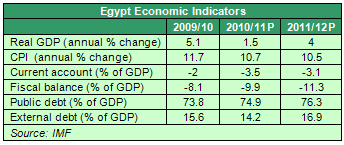
"In Egypt, political shock triggered substantial capital outflows, which in addition to the decline in tourism revenue, remittances, and exports, have led to a loss of foreign exchange reserves of about US$15 billion in the four months to end-April," says the IMF in a report.
The authorities have to find a balance between popular policies and painful decisions that may not be palatable at the moment, but will help the economy in the long run.
In the short-term unemployment is expected to get worse. "Looking ahead, growth is expected to recover gradually up to four per cent in FY2011/12, as confidence improves during the post-electoral period. However, there is considerable uncertainty about the speed of the economic recovery, which hinges primarily on an orderly political transition."
However, help seems to be on the way. The World Bank has pledged it will support Egypt with $4.5-billion in the next 24 months. Meanwhile, the United States pledged to assist the Egyptian economy with $2-billion and Saudi Arabia did better with $4-billion.
Moreover, the US is also looking to forgive the $3.5-billion it owes to Egypt.
Adding the World Bank's package to the total, support pledged by various countries and organizations since the revolution has reached an aggregate of $11-billion.
"This will alleviate the country's rising fiscal deficit, which reached EGP94bn in 9M10/11, compared to EGP86.9bn during the same period a year ago," notes Cairo-based CI Capital Research.
The financing bridge could not have come at a better time.
The Egyptian Government had raised this year's fiscal deficit expectation from 8.5% to 9.2% of GDP. It also expects a higher ratio the following year, with deficit ranging from 9.9-11% to GDP - given the increased allocation for petroleum subsidies, housing, education, health, and transport, notes CI.
"It is worth highlighting that in late April, the Government of Egypt announced that real GDP growth dropped 7%QoQ in 1Q11 and its latest estimates reflect a growth of 3.6% in FY10/11."
Pharos research believes the flood of assistance likely means that the government will be able to bridge the $10-12-billion balance of payments financing gap up to mid-2012, "without depleting the remaining stock of foreign reserves."
The new funds are expected to reduce pressure on domestic liquidity as the Central Bank of Egypt (CBE), will no longer need to intervene. Letters of credit deposits at the CBE had fallen nearly 66% in the first tow months of the year, mainly due to the unwinding of the EGP carry trade and CBE intervention in the foreign exchange market, says Pharos.
"This has pushed money market rates up by 75-200 basis points during 2011 to date, compared to 2010 average. Beyond June 2011, we expect pressures on reserves to ease and gradual compression in money market rates to commence.
The flow of funds will also have a positive impact on banks. Pharos says, it has started to observe "green shoots of recovery" in corporate and retail lending to tier one clients and several private banks have re-launched auto loans, as a sign of recovery.
There is some evidence of consumer recovery as evidenced by GB Auto - the country's biggest car assembling company - suggesting that it has seen a pick up in growth since April.
The country is also moving towards reforms. Prime Minister Essam Sharaf has set up a committee to resolve disputes on investment contracts. This is especially important given the flood of cancellations of real estate projects under the new transitional Egyptian government.
"This affirms the GoE support to a free-enterprise economy and private sector development. It is a positive step towards reviving an attractive business climate," says CI.
Other developments include the cancellation of licensing fees for industrial projects, reducing red tape in establishing companies from 4 to 6 months to three days and extending the trade licences from six months to one year to 3-5 years.
A number of international companies have also signalled their interest in Egyptian companies and sectors. These include Intel, Electrolux, AL Futtaim Group, Prince Waleed's Kingdom Holding and the Saudi Egyptian Touristic Development Company.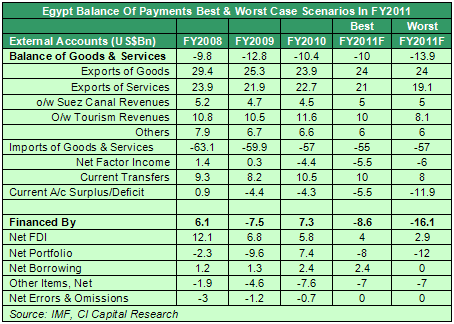
Challenges
Challenges for the Egyptian economy remain. Lack of job opportunities was one of the key reasons for the Egyptian youth to rebel against Hosni Mubarak's regime.
Egyptians now expect the new authorities to ensure that jobs are available for the 700,000 new entrants into the labour market each year.
"Absorbing them and reducing the number of the currently unemployed will require a more vibrant economy. Achieving this requires bold actions, many of which will have to be implemented by the government that will emerge from the general elections later this year," says the IMF.
Key reform challenges include enhancing competition so that markets become more contestable for domestic and foreign investors; creating a business environment that attracts and retains private investment and supports small businesses; reforming labour markets; and reducing the fiscal deficit, including by reducing waste through general subsidies. Even if implemented, the growth dividend from these reforms will take time to materialize. In addition, higher public investment in infrastructure, human capital, and social protection--needed to ensure more inclusive growth -- will involve additional fiscal costs.
As a result, Egypt's fiscal deficit will only decline in the medium term, and it will be important to ensure that public debt returns to a declining trajectory. To avoid excessive reliance on the domestic borrowing and leave sufficient space for private sector credit growth, continued external financing will remain desirable for several more years, including from the private sector.
Conclusion
While the Egyptian economy has been boosted by the promise of international aid, there are two crucial developments that would determine the long term progress of the economy: The parliamentary election and the presidential elections.
There is a danger that weak governments will be formed which would be forced to pursue popular policies that may not necessarily be in the best interest of the nation.
Meanwhile, political, economic and social reforms need to be implemented on war-footing. "The key reform challenges include enhancing competition so that markets become more contestable for domestic and foreign investors; creating a business environment that attracts and retains private investment and supports small businesses; reforming labour markets; and reducing the fiscal deficit, including by reducing waste through general subsidies. Even if implemented, the growth dividend from these reforms will take time to materialize," says the IMF.
The other key reform will be higher public investment in infrastructure, human capital, and social protection which will involve additional fiscal costs.
Aid For Egypt
The Egyptian authorities had indicated that they had expected to have a financing need of some $10-12 billion from now through June 2012 from the international community. They've approached bilateral and multilateral partners, including the IMF, to provide the financial support for what is their home-grown program.
Here is how the international community has responded:
IMF: Finance Minister Samir Radwan has said that Egypt is seeking $3 billion to $4 billion from the IMF. An IMF staff team currently is in Egypt to discuss an economic arrangement that can be supported by IMF financing.
World Bank: The World Bank aims to provide $4.5 billion over the next 24 months, including $1 billion in budget support this year and another $1 billion next year, depending on the country's political and economic reforms.
The remaining $2.5 billion will be invested in development projects in Egypt, lending to support the private sector and political risk guarantees.
Saudi Arabia: Saudi Arabia has announced $4 billion in aid, including a $1 billion deposit at the Central Bank of Egypt, $500 million in bond purchases, $500 million for general budget support and a $500 million soft loan.
$500 million of the fund is from the Saudi Fund For Development focused on financing small and medium-sized enterprises.
The kingdom will also extend another $750 million as a line of credit to finance Saudi exports to Egypt.
United States: The US will relieve $1-billion of Egyptian debt and another $1-billion in financing.
EU: The European Union is considering providing several hundred million euros of its own aid once an IMF agreement is signed.
United Kingdom: 110-million pounds for Tunisia and Egypt
European Bank For Reconstruction & Development: Officials have said lending to Egypt could start at around $140-$280 million. An EBRD spokesman said a team would visit in the next few weeks to identify infrastructure, agriculture and other potential projects.
Qatar: Qatar could invest up to $10-billion in Egypt. One of the proposed projects may be a port near Alexandria. Qatar is also looking to buy Egyptian government bonds.
Qatar is also looking to set up a Middle East Development Bank - in the mould of the European Bank of Reconstruction and Development - along with other GCC states to help Tunisia and Egypt. The UAE, Kuwait and Saudi Arabia are also expected to participate in the initiative.
African Development Bank: The African Development Bank is looking at providing $1-billion in financing at a later stage.
© alifarabia.com 2011