Opec is the latest battleground in Iran and Saudi Arabia's cold war. News that Iranian President Mahmoud Ahmadinejad may attend the next Opec meeting, has the potential of setting the cat among the pigeons.
May 22, 2011
Opec is the latest battleground in Iran and Saudi Arabia's cold war. News that Iranian President Mahmoud Ahmadinejad may attend the next Opec meeting, has the potential of setting the cat among the pigeons.
Opec is the latest battleground in Iran and Saudi Arabia's cold war. News that Iranian President Mahmoud Ahmadinejadmay attend the next Opec meeting set for June 8, has the potential of setting the cat among the pigeons.
The Iranian President has merged the portfolios of the energy and oil ministers and assumed the temporary responsibility of the ministry. He now has three months to find a new minister for the most important portfolio for the world's second largest oil producer after Saudi Arabia.
"The [Iranian] president has accepted the responsibility to take care of it (the oil ministry) and he himself will attend the meeting of the Opec," Iranian Vice-President for Parliamentary Affairs Mohammad Reza Mir-Tajeddini told reporters on May 18.
Ahmadinejad's presence could well thwart Opec kingpin Saudi Arabia's plan to portray the cartel as a responsible energy supplier working towards balancing global financial stability with its own members' needs.
Cold relations between the world's top two oil producers hit a new low earlier this year after the Gulf states accused Iran off igniting riots in Bahrain and dismantled an alleged Iranian spy ring in Kuwait. A war of words has ensued since with Saudi Arabia accusing Iran for fomenting unrest in Bahrain.
Gulf producers now fear Ahmadinejad's presence will do Opec's image no favours, especially if he uses the platform to perpetuate his own views and use it to take political potshots at the United States.
The International Energy Agency (IEA), the energy watchdog of mostly oil-importing OECD countries, has already fired a warning shot, suggesting if Opec does not act to calm crude the prices, the 28-member is "prepared to consider using all tools that are at the disposal of IEA member countries."
The statement is seen by many observers as a coded threat to release emergency stockpiles from the deep inventories of IEA members.
The IEA states have expressed serious concern that there are growing signs that the rise in oil prices since September is affecting the economic recovery by widening global imbalances, reducing household and business income, and placing upward pressure on inflation and interest rates.
"As global demand for oil increases seasonally from May to August, there is a clear, urgent need for additional supplies on a more competitive basis to be made available to refiners to prevent a further tightening of the market," said in a May 19 statement.
"Enhancing consumer-producer dialogue is urgently important to reach both short- and long-term solutions. The Governing Board urges action from producers that will help avoid the negative global economic consequences which a further sharp market tightening could cause, and welcomes commitments to increase supply," notes the EIA.
Iran is a strong advocate of higher oil prices which serves it well due to the international sanctions placed on its economy. Ahmadinejad's presence mean that any Opec gesture to raise output will be dashed. Worse, his comments may even lead to a spike in prices, something Opec is looking to avoid given that it has maintained the rise is not supply-driven (which it can control) but speculators, which it does not.
"Based on the supply-and-demand fundamentals, crude oil prices should not be this high," Saudi Oil Minister Ali Al-Naimi said on April 19, adding that the lower demand for Saudi oil in March compared to February this year was a "sign of surplus supply".
Goldman Sachs and other investment banks expect oil prices to trend upwards given inadequate supplies and perceived threats to the markets.
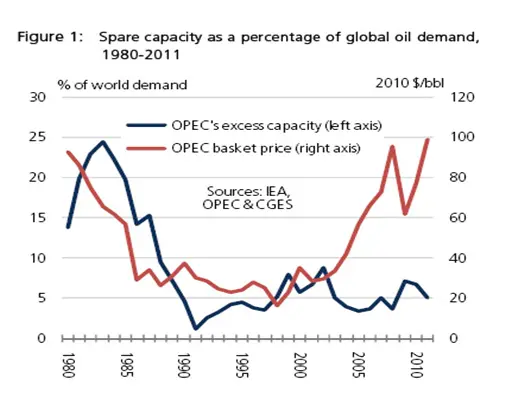
The Centre for Global Energy Studies (CGES), run by the venerable ex-Oil Minister of Saudi Arabia Sheikh Yamani, wonders whether the world's present spare capacity is adequate.
"The answer seems to be 'yes', bearing also in mind the amount of strategic stocks controlled by the OECD governments and a major oil consumer like China. However, the verdict of the oil market seems to be 'no', going by the current level of the oil prices, CGES said in an April note.