08 May 2011
Oil fell nearly $10 in a day, bringing out oil bears with their charts to show how crude will remain weak. But is oil merely catching its breath before it scales new heights? Goldman Sachs thinks so.
Ali Al-Naimi must be feeling vindicated. The Saudi oil minister had noted a few weeks back that there was not much global demand for oil and blamed market speculation for the black stuff's rally.
"Based on the supply-and-demand fundamentals, crude oil prices should not be this high," Al-Naimi said on April 19, adding that the lower demand for Saudi oil in March compared to February this year was a "sign of surplus supply".
The market however, paid no heed and incensed presidential hopeful Donald Trump's Oil Hysteria added fuel to the fire.
And then on May 5, - just as Goldman Sachs had predicted - oil fell $10.
As alifarabia.com had reported in a recent report, Goldman Sachs had expected oil prices to pull back significantly from their current levels of $125 for Brent, to around $105 in the near term. On May 6, Brent stood at 109.13 a weekly decline of 13%.
"Although the contagion risk in the Middle East and North Africa (MENA) remains elevated, and the oil market's ability to weather the loss of supplies from another producer in the region is limited, we believe that, with the market continuing to embed at least a $10/bbl risk premium in prices, that the price risk is becoming more symmetric at these price levels as we believe that the market will experience a substantial correction toward our $105/bbl near-term target for Brent crude oil in coming months," Goldman Sachs had written in a note to clients.
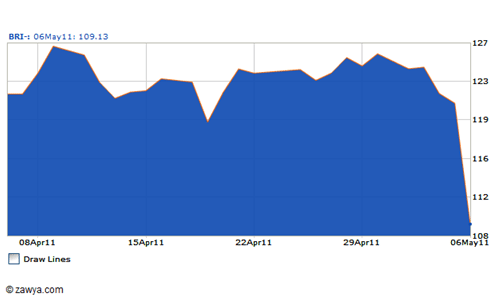
Now, the Wall Street giant expects a further downside risk for oil prices in the next few days but thinks oil prices will retrace or even surpass recents highs by next year.
"While a large portion of the risk premium likely came out of prices yesterday, we remain wary of the potential for further downside in coming days," the bank noted on May 6. "The sell-off yesterday (May 5) has likely removed a large portion of the risk premium that we believe has been embedded in oil prices, which could suggest further downside may be limited from here. However, we remain wary of potential further downside should economic data releases in coming days continue to disappoint..." said Goldman in a report.
"It is nevertheless important to reiterate that while we saw recent prices as having risen above the levels consistent with underlying near-term supply-demand fundamentals, we continue to believe that the oil supply- demand fundamentals will tighten further over the course of this year, and likely reach critically tight levels by early next year should Libyan oil supplies remain off the market. Consequently, it is important to emphasize that even as oil prices are pulling back from their recent highs, we expect them to return to or surpass the recent highs by next year."
JP Morgan has chimed in and in fact, raised its price forecast for Brent from $110 for the year to $120 and $114 in 2012.
"While financial bushfires or perhaps a rapid resolution to the Libyan civil war could radically alter market dynamics, the balance of both risks and fundamentals still points to a supply-constrained world," said JP Morgan in a note on May 7.
Oil markets had climbed a wall of worry due to unrest in the Middle East, especially as Libyan oil stopped flowing into the market. But the death of Osama Bin Laden, the world's most wanted terrorist, has suddenly taken a fair amount of risk out of the equation.
"With Osama bin Laden dead, the market is adjusting the geopolitical risk premium down accordingly," said Chris Jarvis, senior analyst, Caprock Risk Management wrote. " Given this, speculative money is being taken off the table."
OIL BEARS
The steep drop in oil prices has suddenly brought out the bears coming out of the woodworks.
Consider the chart below from Mike 'Mish' Shedlock, investment adviser at Sitka Pacific Capital:
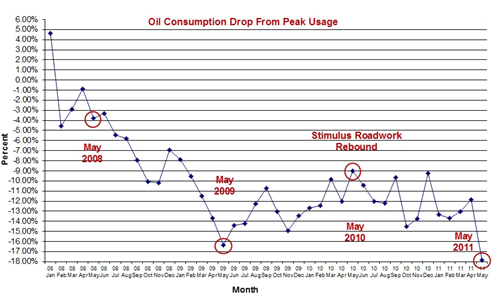
The chart shows demand for oil distillates - which, reportedly rose to their peak in the United States from January 2008, and shows how we are nowhere near peak demand for oil at least in the U.S.
Shedlock argues that future volumes "went through the roof earlier this year... One certainly cannot use this information as a timing device, but it is interesting to see everyone plow into this 'sure thing' trade right as demand has collapsed. Unwinding this trade can easily collapse the price of oil and send the US dollar higher, and I think it will."
There are other signs of worry. Emerging markets are cooling inflation with interest rates hikes, while economic data from Europe and North America is not exactly heartening - and the markets can well see the signs.
"The global economy is critically ill," says Societe-Generale's Albert Edwards. "The fact that it has just risen from its sick-bed to perform a frenetic Irish jig is more a function of the financial morphine and steroids that have been pumped into its emaciated body than any miracle cure. You don't have to be Dr Doom to expect the patient to collapse back into a deep coma after the stimulus has worn off."
Analysts remain divided about where oil prices are next, but Opec members will be eyeing a cut if they see oil prices go below the 'fair' price of $90-$100.
"The price had been going too high, to $120 a barrel, which is not good for consumers because it can affect the world economy," an OPEC delegate, told media on May 7. "A price in the range of $90 to $100 will be ideal." alifarabia.com 2011
Oil fell nearly $10 in a day, bringing out oil bears with their charts to show how crude will remain weak. But is oil merely catching its breath before it scales new heights? Goldman Sachs thinks so.
Ali Al-Naimi must be feeling vindicated. The Saudi oil minister had noted a few weeks back that there was not much global demand for oil and blamed market speculation for the black stuff's rally.
"Based on the supply-and-demand fundamentals, crude oil prices should not be this high," Al-Naimi said on April 19, adding that the lower demand for Saudi oil in March compared to February this year was a "sign of surplus supply".
The market however, paid no heed and incensed presidential hopeful Donald Trump's Oil Hysteria added fuel to the fire.
And then on May 5, - just as Goldman Sachs had predicted - oil fell $10.
As alifarabia.com had reported in a recent report, Goldman Sachs had expected oil prices to pull back significantly from their current levels of $125 for Brent, to around $105 in the near term. On May 6, Brent stood at 109.13 a weekly decline of 13%.
"Although the contagion risk in the Middle East and North Africa (MENA) remains elevated, and the oil market's ability to weather the loss of supplies from another producer in the region is limited, we believe that, with the market continuing to embed at least a $10/bbl risk premium in prices, that the price risk is becoming more symmetric at these price levels as we believe that the market will experience a substantial correction toward our $105/bbl near-term target for Brent crude oil in coming months," Goldman Sachs had written in a note to clients.
Now, the Wall Street giant expects a further downside risk for oil prices in the next few days but thinks oil prices will retrace or even surpass recents highs by next year.
"While a large portion of the risk premium likely came out of prices yesterday, we remain wary of the potential for further downside in coming days," the bank noted on May 6. "The sell-off yesterday (May 5) has likely removed a large portion of the risk premium that we believe has been embedded in oil prices, which could suggest further downside may be limited from here. However, we remain wary of potential further downside should economic data releases in coming days continue to disappoint..." said Goldman in a report.
"It is nevertheless important to reiterate that while we saw recent prices as having risen above the levels consistent with underlying near-term supply-demand fundamentals, we continue to believe that the oil supply- demand fundamentals will tighten further over the course of this year, and likely reach critically tight levels by early next year should Libyan oil supplies remain off the market. Consequently, it is important to emphasize that even as oil prices are pulling back from their recent highs, we expect them to return to or surpass the recent highs by next year."
JP Morgan has chimed in and in fact, raised its price forecast for Brent from $110 for the year to $120 and $114 in 2012.
"While financial bushfires or perhaps a rapid resolution to the Libyan civil war could radically alter market dynamics, the balance of both risks and fundamentals still points to a supply-constrained world," said JP Morgan in a note on May 7.
Oil markets had climbed a wall of worry due to unrest in the Middle East, especially as Libyan oil stopped flowing into the market. But the death of Osama Bin Laden, the world's most wanted terrorist, has suddenly taken a fair amount of risk out of the equation.
"With Osama bin Laden dead, the market is adjusting the geopolitical risk premium down accordingly," said Chris Jarvis, senior analyst, Caprock Risk Management wrote. " Given this, speculative money is being taken off the table."
OIL BEARS
The steep drop in oil prices has suddenly brought out the bears coming out of the woodworks.
Consider the chart below from Mike 'Mish' Shedlock, investment adviser at Sitka Pacific Capital:
The chart shows demand for oil distillates - which, reportedly rose to their peak in the United States from January 2008, and shows how we are nowhere near peak demand for oil at least in the U.S.
Shedlock argues that future volumes "went through the roof earlier this year... One certainly cannot use this information as a timing device, but it is interesting to see everyone plow into this 'sure thing' trade right as demand has collapsed. Unwinding this trade can easily collapse the price of oil and send the US dollar higher, and I think it will."
There are other signs of worry. Emerging markets are cooling inflation with interest rates hikes, while economic data from Europe and North America is not exactly heartening - and the markets can well see the signs.
"The global economy is critically ill," says Societe-Generale's Albert Edwards. "The fact that it has just risen from its sick-bed to perform a frenetic Irish jig is more a function of the financial morphine and steroids that have been pumped into its emaciated body than any miracle cure. You don't have to be Dr Doom to expect the patient to collapse back into a deep coma after the stimulus has worn off."
Analysts remain divided about where oil prices are next, but Opec members will be eyeing a cut if they see oil prices go below the 'fair' price of $90-$100.
"The price had been going too high, to $120 a barrel, which is not good for consumers because it can affect the world economy," an OPEC delegate, told media on May 7. "A price in the range of $90 to $100 will be ideal." alifarabia.com 2011