Apr 11 2011 |
more articles from
|
Rise Of Egypt
11 April 2011
Egypt will surpass Saudi Arabia as the region's largest economy by 2050 and emerge as the 19 th largest economy in the world, according to an HSBC report.
When the going gets tough, the tough go long. HSBC 's farsighted report on The World In 2050, looks into its crystal ball and makes some interesting predictions about economic trends in the future.
"Substantial progress up the global league table will be made by a host of other emerging economies - most notably, Mexico, Turkey, Indonesia, Egypt, Malaysia, Thailand, Colombia and Venezuela," said the report which was published in January 2011.
According to HSBC estimates, by 2050 Egypt's economy will emerge as the 19th largest in the world, to reach $1,165 billion, surpassing Saudi Arabia's $1,128 billion. Iran will be the only other Middle East state in the world's 30 largest economies, with $732-billion.
The small-population, ageing, rich economies in Europe are the biggest losers in the future. Switzerland and the Netherlands slip down the grid significantly, and Sweden, Belgium, Austria, Norway and Denmark drop out of the Top 30 altogether, notes HSBC , adding that 19 of the 30 largest economies in the world by 2050 will be what we currently know as 'emerging markets'.
Demographic change is even more dramatic outside of Europe. The working population will rise by 73% in Saudi Arabia and fall by 37% in Japan. That is reflected in these countries' differing fortunes in the top 30 table (below).
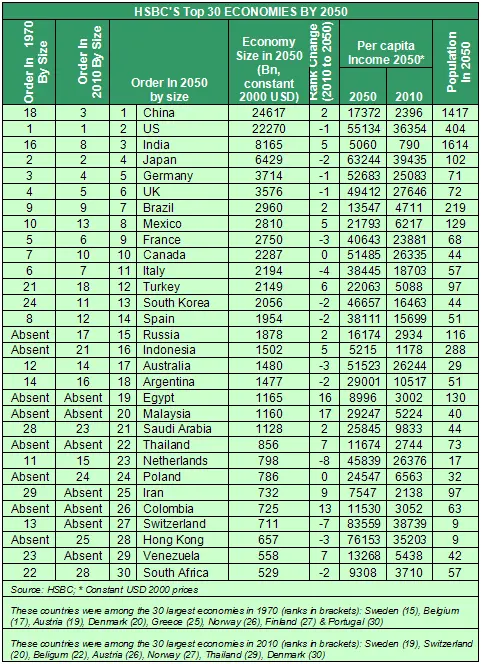

Most interestingly, there might not be a major correlation between economic growth and democratic values. Growth in China, Singapore and Saudi Arabia, for example, may come despite an absence of an open political participation for the citizens.
"Overall, authoritarian regimes can deliver economic success if the system manages to set in place the incentives that a market-based system naturally delivers, namely competition and a motivation to drive efficiency," says HSBC .
HSBC 's calculations suggest that the Egyptian economy has to grow at a steady pace of around four per cent to emerge as the 19th largest economy in the world. Meanwhile Saudi Arabia is expected to grow around 2 to 2.6% for the next 40 years to become the 21st biggest economy in the world.
HSBC less confident of its prediction on Iran: "With a good level of education, Iran would produce good growth rates. However, the backcasting exercise shows that Iran has failed to achieve this. Poor relations with the rest of the world and the trade and capital sanctions likely play a key role here. This just shows how the model cannot capture all of the issues, and Iran is the one country where we haven't taken the model's forecast but have replaced it with the past growth rate."
DEMOGRAPHIC REVOLUTION
The populations of the varying countries will have much to do with their economic fortunes. Japan and European countries will slip on the back of slowing and ageing populations, but countries like Saudi Arabia and Egypt will see the greatest change in their working populations among the world's 30 largest economies, which will spur growth.
"Saudi Arabia, with the highest fertility rate, gets a significant boost to growth with the working population expected to growth by more than 70%. Egypt isn't far behind. Certain parts of Asia - Malaysia, India, and Indonesia - will all see strong growth in their workforce."
These demographic opportunities will also mean a great challenge for scarce resources.
"The scale of economic expansion forecast in this report over the next four decades raises inevitable questions about environmental feasibility: Put simply, does the planet have enough capacity to sustain this tripling in economic output by 2050?," asks HSBC . "The answer is a cautious yes: The world economy can triple its income, but only if levels of resource productivity are improved many times over."
In short, energy availability need not hinder this path of global development so long as there is major investment in efficiency and low-carbon alternatives. Meeting food demand may prove more of a challenge, but improvements in yield and diet could fill the gap."
CITIBANK REPORT
The HSBC report contrasts with a similar report by Citibank, which estimates that the Saudi economy will grow to be the sixth largest by 2050 (read here: Saudi Arabia 6th Richest Economy By 2050 ),.
Citibank expected Egypt to be among the leading economies in the world, though not above Saudi Arabia. Both the HSBC and Citibank ignored the recent turmoil in the North African state to focus on its raw potential.
"We expect a steadily rising growth rate for the next 40 years, averaging 5% per annum between 2010 and 2050. Egypt ranked 48th in 2010 as regards real per capita GDP with US$5,878," Citibank analysts said in the report.
Of course, all such reports need to be taken with a pinch of salt. Unrest, wars and natural catastrophes such as the one Japan is currently enduring means that some of these countries may not fulfill their potential, or other economies that are currently under the radar may exceed expectation.
But it does offer a world view on where to look for pockets of opportunities and sometimes drown out the short-term noise and take a long-term view.
© alifarabia.com 2011
Zawya Comment Policy
-
Zawya encourages you to add a comment to this discussion. You agree that when you add content to this discussion your comments will not:
1.1 Contain any material which is libelous or defamatory of any person, is obscene, offensive, hateful or inflammatory or causes damage to the reputation of any person or organisation.
1.2 Promote sexually explicit material, violence, discrimination based on race, sex, religion, nationality, disability, sexual orientation or age or any illegal activity.
1.3 Be made in breach of any legal duty owed to a third party, such as a contractual duty or a duty of confidence.
1.4 Be threatening, abuse or invade another's privacy, or cause annoyance, inconvenience or needless anxiety.
1.5 Be used to impersonate any person, to misrepresent your identity or affiliation with any person, or be likely to deceive any person.
1.6 Give the impression that they represent Zawya.
1.7 Advocate, promote or assist any unlawful act such as (by way of example only) copyright infringement or computer misuse. - The content posted on www.zawya.com is created by members of the public. The views expressed are theirs and unless specifically stated are not those of Zawya. Zawya reserves the right to review all comments prior to posting and edit or delete any contribution, but Zawya is not responsible for and can not be held liable for any content posted by members of the public on www.zawya.com.
- Zawya is not responsible for the availability or content of any third party sites that are accessible through www.zawya.com. Any links to third party websites from www.zawya.com do not amount to any endorsement of that site by Zawya and any use of that site by you is at your own risk.
- By submitting your comment, you hereby give Zawya the right, but not the obligation, to post, air, edit, exhibit, telecast, webcast, re-use, publish, reproduce, use, license, print, distribute or otherwise use your comments worldwide, in perpetuity.
Comments By Our Users (3)
Good article about Egyptian economy.
Post Your Reply
Not sure what the source is but most 2010 GDPs are just incorrect. (across three different sources)
http://en.wikipedia.org/wiki/List_of_countries_by_GDP_(nominal)_per_capita
Hopefully the growth of Egypt is valid but just not sure about overall numbers presented here. (e.g. India: 700 vs 1,200; Mexico: 6,217 vs 8,500; Egypt: 3,002 vs ~2,500)
Pretty substantial difference on the 2010 figures which all future growth would be based off, just doesn't give me much comfort in underlying analysis if publicly available data is incorrect.
Replies
We looked again at the numbers provided in the report and they are correct.
The disparity could arise from the fact that the HSBC numbers are based on constant 2000 USD, which they have used for their calculation purposes, which would make it different from the IMF, World Bank and CIA data.
Hope this explains the deviation.
Post Your Reply
Copyright © 2012 Zawya Ltd. All rights reserved. |
provided by www.zawya.com |


Post Your Comment