USD 30 billion expected value of Sukuk issuance in 2010 and USD 16.5 billion in the first half
A report prepared by KFH Research Limited about the global Sukuk market, shows remarkable recovery from the effects of the global financial crisis. There seemed to be a recovery in the growth of the total value of Sukuk issuance in 2009 and during the first half of this year.
KFH Research expects Sukuk market to maintain its vitality during 2010, and foreseeable future under the push of positive factors monitored by the report. The most important factors are stimulus programs, huge government expenditures and government initiatives that will enforce and develop Sukuk as well as the increasing popularity of Sharia compliant products.
The report expected the global Sukuk issuance to reach USD 30 billion in 2010 in light of the recovery in global economic activity and the increase of sovereign wealth funds, companies, and the revival of private sector projects.
According to the report, the value of the Sukuk market has increased to reach about USD 100 billion in 2009, pointing out that the total value of issues for this market has seen a marked increase during the first half of 2010 to reach USD16.5 billion, a growth of 16.3%. Hence, sovereign and similar funds played a prominent role in the rehabilitation of the Sukuk market after hitting 79.7% of the funding period, as Malaysia is still controlling the largest share of global Sukuk market.
At the level of the GCC, the report highlighted government allocation of these countries to spend large amounts on development projects during 2010 and the coming years, which enforce the demand for Islamic Sukuk. Below are details of the report:
Sukuk Strategy
Over the years, the Sukuk market has grown to reach approximately USD100bln and contributed to 12% of the total global Islamic finance assets in 2009. The Sukuk market has come out of the worst of the financial crisis and its prospects remain high. In 2009, global Sukuk issuances rebounded by 58.8% yoy to USD24.65bln compared to the USD15.46bln raised in 2008.
In 1H10, total Sukuk issued globally was at USD16.5bln, 116.3% higher than the USD7.6bln raised in 1H09. On a quarterly basis, 1Q10 global Sukuk issuance was up by 114% yoy to USD4.7bln, while 2Q10 issuance increased by 112.0% yoy to USD11.8bln, underpinned by an emerging markets-led global economic recovery and huge government stimulus packages and infrastructure spending. As such, approximately 79.7% of 1H10's fund-raisers were sovereign and quasi-sovereign entities. Power and utilities sector trailed behind at 11.5% of total Sukuk issues while financial services sector stood at 3.4%, driven by continued infrastructure spending and fund raising activities by financial institutions worldwide. By country, Malaysia continued to dominate the global Sukuk market, contributed to 60.5% of total value of Sukuk issued in 1H10. Saudi Arabia and Indonesia each trailed at 14.1%. As such, by currency type, Ringgit-denominated Sukuk deals topped at 53.4%, followed by USD deals of 10.3% and Qatar Riyal issues of 8.3%.
For 2010, global Sukuk issuance is expected to potentially come in around USD30bln, characterised by the following:
- 2010 Sukuk market will be driven by the recovery in global economic activities, record low interest rates, continued sovereign fund raising to support economic growth as well as revival of private sector projects
- More sovereign and corporate issuers are anticipated in 2010, which include potential debuts from Japan, Thailand, Turkey, United Kingdom and Russia
- Sovereign Sukuk issuances in 1H10 are expected to help to revive the global Sukuk market as they provide the necessary benchmark pricing for the private sector to gauge investor appetite in 2010
In the GCC region, Saudi Arabia has allocated almost USD70bln to development projects for 2010, an increase of 16% yoy. In Qatar, the government and state-owned companies plan to spend as much as USD100bln in the next four years on projects including roads, sewage treatment, water treatment, ports and airports. The UAE is investing in nuclear power and railways to revive economic growth in 2010 and 2011. Bahrain is investing heavily in infrastructure as a means of providing economic stimulus in the short term and to lay the foundations for economic growth in the future. The 2010 state budget allocated the Ministry of Works with a record USD570mln for infrastructure development, with the ministry also being tasked with carrying out projects worth a further USD343mln on behalf of other state agencies. In Kuwait, the government has allocated a KD5bln stimulus package for infrastructure development in the next few years.
The factors that will drive the demand for Sukuk include the following:
- Growing preference for Shariah-compliant products from both conventional and Islamic investors particularly after the subprime crisis
- Massive liquidity from emerging markets (Asia's surplus savings and huge reserves and GCC's oil revenues) searching for Shariah-compliant investment products
- GCC economic diversification away from oil and gas investments
- Greater understanding of Sukuk instruments
- Governments initiatives to further develop and promote Sukuk instruments and investments
In summary, the long-term prospects for the Sukuk market are expected to remain strong given the increasing popularity of Shariah-compliant products, governments' support for Islamic finance, huge investment and financing requirement in the GCC and Asia regions, and issuers' desire to tap investors from the Middle East and Muslim Asia. With a healthy array of Sukuk in the pipeline, the market is attracting interest from an increasing number of issuers in Muslim and non-Muslim countries alike.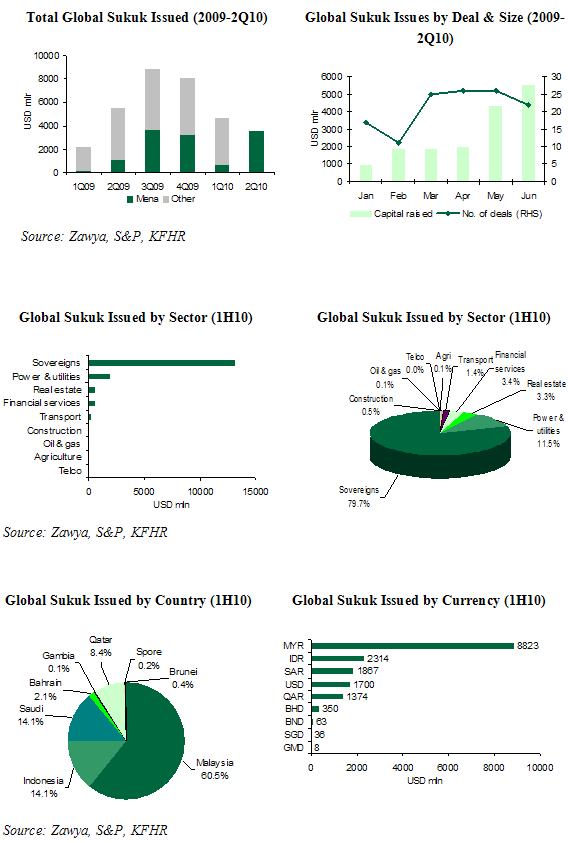
-Ends-
© Press Release 2010