10 July 2011
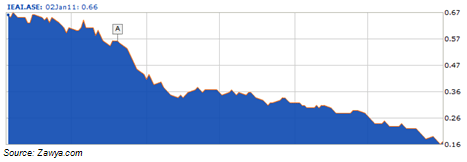
Meanwhile, Alentkaeya For Inv. & Real Estate Development rose an astonishing 167.20% from January 1 to June 30, EFG-Hermes data shows.
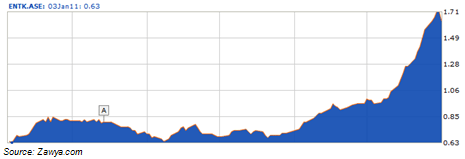
Overall, the ASE fell 12.66% over the past six months, but it was no means the worst performing market in the region.
The peaks and troughs were not restricted to the Amman Stock Exchange. As the full scale of the Arab Spring tsunami swept the region, none of the markets were spared.
While countries that were directly impacted by the political crisis such as Egypt, Oman, Syria, Bahrain and Tunisia saw some of the biggest declines in the region, other regional markets were not immune either, as global worries also restrained investors from diving headlong into the market.
Also Read: What are the best and worst performing markets in the MENA region?
Egypt's Palm Hill Developments was perhaps the most high profile casualty of the crisis. Its management's close links to Egyptian president Hosni Mubarak's regime came under the spotlight as the President was ousted and the new government came down hard on many institutions.
"We remain of the view that PHD will be fundamentally affected by legal issues facing top management as well as its currently ongoing land court cases," noted an EFG-Hermes report in May.
"We believe that the company's brand equity has been impacted by negative news flow, which is affecting its ability to sell and secure additional cash flows. Furthermore, we remain concerned about the state of PHD's balance sheet, its unclear land divestment strategy, minimal cash position, risks to its secured loans, the physical absence of its chairman in Egypt, and increasing rate of sales cancellations."
PHD has fallen 63.20% in the first six months to finish the period at EGP2.33 - EFG estimates PHD's fair value to be EGP2.1. At one point PHD had fallen as low to EGP1.57 but has clawed its way back since then on news that the new military government to curb persecution of Egyptian businessmen and resolve land disputes.
Gulf Performers
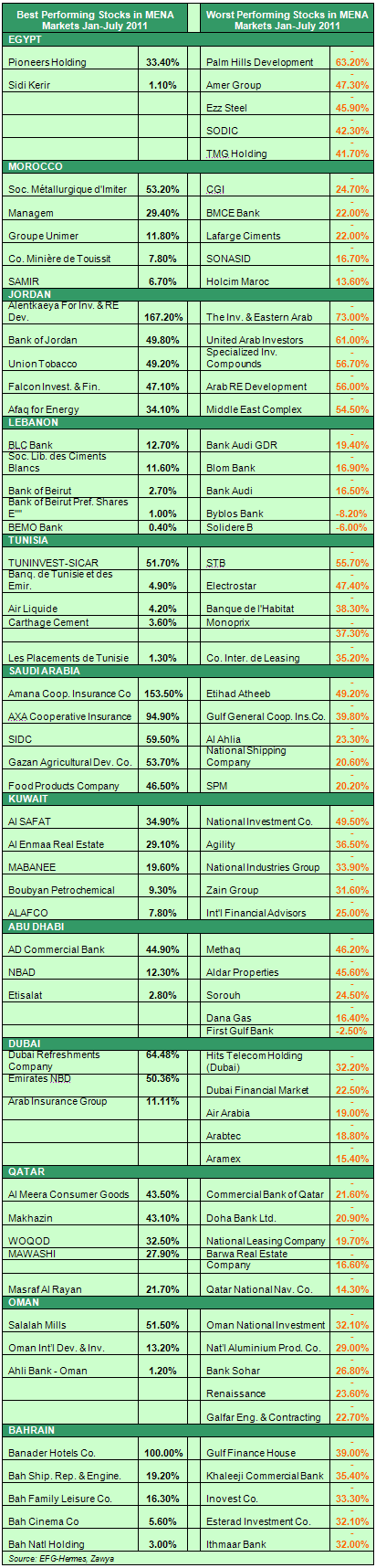
National Investment Co. was the worst performing Gulf stocks during the period, falling nearly 50%.
Part of the Al Kharaifi Group that owns Zain Mobile Co., the company also has assets across the region including stakes in Gulf Investments Co, Fujairah Cement Industries, Al Bawwaba Trading, according to Zawya.com.
"National Investment Company's balance sheet is exposed to financial assets, which accounted for 76.1% of total assets during 2010," notes Taib in a report. "Since the value of these assets correlates to the health of financial markets and grossly to the economy, the company remains exposed to overall market volatility. During the 2009 economic crisis, financial assets declined 14.2% in value to KWD 163.43 million, as impairments stood at KWD 33.04 million."
National Investment Co. stock also suffered after the company said it is no longer committed to UAE telecom giant Etisalat bid to buy a 46% stake in Kuwait's Zain telco company. The deal, which ultimately went nowhere, would have been worth $12-billion.
Saudi Arabia's Amana Co-operative Insurance Co. was the best performing stock in the Gulf, rising 153.50% during the first six months of the year.
The stock has risen nearly 300% since it listed in July 2010, generally on the back of improved sentiment in the Saudi healthcare industry, as the government is looking to make healthcare insurance mandatory.
Listed insurance companies in Saudi Arabia have grown 40% CAGR from 2006 to 2009, according to NCB Capital.
"The anticipated all comprehensive health insurance scheme will act as a catalyst in propelling private sector participation forward."
Amana was not the only beneficiary of this positive development in the Saudi healthcare sector, as AXA Co-operative Insurance also saw its stock rise 95% during the past six months - the third best performing stock in the Gulf.
While the first six months were extremely difficult for the markets, the next six months may not prove to be any better. Contagion effect from Greece, continued lethargy in the global economy, continued regional unrest and oil prices that are cooled off from their highs could weigh heavily on the stocks in the region.
Most analysts suggest Dubai, Abu Dhabi stocks to perform better given their renewed safe haven status and cheap valuations, apart from Saudi and Qatari defensive stocks. The UAE and Qatar markets may also benefit from a possible MSCI upgrade.
"Foreign investment is at structural lows given the depth and breadth of these markets," says a Religare Capital Markets report. "We believe that in 3-4 years time the region could make up 10% of the main MSCI EM index (less than 1% currently) and are significantly more transparent and well-covered than other frontier markets."
Many MENA companies saw their share price erode during the first six months. But there were a few that also registered three-digit growth. Find out which stocks fared the best and worst.
The Amman Stock Exchange (ASE) was home to the worst and performing stocks in the region.
Jordan's Investment & Eastern had the dubious distinction of being the worst stock in MENA markets over the past six months, according to EFG-Hermes data.
Meanwhile, Alentkaeya For Inv. & Real Estate Development rose an astonishing 167.20% from January 1 to June 30, EFG-Hermes data shows.
Overall, the ASE fell 12.66% over the past six months, but it was no means the worst performing market in the region.
The peaks and troughs were not restricted to the Amman Stock Exchange. As the full scale of the Arab Spring tsunami swept the region, none of the markets were spared.
While countries that were directly impacted by the political crisis such as Egypt, Oman, Syria, Bahrain and Tunisia saw some of the biggest declines in the region, other regional markets were not immune either, as global worries also restrained investors from diving headlong into the market.
Also Read: What are the best and worst performing markets in the MENA region?
Egypt's Palm Hill Developments was perhaps the most high profile casualty of the crisis. Its management's close links to Egyptian president Hosni Mubarak's regime came under the spotlight as the President was ousted and the new government came down hard on many institutions.
"We remain of the view that PHD will be fundamentally affected by legal issues facing top management as well as its currently ongoing land court cases," noted an EFG-Hermes report in May.
"We believe that the company's brand equity has been impacted by negative news flow, which is affecting its ability to sell and secure additional cash flows. Furthermore, we remain concerned about the state of PHD's balance sheet, its unclear land divestment strategy, minimal cash position, risks to its secured loans, the physical absence of its chairman in Egypt, and increasing rate of sales cancellations."
PHD has fallen 63.20% in the first six months to finish the period at EGP2.33 - EFG estimates PHD's fair value to be EGP2.1. At one point PHD had fallen as low to EGP1.57 but has clawed its way back since then on news that the new military government to curb persecution of Egyptian businessmen and resolve land disputes.
Gulf Performers
National Investment Co. was the worst performing Gulf stocks during the period, falling nearly 50%.
Part of the Al Kharaifi Group that owns Zain Mobile Co., the company also has assets across the region including stakes in Gulf Investments Co, Fujairah Cement Industries, Al Bawwaba Trading, according to Zawya.com.
"National Investment Company's balance sheet is exposed to financial assets, which accounted for 76.1% of total assets during 2010," notes Taib in a report. "Since the value of these assets correlates to the health of financial markets and grossly to the economy, the company remains exposed to overall market volatility. During the 2009 economic crisis, financial assets declined 14.2% in value to KWD 163.43 million, as impairments stood at KWD 33.04 million."
National Investment Co. stock also suffered after the company said it is no longer committed to UAE telecom giant Etisalat bid to buy a 46% stake in Kuwait's Zain telco company. The deal, which ultimately went nowhere, would have been worth $12-billion.
Saudi Arabia's Amana Co-operative Insurance Co. was the best performing stock in the Gulf, rising 153.50% during the first six months of the year.
The stock has risen nearly 300% since it listed in July 2010, generally on the back of improved sentiment in the Saudi healthcare industry, as the government is looking to make healthcare insurance mandatory.
Listed insurance companies in Saudi Arabia have grown 40% CAGR from 2006 to 2009, according to NCB Capital.
"The anticipated all comprehensive health insurance scheme will act as a catalyst in propelling private sector participation forward."
Amana was not the only beneficiary of this positive development in the Saudi healthcare sector, as AXA Co-operative Insurance also saw its stock rise 95% during the past six months - the third best performing stock in the Gulf.
While the first six months were extremely difficult for the markets, the next six months may not prove to be any better. Contagion effect from Greece, continued lethargy in the global economy, continued regional unrest and oil prices that are cooled off from their highs could weigh heavily on the stocks in the region.
Most analysts suggest Dubai, Abu Dhabi stocks to perform better given their renewed safe haven status and cheap valuations, apart from Saudi and Qatari defensive stocks. The UAE and Qatar markets may also benefit from a possible MSCI upgrade.
"Foreign investment is at structural lows given the depth and breadth of these markets," says a Religare Capital Markets report. "We believe that in 3-4 years time the region could make up 10% of the main MSCI EM index (less than 1% currently) and are significantly more transparent and well-covered than other frontier markets."
© alifarabia.com 2011