With stock markets quaking in their boots at the thought of an EU collapse, gold should have been skyrocketing.
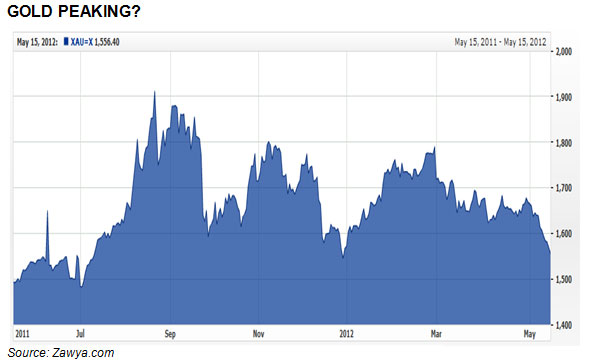
Instead, the price of gold is trending downwards at $1,556 per troy ounce, after hitting nearly $1,790 in late February.
"Coupled with concerns over a slowdown in China overshadowing the precious metals markets, we have revised lower our gold price forecasts," said Barclays Capital in a report earlier this week.
"We had expected gold to move higher from a solid responsive physical floor, on the back of continued net purchases from the official sector and growth in investment demand as uncertainties linger amid negative real interest rates, concerns over inflationary pressures and currency debasement, and instability surrounding the financial markets and economic outlook."
The bank cut its price forecast by 8% to USD1,716 for the year, with 2013 prices no higher than USD1,790.
Indeed, gold has been behaving like other risky assets rather than differentiating itself as a safe haven asset and has been winded by the possibility of further quantitative easing being scaled back, said the bank.
But perhaps more importantly, the responsive physical buying which materialised last year from key markets, India and China, has become lacklustre.
While tax changes in India have created uncertainty, the weakness of the Indian rupee has hampered end consumption but on a more positive note, the monsoon season is forecast to be within the normal range.
"We retain a positive view on gold given the ongoing market uncertainty, continued central bank buying and tactical positioning being relatively light," said Barclays analysts in a note to clients.
Standard Chartered Bank is also being defensive and has cut its gold price forecast to $1,685 per troy ounce for 2012 and $1,900 for 2013.
"We have lowered our price forecasts for the base metals, precious metals and gold as prices have fallen below support in the past week and sentiment remains very gloomy," said the emerging market bank. "We are now looking for a period of generally sideways trading, although we remain bullish from a medium-term perspective."
Deutsche Bank analysts think gold is hurting due to a strengthening dollar and expects central bank gold buying, negative real interest rates and the non-negligible risk that central banks take to benefit the gold price.
GOLDMAN'S CALL
While other investment banks are revising forecasts, Goldman Sachs - the most influential Wall Street bank - maintains its bullish view on gold, calling it the 'currency of last resort'.
The bank expects gold to scale back to USD1,840 within six months, a near-USD300 rise from current levels.
"In early 2009, we suggested that gold had become the currency of last resort, overtaking the U.S. dollar's status due to the rising risk of sovereign default and debasement concerns," said Goldman Sachs analyst Jeffrey Currie. "Even as the U.S. currency advanced and gold fell on the European crisis in recent months, "it is too early for the dollar to reclaim this status."
Goldman Sachs analysts often go against conventional wisdom, and often get it right, which is why the bank's research group has such an exalted status among investors.
"The case for higher gold prices remains in place," Mr. Currie said. "U.S. economic and employment data has now disappointed for several weeks, European election results point to further stress in the euro area, while anecdotal data suggests that physical gold demand remains resilient."
RALLY FATIGUE?
Gold may have fallen 17% since its all-time high of USD1,923 last September, but it's important to put the price in perspective: the metal was priced at USD672 on May 15, 2007 - it has risen two-and-a-half-times in four years amid one of the worst global financial crisis of our lifetimes.
But some analysts believe that gold is losing momentum for structural reasons too. Bouyed by high prices, more companies are mining for gold and the current stock of the yellow metal now stands at 171,300 tonnes from 100,000 tonnes 30 years ago.
And while gold served as a 'safe haven' during the crisis, investors are now looking for other, less-expensive investments. In many markets, real estate and stocks are at bargain prices and the precious metal is losing out. This appears to be evident in the SPDR Gold ETF - the most popular ETF in the world -- which has seen investment outflows of around USD11-billion in three months.
As such, analysts believe that the metal's golden run is coming to a natural end and it would take a fundamental change to move the needle signficantly from here onwards.
The two clear needle-moving events could be a breakup of the euro, and/or the launch of a third tranche of quantitative easing by the U.S. Federal Reserve. And even though both events are hovering on the horizon, gold seems remain subdued. Could that be a sign?
ALSO READ: Gold will plateau at USD2000: Analysts
Biggest Gold Holdings
© alifarabia.com 2012