Bahrain's economy faces a difficult period as it tries to recover from the political unrest that has rocked the country. But there are glimmers of hope
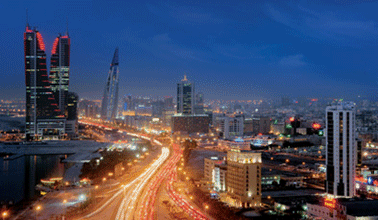
On Friday evening in Bahrain's restaurant district, Adliya, scores of people spill out from crowded cafs onto roads packed with cars unable to find spaces to park. Stability has returned to Bahrain, but the unrest that swept through the country in February and March and the ensuing crackdown on anti-government protesters and opposition figures has come at a hefty price.
Bahrain's economy, which grew at 4.5 per cent last year, is expected to suffer a significant blow in 2011, as weeks of demonstrations, the imposition of martial law and the arrival of troops from Saudi Arabia and other Gulf states, take their toll.
Though the government is still plumping for a relatively healthy economic growth this year, economists are more circumspect.
"I think the economy is likely to be flat at best this year," Simon Williams, HSBC's chief economist for the Middle East tells The Gulf.
Barclays Capital last month slashed its growth outlook for Bahrain to 1.4 per cent, down from 4.3 per cent, while Bank of America Merrill Lynch expects the economy to deflate 2.2 per cent in real terms, before returning a 2.9 per cent growth in 2012.
Retail and hospitality businesses have been particularly hard hit, as tourists and executives have stayed away. The cancellation of the opening Formula One Grand Prix in March as well as a number of high profile conferences have hurt local businesses. Bahrain's traditional economic drivers, financial services and construction - which were only slowly emerging from the rubble of the financial crisis - are also suffering.
Yet despite the gloomy forecast, there are some positive signs. Bahrain is expected to benefit from higher oil and aluminium prices, as well as the $10 billion stimulus package - dubbed the Gulf Development Programme - offered to Bahrain by Saudi Arabia and other Gulf Co-operation Council (GCC) countries. The package will deliver $1 billion a year for the next 10 years to fund infrastructure and housing projects, taking some of the capital investment burden off the shoulders of the government and freeing up budgetary resources.
Bahrain's Economic Development Board (EDB), which sets the country's economic policies and is tasked with attracting international business, says that it expects Bahrain to enjoy a better fiscal position and a bigger current account surplus.
"Bahrain is currently reviewing its official economic forecasts, as it does after each quarter of the year," the EDB said in an emailed statement. "Whilst the projected GDP [gross domestic product] will be affected by the recent events, the current account surplus will likely be higher than earlier expected and the fiscal position somewhat firmer, due to the positive impact of factors such as the rises in oil and aluminum prices and the Gulf Development Programme."
The EDB is expected to soon release a report outlining sectors affected by the unrest and how it plans to help businesses and investors. It is also working to soothe concerns that Bahrain's political crisis will hurt its status as a Gulf financial centre.
"The difficulty will be that external, international perceptions have been heavily impacted by the events of recent months. And that's going to weigh on many aspects of the economy, including demand for real estate and for Bahrain's role as a financial centre," says HSBC's Williams.
In an increasingly competitive regional landscape, Bahrain will need to act quickly to try to restore its image, and to promote its positives, say analysts.
"Bahrain does have the lowest taxation in the GCC, it has the best educated workforce in the GCC by far," observes Jarmo Kotilaine, chief economist at Saudi Arabia's National Commercial Bank.
"It has a pretty decent infrastructure, and good quality commercial and residential real estate - and if they allow prices to correct that's going to make it even more attractive. It has a good location, right next to the industrial heartland of the GCC, Saudi Arabia's Eastern Province. It has, even with the crackdown apart, a history of great tolerance and harmony. And I think making people aware of that and building this positive story can once again potentially help create the basis for success."
Bahrain's financial sector, which holds about $220 billion in assets and accounts for about a quarter of GDP, has been impacted by political unrest. But so far no big financial institution has told the government it plans to leave, an EDB official told a news conference in mid-April.
"We confirmed with them that the vast majority of banks are staying, they're all committed to Bahrain, they recognise the business in Bahrain," Boyd Winton, director of financial services for the EDB, said.
Only four firms planned to leave, he said, including two firms which maintained only representative offices and one member of staff, and an asset management firm which had long planned to leave by the end of the year. However, Bahrain-based bankers say that some staff and units of some institutions have been moved to other centres such as Dubai, since unrest began.
"The general message that we've been getting that business is normalising and that there hasn't been a huge exit of capital is probably on the whole true," says Kotilaine. "And I think the kinds of investors who have money in Bahrain are generally speaking satisfied that the situation now has been stabilised. The dinar is stable. And government bond markets on the whole look reasonable - compared with Europe the situation is not that bad."
Despite ratings agencies Fitch and Standard & Poors' decision in March to downgrade Bahrain to BBB, the lowest investment grade rating as a result of civil unrest, markets appear relatively unperturbed. Prices on Bahrain's Eurobond maturing in 2014 have not moved dramatically.
"Prices of Bahrain's 2014 Eurobond have fallen just under three per cent this year indicating that market participants don't expect government finances to get worse because of civil unrest," says Magdolarthur Raghu, head of research at Kuwaiti investment company, Markaz.
He does expect Bahrain's bond issue planned for this year to be delayed "because the dust has not settled yet."
"Even though the bond issue is expected to go through comfortably, the central bank might want to get the pricing right," he explains.
The cost of insuring Bahrain's debt has however risen. It is now the second most expensive in the region after Dubai. Credit default swap spreads have risen almost 45 per cent this year, says Raghu, and a further downgrade to junk status by ratings agencies would see a significant rise in spreads and yields.
"The unfair downgrade, driven by political rather than economic considerations, was unjust, and I hope the government can convince the ratings agency to quickly upgrade the country," says Abdul Karim Bucheery, chairman of the Bahrain Association of Banks.
Bucheery is optimistic that domestic banks will be able to withstand the turmoil, but admits that lenders are likely to face higher volumes of loan defaults as the unrest hurts the cash-flows of corporate customers. Consumer loans may also be impaired, as a result of job losses. He expects the full impact of the unrest to emerge in banks' third quarter results.
"First quarter the banks posted strong results; I think the impact will be seen more in the third quarter," he says. "Having said that there will be some problems; people have lost jobs in major companies, although the scale of the damage will not be too big that the banks will not be able to withstand the negative implications. But there will be some provisions required. There will be some impairment of consumer and corporate loan portfolios, but the banks will be able to overcome it."
Some banks with exposure to local real estate projects could also be impacted as inflows of fresh capital will be harder to come by, hurting more leveraged developers as high profile projects are delayed. A research note from property consultancy CB Richard Ellis, says that any "major recovery" in the real estate sector will likely be put on hold, as the market adopts a "wait and see approach."
NCB's Kotilaine suggests that a price correction could help. "In Dubai you had a leverage and liquidity crisis. In Bahrain you have a political crisis. But nonetheless the road to recovery in Dubai involved a significant real estate correction, and Bahrain may well have to do the same," he says.
"You could potentially kick-start some of the sectors that have been hard hit allowing a market correction," he continues. "If they are willing to do that you end up with valuations and prices that are attractive and competitive and that will draw investors again. In a sense Bahrain could use a national devaluation as a way of restoring competitiveness."
The problem with that scenario, he acknowledges, is that local investors would be hard hit.
In the coming years Bahrain will also have to step up its diversification efforts. Bahrain has already been working hard to diversify its economy away from oil, though as Bahrain's oil minister Abdul Hussain bin Ali Mirza observes: "Our role is to enable this shift to take place by firstly providing funds for the diversification of industry. We do this by increasing the production of crude oil and gas and by working toward operational excellence."
Dr Mirza acknowledges that the increase in oil prices could be a double-edged sword for Bahrain: "This has both a good and a bad impact for Bahrain," he says. "On the one hand we have the direct, immediate, and positive impact of greater revenue as a crude oil seller. On the other hand, it has been recognised that residents of developed countries in Europe and the Americas are changing their behaviour and reducing their consumption of petroleum product. The higher price of crude could also initiate a second global recession which will have lasting effects on demand and price."
Such concerns have underscored Bahrain's urgent need to develop its diversification strategy. A report published earlier this year by the EDB suggested that the country's changing pattern of output growth needs to be factored into economic strategy, citing the manufacturing, transport, information communications technology, services and tourism sectors.
"Bahrain bet very heavily on financial services and real estate, and those are the sectors which are now being hit, so it needs to start developing other sectors which it has said it will do," says Kotilaine. "It will also have to reinvent and boost its competitiveness vis--vis other GCC economies."
Areas like logistics and manufacturing are likely to be more heavily targeted for growth. Kotilaine points to the initial public offering (IPO) by Aluminium Bahrain (Alba) earlier this year as a cause for optimism.
"You have the Alba IPO which gave some money for these kinds of developments. I think the financial sector has lost a lot of its momentum and its perceived competitiveness to Dubai. So it will be a slower grind, with much more investment in areas like Alba, some downstream oil and gas, and hopefully above all, services."
Creating jobs will be a pressing challenge for the country; it will also have to balance the desire to quickly create positions by further swelling the public sector, against creating more productive employment opportunities elsewhere.
Bahrain has a number of options as it moves forward. Allowing market corrections to happen could be start, say analysts.
"As painful as this, it is the best way of restoring the competitiveness of the place. Dubai would not be standing quite as tall as it is today had it not been for the fact that it is no longer an expensive place," says Kotilaine.
Rebuilding Bahrain's image by getting a national dialogue underway that includes all segments of the population, will also be a key step, he suggests.
"Whatever Bahrain needs to do, it needs to do it fairly quickly," says Kotilaine. "But it is very important for Bahrain to understand, that this time around, business as usual won't do it. The marketplace has become much more competitive and the challenges far greater, so in that sense they need to go the extra mile and possibly more."
The Gulf 2011