Facility management encompasses multi-disciplinary activities within the built environment and the management of their impact upon people and the workplace. Facility managers have extensive responsibilities to provide, maintain and develop myriad services ranging from property strategy, space management and communications infrastructure to building maintenance, administration and contract management.
Today, the facility management sector is a large and complex field comprising a mix of in-house departments, specialist contractors, large multi-service companies, and consortia delivering the full range of design, build, finance and management functions.
A report by international research and consultancy firm Frost & Sullivan suggests that the GCC facility management market is estimated at around USD 4.2 billion and is expected to rise to USD 9 billion by 2014. The global market is expected to reach USD 395 billion by 2017.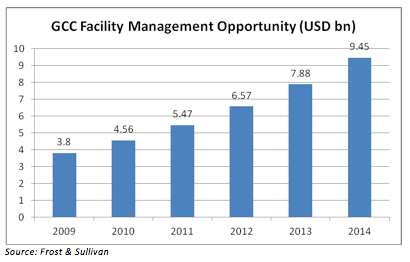
While clear data about the number of facility management firms functioning in the Arabian Gulf are hard to find, Mick Dalton, managing director Musanadah FM and past chairman of the British Institute of Facilities Management estimates that there are about 95 such multi-service firms in the UAE alone. "If one includes the single-service suppliers, the figure runs to above 190 companies," he told Zawya.
"The current heightened awareness of the FM sector arises out of fundamental drivers such as interest in outsourcing as a hot management topic, heavy media coverage of PFI/PPP [private finance initiatives / public private partnership] and increasing attention being paid to the sector by the financial community," Dalton said.
With the governments in the Middle East continuing to invest heavily in building infrastructure and public spaces such as airports and shopping malls, there is a growing need to efficiently manage these concrete assets.
"The market potential for FM is huge throughout the GCC countries," said Markus Oberlin, chief executive of Farnek Avireal. "There has been so much real estate development in the region. All buildings need maintenance - whether fully occupied or not. It is an asset and investors get a better return when you prolong the life-cycle of the building. It is also true of older buildings - regular maintenance will help to protect their lease or sales prices."
Shift in Market Focus
Each country has a different market dynamic, Dalton said. "So far, the UAE has been the market leader in terms of the volume of business. But clearly, there is a shift in focus towards Saudi Arabia and Qatar. To date, about a hundred companies have moved to Saudi Arabia. However, doing business is difficult in terms of obtaining visas. New businesses must also take into account the Saudization program and the need for obtaining a SAGIA [Saudi Arabian General Investment Authority] license or a local joint-venture partner. Besides, the Saudi market is still nascent in terms of being FM-oriented," Dalton said.
The facility management industry in the GCC is structured into three groups:
- Single-service providers
- Bundled-service providers
- Integrated facilities management (IFM) service providers
"We are very proud of our current membership count which is now well over 500, representing some of the largest and most respected facility management operators, suppliers and owners in the region," Sinead Bridgett, director at Middle East Facility Management Association, or MEFMA, told Zawya.
MEFMA was initiated by the UAE's Real Estate Regulatory Agency (RERA) in 2009 as a non-profit association. It was fully operational from August 2010 and RERA voted in the board of directors, which will remain in place for the first five years. The objective was to standardize and set benchmarks that enable companies operating in the Middle East to have clear operating standards to protect everyone involved, right from the facility management companies to the owners and the end users.
"We seek to spread throughout the Middle East and are exploring possibilities to reach new regions for more members to ensure it has a fair, encompassing understanding of the FM sector in the region," Bridgett said.
According to estimates by the Dubai Chamber of Commerce, the Middle East FM industry will be worth USD 8 billion by 2013, said Oberlin. Other reliable sources include MEFMA, the Abu Dhabi Chamber of Commerce, international trade and industry bodies such as the IFM and independent market researchers.
"However, what is clear is that the quality of data available on the regional FM industry is poor. Most data that does exist was gathered as part of market research surveys - and often from relatively small scale sample surveys," Oberlin told Zawya.
Price Sensitive Market
After 2008, the facility management market in the UAE saw a downward spike as the real estate sector imploded and costs and competition both increased, according to Dalton.
Home owners' associations started becoming increasingly price conscious, which raised the pressure on service providers, who in turn needed to reduce costs to remain competitive.
"Pricing of services is the key to success in this market and there is stiff competition. But competitive pricing will need careful planning as this might affect returns in the long term; it demands cautious execution," Dalton said.
"Labor cost is a vital component that has a major influence on the price of services. With rapidly increasing labor costs, FM companies are fighting to balance the needs of the customers and their costs. Some international companies have left the market.
"There is still opportunity with international blue chip clients, government and large corporate customers. Small companies are chasing RERA-regulated towers while large FM players are focusing on the community developments by bigger developers. However, the market needs better education to ensure everyone understands asset value and how it can be enhanced by professional facility management."
Oberlin agreed that one of the main challenges facing the FM industry is the low awareness about the sector. "International firms that operate out of the Middle East provide a strong customer base, but many local building owners have still not opened up to the concept of outsourcing total FM services. The solution is really down to FM professionals themselves, with the help and support of MEFMA and government bodies, to create awareness amongst building owners about the life-cycle costs of buildings as well as carbon emissions and energy saving, especially outside the UAE," he said.
Awareness can be improved through media/ industry associations using case studies about FM best practice, which has already been initiated by MEFMA. FM codes of practice or standards should be monitored by regulatory bodies. FM companies should be classified by the areas of FM they choose to specialize in and the authorities should then limit their license to that category, he recommended.
Sustainable and Strategic Approach
Energy conservation and pragmatic solutions that reduce energy costs are increasingly in demand from end-users. "Sustainability and the environment are two other issues within the building industry. They are becoming increasingly important as facility managers work within a more regulated framework and have to find innovative and cleaner ways to improve their building's performance," Oberlin said.
"Organizations want to be greener. It is just a case of education, starting with a professional energy audit of the building, highlighting cost and energy saving potential," he said. "Sustainable FM is not a cost. It can actually save money. So why not be kind to your building, the environment and your accountant? This is the real message we try to convey to our building owners and facility managers."
Successful organizations in future will approach FM as an integral part of their strategic plan, Dalton said.
Hence, organizations that treat FM as a 'commodity overhead' will be at a significant strategic disadvantage.
There has been a significant increase in the number of companies, globally and regionally, that outsource the management and maintenance of their facilities and take advantage of the strategic benefits of FM services such as additional cost savings, minimized risks, and better integration with core operations.
"The positive growth outlook has been confirmed by the KPMG 2011 global survey, which also notes that improving economic conditions are contributing to higher long-term demand for outsourced services," Dalton said.
Price sensitivity and heightened competition will push the industry to work smarter and get more people-focused by investing in training. It will also witness the use of technology and sustainable solutions such as ERP systems, GPS tracking and CAFM systems.
"There is a large cluster of companies that provide single services and specialize in those disciplines," Oberlin said. In a new trend, many single-service companies are now beginning to partner with total FM providers in order to secure their order books.
Dalton added that the UAE still holds a strong position in terms of lucrative business prospects. "Mainly due to the vast developmental activities that took place over the last decade in the UAE, all big-ticket completed construction projects now demand facility management in order to maintain them," he said.
© Zawya 2012