Egypt has slotted an investment of about EGP 513 billion (USD 85 billion) between 2012 and 2015 on healthcare projects, including the construction of new hospitals and clinics and the establishment of medical cities and international centers in the governorates of Cairo, Alexandria and Aswan.
The health ministry is studying a proposal to establish a public body that covers all hospitals and government centers under its management. The government is planning to underwrite 49% of all activities undertaken by this entity, in order to ensure adequate support for the improvement of the public health services provided by these government centers and hospitals.
Spending on Projects
An economic report on healthcare in Egypt issued by the Economist Intelligence Unit in 2011 forecast that government expenditure on healthcare projects will increase to USD 25.86 billion by 2015, from USD 16.611 billion in 2012. This will raise the per capita healthcare spend from USD 86 in 2006 to an estimated USD 278 in 2015.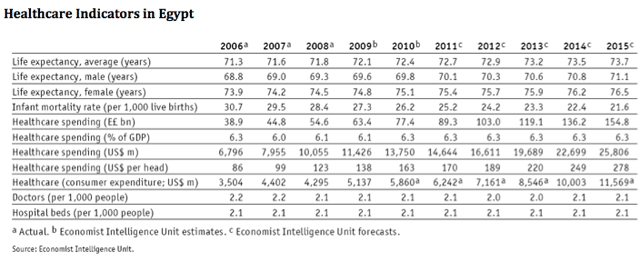
According to the health ministry, the state bears a large part of the expenditure on healthcare in Egypt, in participation with the private sector.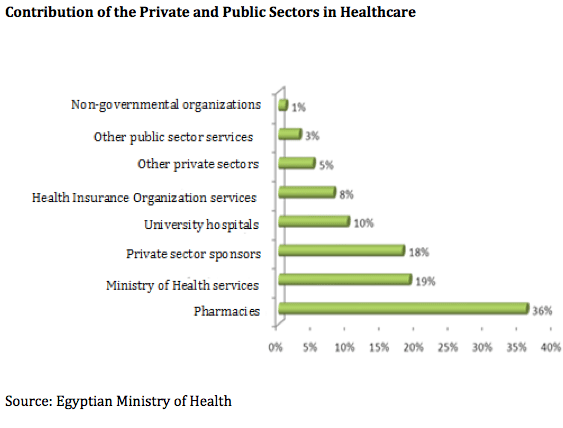
Public-private partnerships in Egypt's healthcare sector include an allocation of EGP 12 million to complete the development of the old building of Damanhur National Medical Institute by the health ministry and EGP 10 million for the development of Hosh Issa Hospital to ensure an integrated medical service within three months. The admission and emergency sections at Itay El Baroud Public Hospital in Gharbia governorate are also being developed.
The investment ministry is seeking to create an integrated International Medical City on a total area of 200 acres in the west of Alexandria. The project consists of establishing an integrated medical area that contains hospitals, clinics, convalescence centers, five-star hotels, research centers and laboratories, medical education center, and administrative and commercial buildings. The project aims at providing nearly 10,000 direct job opportunities and more than 20,000 indirect job opportunities. The initial investment in this project will be around USD 218 million and the total investments are expected to exceed USD 14.55 billion.
The Medical City will include some international centers and hospitals and will be promoted in Europe and the Middle East.
An advanced university hospital will be established at Port Said governorate, at a cost of EGP 10 billion, planned to be completed before 2015. The establishment of an international hospital has also started at Sharqiya governorate, at a cost of EGP 13 billion.
Institution for Project Management
The health ministry is considering a project for the assessment of the fixed assets of its affiliated hospitals, determination of their fair material value at current market prices, and the establishment of an independent institution to manage these hospitals. These assets will then be considered as shares in kind owned by the state at the new institution, and 49% of the latter's shares will be underwritten in an IPO by individuals.
The proceeds of the IPO will be used in the development of public hospitals, so that they will be able to provide high quality medical services according to international standards and at fair and moderate prices for all people.
Dr. Osama Abdel Moneim Abdel Salam, expert on human resources development and healthcare projects management, who presented the project to the ministry, said the project includes the formation of a specialized board of trustees to supervise every hospital. He added that the new institution will supervise and monitor the performance of the affiliated hospitals, pointing out that it will be entitled to use a portion of its funds in the establishment of medical projects, along with the establishment of other affiliated companies aiming at providing integrated services.
The second project, according to Abdel Salam, consists of converting the General Authority for Hospitals and Educational Institutes into a Health Sciences University, through the assessment of the authority's assets by specialized consulting offices and determination of their material fair value, according to the current market prices. These assets will then be considered as shares in kind owned by the state in the National Health Sciences University project, and 49% of the latter's shares will be underwritten in an IPO by individuals.
According to a study conducted by the Egyptian ministry of finance, the government called for investors and businessmen to invest in the healthcare sector, to which it allocated an additional amount of EGP 10 billion in the budget of the financial year 2011-2012, with a current increase of 3% per year, to reach an increase of 10% within a period not exceeding three years.
The Egyptian Financial Supervisory Authority (EFSA) prepared a study on a new draft law concerning the supervision and organization of the healthcare companies' activities in Egypt. Dr. Adel Moneer, Deputy Chairman of EFSA said that the draft law would make the global healthcare companies enter the Egyptian market, which will increase competition and will be positively reflected on the Egyptians. The law includes the formation of a senior common advisory committee with representatives of EFSA and the health ministry, as well as a representative of the healthcare sector. This committee will set the rules and conditions of the healthcare companies' activities in Egypt, while regulating their relationship with the various medical bodies.
Public Private Partnership
The Egyptian government started to follow the PPP system in order to finance some infrastructure projects during the coming five years at up to EGP 100 billion. These projects range between roads, sewers, schools, hospitals and other key projects.
A report issued by the Egyptian finance ministry indicated that the government is waiting for the implementation of some healthcare projects in cooperation with the private sector, namely:
Alexandria University Mowassat Specialized Hospital: The establishment of a hospital with a capacity of 223 beds in order to provide high quality healthcare services (centers of excellence). The new hospital will be established in the same location next to the old hospital, and an invitation to a bid was sent to receive offers on October 19, 2009, then was postponed to October 2011, and the party in charge of implementation of the project has not been announced yet.
The term of partnership in the project is of 20 years, the operating duration is 17 years. IFC was selected as the financial advisor for the IPO, Mott Macdonald as the technical advisor and Trowers & Hamlins as the legal counsel. Nine companies submitted offers for the project from Egypt, Kuwait and the United Kingdom.
Alexandria University Smouha Maternity Hospital and Blood Bank: A gynecology and obstetrics hospital with a capacity of 200 beds, in addition to a blood bank as a part of the new Smouha Hospitals Complex, including a new pediatric hospital and an emergency hospital.
An invitation to a bid was also sent to receive offers on October 19, 2009, then was postponed to October 2011, and the party in charge of implementation of the project has not been announced yet.
Boulak and El Abassia General Hospitals: Replacing and renewing both hospitals in Cairo, with the purpose of providing non-medical services, using the system applicable in Britain. The project will be launched in one tender divided into two parts, according to the finance ministry.
© Zawya 2012