President's Gurbangul Bergmukhamedov recent decree to explore Turkmenistan's entry into the World Trade Organization (WTO) marks a turning point for the isolated country.
Turkmenistan sits on the fourth largest natural gas reserves in the world after Russia, Iran and Qatar.
The country's natural gas reserve estimates doubled to 208 trillion cubic metres in 2011, according to BP's estimates, giving the country a boost.
"After about 15 years of isolation and a political regime change, Turkmenistan began the process of renewing diplomatic relations with several countries including Russia, China, Europe, the US, and other Central Asian neighbors in 2007," notes the U.S. Department of Energy.
Foreign energy firms experienced extreme political challenges and investment impasses prior to 2007, and several exited the country leaving a dearth of investment, notes the department.
But that is changing fast as the government unveils a raft of investment ideas and spending heavily on infrastructure.
While Turkmenistan is taking slow steps to increase its business-friendliness, investors are wary of the human rights issues plaguing the country. The country is ruled, old-Soviet style, with an iron fist with little room for dissension.
"Five years after the death of dictator Saparmurad Niyazov, President Gurbanguly Berdymukhamedov's authoritarian rule remains entrenched, highlighting Turkmenistan's status as one of the world's most repressive countries," notes Human Rights Watch.
"The country remains closed to independent scrutiny, media and religious freedoms are subject to draconian restrictions, human rights defenders face constant threat of government reprisal, and torture is widespread."
FOCUSED ON BUSINESS
Still, Turkmenistan is creating a more business-friendly environment, attempting to attract foreign investment to increase both oil and gas production and expand its export portfolio.
Last week, the President also announced sale of state-owned enterprises, which would be rolled out over the next three years.
"Our privatisation programme is just in line with our plans of gradual transition to a market economy," said Berdymukhamedov, according to a Reuters report.
While the programme does not include oil and gas assets, the government includes transportation, telecommunications and construction assets. The government has unleashed a USD5-billion plan in 2012 for 397 large projects, including industrial companies, gas turbine stations, railways and bridges.
The economy of US$24-billion grew by an estimated by 9.2% in 2010 and 14.7% in 2011, but is expected to shrink to 8% in 2012 and 7.7% in 2013, according to the International Monetary Fund.
"The near and medium-term growth outlook is favourable, buoyed by more diversified gas exports and sustained strong public investment... Near term downside risks arising from the global economic outlook, especially in Europe, are likely to be balanced by the continued high public spending and strong growth in China."
The IMF believes the Turkmenistan economy is benefiting from earlier monetary and exchange rate unification reforms, while governance and management of hydrocarbon sector has helped macroeconomic stability. Meanwhile, the diversification of the economy is under way, which would increase the role of the private sector, and foster sustained and inclusive growth.
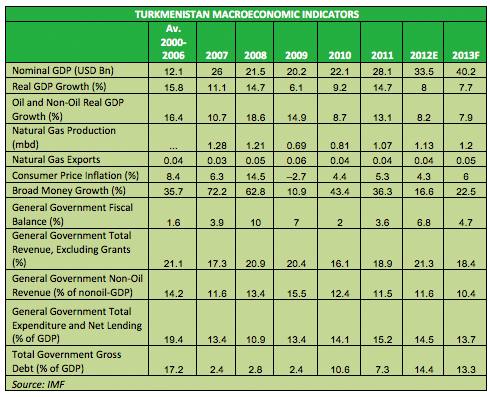
In addition, current account balances are expected to post continued surpluses in 2012 and 2013, although lower global commodity prices could crimp that growth.
"Turkmenistan's sustained public investment program, including its investments in the gas sector, will, however, result in small deficits in both years."
However, while credit to private sector has risen 70%, banks will have to be careful to manage its balance sheet.
The IMF believes the financial sector reform should include reducing banking sector segmentation to increase competition and eliminating regulatory controls on interest rates and lending.
But for now the government will keep the foot on the accelerator as natural gas revenues continue to pour in.
The high level of government revenue contributes to the implementation of the 2011-2030 National Program of Social and Economic Development, sats Arman Ahunbaev, analyst at Eurasian Development Bank.
"This is aimed at: the strengthening of the economic security of the country; the diversification of the national economy; and the implementation of the government's social policy. Despite the massive stimulation of the economy, and an 11.1% increase in pay, consumer prices in June 2012 were 1.8% lower than in December 2011, according to official statisticians.
The European Bank for Reconstruction and Development believes the government should speed up progress with its stated goals to increase the share of the private sector and reduce government intervention in the economy.
"A number of sectors remain distorted by production targets and subsidised inputs that hamper their productivity and the effective use of resources. The remaining controls on prices, interest rates and the exchange rate should be gradually phased out and production targets should be abolished," notes the EBRD.
"The new law on foreign exchange regulations is an important step forward, as it allows for advance payments on imports, but faster progress needs to be made with implementing the regulations."
TRADE PARTNERS
The UAE is among Turkmenistan's top five trading partners in the world. Turkey, China and the European Union are the Central Asian states top three partners (in that order), with Russia in fourth place.
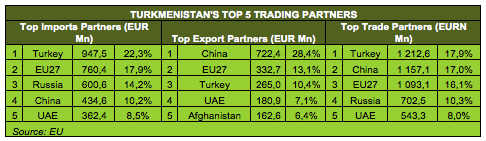
The UAE Ministry of Foreign Trade data shows UAE-Turkmenistan trade grew 52% year-on-year in 2011, reaching around $513.6-million.
Iran is also a strong trading partner with Turkmenistan, although Western sanctions on the Islamic Republic have hurt trade between the two nations.
While Turkmenistan is slowly opening the door to its closed economy, foreign investors and trading partners should also push Turkmenistan to open the government up for greater scrutiny and ensure that the reforms taking place in the country spread to areas of human rights and social justice.
© alifarabia.com 2013