As Tunisia approaches election day set for October 23, many Tunisians wonder whether they will lose their secular values with the rise of Islamist parties and, more importantly, when they will get jobs.
While Egypt, Libya and Syria have stolen the limelight over the past few months, Tunisia - the place where the Arab revolution started - had been quietly beavering away, working on its democracy.
Until, that is, when it returned to global headlines when Islamists were tear-gassed by law enforcement forces last week.
The incident occurred just two weeks before the country goes to election on October 23, and highlights the vulnerabilities in the country and the fragility of peace in the country.
The riots occurred after a TV station aired the controversial Persepolis, an Iranian animated film that conservative Muslims see as disparaging to Islam - and they came out in force to show their displeasure.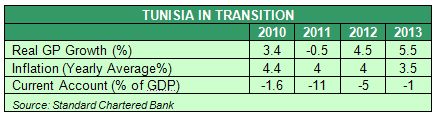
The incident highlights the ideological debate between liberal and conservative Tunisians, and the fear that the country would leave its progressive outlook to revert to a more conservative mindset that would limit freedoms that Tunisians have take for granted.
Unlike many Arab states, Tunisia is known to be a secular state, Constitutionally-enshrined rights for women and an educated population that is comfortable with its interaction and influences from neighbouring European states.
That could change if the Islamist Ennahda Party comes into power. The party is expected to win 20 to 30% of the seats in the elections, much to the dismay of many Tunisians who feel their liberties may be curtailed due to Ennahda's more theocratic approach.
For its part, the Ennahda party is looking to improve its image, citing that the previous regime of Ben Ali had painted it in a poor light to retain control.
"We don't make a difference between the sexes," said party chairman Rachid Ghannouchi. "Rather, we acknowledge the rights of women in education, public life and also, of course, in equal rights."
To dispel its negative reputation, the party has recruited Souad Abderrahim - a pantsuit-wearing woman who does not wear a headscarf, to stand for one of the seats in the capital.
"I believe in the sincerity of Ennahda, otherwise it wouldn't have placed a woman like me at the top of their party list," she told the media.
Skeptics have dismissed this as a party gimmick and 'modernists' have been out on the street in recent days, defending the TV stations right to air the animated Iranian film.
This is not the last issue Islamists and liberals are expected to lock their horns.
Economic transition
Apart from the political and social transition, Tunisian economy is also going through a significant transformation.
Standard Charted expects a 0.5% contraction in the Tunisian GDP this year, especially after the complete economic lockdown in the immediate aftermath of Tunisian strongman Ben Ali's departure.
The country has also suffered due to the civil war in Libya. According to the central bank governor, links with Libya contributed up to 5% to the country's GDP, and it was the source of the largest number of non-European tourists, foreign direct investments and remittances.
"One of the most urgent problems that must be addressed is unemployment, which has risen from an official 13% to close to 20%, with peaks of around 50% among the youth (including educated) population," notes Standard Chartered.
"Preliminary figures from the central bank estimate that the economy contracted by 3.3% in the first quarter of this year. Many sectors posted substantial negative growth, with tourism revenues being hit the worst, down 51% y/y in H1 as a decline in tourist numbers was exacerbated by a fall in the amount spent by those who still came. Nevertheless, some recent economic indicators point toward a selective economic recovery starting in Q2, which should translate into a full-year real GDP growth figure close to zero."
Other recent data also suggests that the economy is showing signs of life. Manufacturing, which had fallen 4% year-on-year in the first quarter, started to pick up in April. The mechanical, electrical and textile sectors picked up in April, driven by goods exports, which grew by 14.2% y/y overall in the year to May.
Agricultural output, in particular, is expected to be very strong this year, after excellent rainfall led to a cereal crop now forecast at 2.1mn tonnes, almost double the 2010 figure.
Having fallen by around 30% from end-2010 to June 2011, foreign exchange reserves reversed in July and are now equivalent to four months of imports, notes Standard Chartered.
"The Tunisian economy has considerable potential, and if it manages to successfully implement governance changes we believe it could rebound strongly in 2012," says the bank.
October 23: A Milestone
The elections for the 218-seat assembly is expected to be a major milestone for the country, especially after the country saw two interim governments collapse after Ben Ali's departure, and elections were pushed back from their scheduled date of July 24.
"Things are calming down," said Tunisian Prime Minister Béji Caïd Essebsi in a speech to World Bank officials in early October.
"Tunisia is doing better. I, myself, when I started I promised only one thing. I promised that when I would leave the government, Tunisia would be in better shape than the one I found it in. I think it's a bet that I won."
That may be a premature statement.
The country had 600,000 unemployed out of 3.5 million workforce - a 17.1% unemployment rate, but the Prime Minister says he hopes to reduce that number by 100,000 each year.
"Tunisia was not able to create more than 70,000 jobs with a 7 percent growth rate. So right now we have almost zero percent economic growth," Essebi explained, noting that Tunisian companies have 'sacrificed' to create 50,000 jobs this year, and foreign companies are returning to the country.
"I wouldn't say that I'm satisfied with everything I see, but I'm not dissatisfied either... The honour for this government is that by October 23, if everything goes according to plan... we want to give the house keys to another team, a team chosen by the people."
© alifarabia.com 2011