28 April 2011
Donald Trump's recent hysterical comments on Opec, Saudi Arabia and Kuwait are set to put more pressure on President Obama. Expect more pressures on Mideast states as the race for the White House heats up.
As the race for the White House begins in earnest, expect oil prices to feature prominently in discussions, and discussions of 'our oil' by American newscasters and talking heads to get more frenzied.
Some say it has already begun. Donald Trump, the garrulous star of reality show The Apprentice and real estate billionaire is looking to run for the top office in the United States of America, and he has sets its sights on Opec, Kuwait and other easy targets as he plays to the galleries.
Fresh from a kick in his teeth after he had challenged U.S. President Barrack Obama to produce a birth certificate, Donald Trump has now jumped on the Opec-bashing bandwagon.
After Obama revealed his birth certificate to the public, without missing a beat, Trump told (incredulous) reporters: "we can now move on to talk about gasoline prices. We can talk about China ripping off this country. We can talk about Opec doing the numbers on us like nobody has ever done before...
"...If you look at Saudi Arabia, what they did, it's unbelievable. Three days ago, they announced essentially that they are going to raise the price of oil by cutting back production - and we have nobody to speak to these people. We have nobody that calls or talks and says 'you are not going to do this fellas, we are protecting you. You wouldn't be there except for us.'... Yesterday, our president said we have very little impact over the price of gasoline. I think he is a 100 per cent wrong. Because Opec is setting the price of fuel. We have oil all over the place, and yet everyday we are setting records, and we will be at the all-time record of $150. When the [U.S.] President says he has no power over it, it is pretty sad."
So what would he do different, if he got elected? "What I would do is come down really hard on Opec. If you look at these nations, they would not even be there, except for us. You take a look at Kuwait, we handed Kuwait back to people right now who essentially own Kuwait. ... we handed it back, and they never paid us. You look at Saudi Arabia they want to raise the price of fuel, it would be very easy and very quick to get gasoline prices down. Gasoline prices are going to 4 to $5 to $6 to $7, as sure as you are standing there."
For all his hysteria, Trump is riding on an issue that President Obama can not ignore - U.S. citizens paying excruciatingly high prices at the gas station.
In the more mainstream political circles, U.S. Speaker of the House John Boehener issued a scathing press release titled: "Running on empty: Obama administration does nothing to address skyrocketing gas prices," on April 27.
While Obama is unlikely to be upstaged by Donald Trump or even Sarah Palin in his quest for a second term in the White House, gasoline prices could be his undoing.
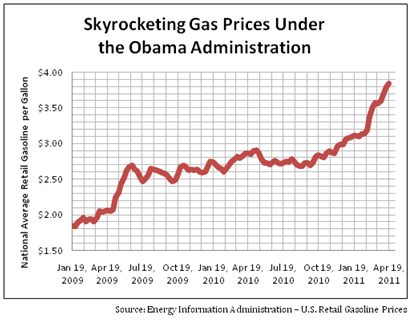
As the chart below shows, prices at the American gas stations have doubled since he took office and even he can't avoid taking pot shots at "Middle East oil".
House Republicans intend to put further pressure on the embattled President. On April 26, House Majority Leader Eric Cantor said in a statement that gas prices are "placing additional strain on budgets for families and job creators, making it harder for business owners to grow and create new jobs." It added that while the administration is promoting "backward energy policies," House Republicans "in the coming weeks" will pursue the three energy bills, all of which the House Natural Resources Committee marked up in mid-April.
The three bills will focus on allowing oil drilling permits in the Gulf of Mexico, restarting American Offshore Leasing and Reversing President Obama's Offshore Moratorium Act.
Obama is playing the blame-the-foreign-oil game. "We are in a lot of conversations with the major oil producers like Saudi Arabia to let them know that it's not going to be good for them if our economy is hobbled because of high oil prices," Obama told a U.S. television station.
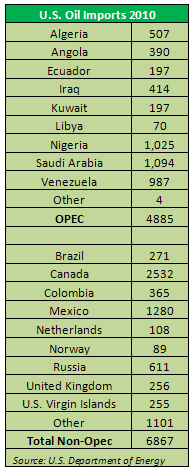
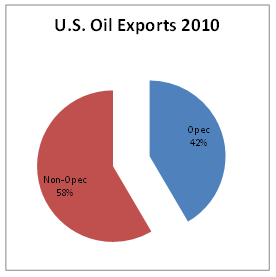
What he didn't say was that he should also have spoken to other 'foreign' oil suppliers such as Canada. Contrary to popular American belief, it is Canada that is the number one supplier of gas, not Saudi Arabia. The Kingdom is not even the second biggest oil supplier to the U.S., as the table below shows.
OBAMA'S CALL
Many critics dismissed U.S. President Barrack Obama's recent energy strategy speech, calling it a 'recycled' agenda - a dig on the U.S. Government's hackneyed and failed attempts to spur renewable energy consumption in the oil addicted country.
But it may well be different this time as America is no longer the same place it was in the 1970s. Its citizens are struggling, its economic outlook is at its worst in decades and the backlash of high oil prices can no longer be absorbed by Capitol Hill. In short, America needs a new 'bad guy' and the Middle East, with its motley crue of unloved leaders (Libya's Gaddhafi and Iran's Ahmedinajad), is making it an easy choice.
Taking a leaf out of the energy strategy in the report by HSBC (The World May Have 49 Years Of Oil Left: HSBC), President Obama has focused on more fuel-efficient cars as a way to wean itself on oil. Ford, General Motors and Chrysler are already building more fuel-efficient cars, ditching the Hummers for Ford Fiesta - expect the rest of the world to follow suit.
Combined, these strategies could dent U.S. demand for Mideast oil producers.
Currently, Saudi Arabia exports roughly 14% of its oil production to the United States and Kuwait nearly nine per cent, according to the U.S. Department of Energy.
Obama wants to cut U.S. oil imports by a third and that means the axe is likely going to fall on the Middle East states. "If you look at what (Saudi oil minister Ali) al-Naimi has been saying recently, the Saudis are not looking to the West anymore. For them demand in the West has peaked and the future is really in the East. So Saudi Arabia has given up on the West anyway," says Olivier Jakob of Petromatrix.
Indeed, many Middle East exporters such as the United Arab Emirates, Iran and Oman already export to Asian economies, and Saudi Arabia and Kuwait are already ahead of the United States and are big suppliers to Japan, South Korea and China, rather than the United States.
Opec has already deflected criticism to market speculators, with Saudi oil minister saying on April 17 that the kingdom, in fact had cut output by 800,000 barrels per day in March due to oversupply, and that there were no takers for its oil in international markets.
There are other reasons why we don't expect Opec to move quickly next time oil prices jump. (Read: Opec breakeven oil prices are at worrying levels)
Saudi Arabia and other Opec leaders will also not take kindly to Donald Trump's remarks. Already, there is resentment among Gulf states towards the Obama Administration over the way it handled Egyptian President Hosni Mubarak's departure. This latest sore point over oil prices will not help relations, especially at a time when the Middle East is in turmoil.
However, these strange bedfellows will continue to remain allies behind the scenes on fears of perceived Iranian influence in the region. But on the public stage, expect more hysteria about Middle East oil as the race for the White House heats up.
alifarabia.com 2011
Donald Trump's recent hysterical comments on Opec, Saudi Arabia and Kuwait are set to put more pressure on President Obama. Expect more pressures on Mideast states as the race for the White House heats up.
As the race for the White House begins in earnest, expect oil prices to feature prominently in discussions, and discussions of 'our oil' by American newscasters and talking heads to get more frenzied.
Some say it has already begun. Donald Trump, the garrulous star of reality show The Apprentice and real estate billionaire is looking to run for the top office in the United States of America, and he has sets its sights on Opec, Kuwait and other easy targets as he plays to the galleries.
Fresh from a kick in his teeth after he had challenged U.S. President Barrack Obama to produce a birth certificate, Donald Trump has now jumped on the Opec-bashing bandwagon.
After Obama revealed his birth certificate to the public, without missing a beat, Trump told (incredulous) reporters: "we can now move on to talk about gasoline prices. We can talk about China ripping off this country. We can talk about Opec doing the numbers on us like nobody has ever done before...
"...If you look at Saudi Arabia, what they did, it's unbelievable. Three days ago, they announced essentially that they are going to raise the price of oil by cutting back production - and we have nobody to speak to these people. We have nobody that calls or talks and says 'you are not going to do this fellas, we are protecting you. You wouldn't be there except for us.'... Yesterday, our president said we have very little impact over the price of gasoline. I think he is a 100 per cent wrong. Because Opec is setting the price of fuel. We have oil all over the place, and yet everyday we are setting records, and we will be at the all-time record of $150. When the [U.S.] President says he has no power over it, it is pretty sad."
So what would he do different, if he got elected? "What I would do is come down really hard on Opec. If you look at these nations, they would not even be there, except for us. You take a look at Kuwait, we handed Kuwait back to people right now who essentially own Kuwait. ... we handed it back, and they never paid us. You look at Saudi Arabia they want to raise the price of fuel, it would be very easy and very quick to get gasoline prices down. Gasoline prices are going to 4 to $5 to $6 to $7, as sure as you are standing there."
For all his hysteria, Trump is riding on an issue that President Obama can not ignore - U.S. citizens paying excruciatingly high prices at the gas station.
In the more mainstream political circles, U.S. Speaker of the House John Boehener issued a scathing press release titled: "Running on empty: Obama administration does nothing to address skyrocketing gas prices," on April 27.
While Obama is unlikely to be upstaged by Donald Trump or even Sarah Palin in his quest for a second term in the White House, gasoline prices could be his undoing.
As the chart below shows, prices at the American gas stations have doubled since he took office and even he can't avoid taking pot shots at "Middle East oil".
House Republicans intend to put further pressure on the embattled President. On April 26, House Majority Leader Eric Cantor said in a statement that gas prices are "placing additional strain on budgets for families and job creators, making it harder for business owners to grow and create new jobs." It added that while the administration is promoting "backward energy policies," House Republicans "in the coming weeks" will pursue the three energy bills, all of which the House Natural Resources Committee marked up in mid-April.
The three bills will focus on allowing oil drilling permits in the Gulf of Mexico, restarting American Offshore Leasing and Reversing President Obama's Offshore Moratorium Act.
Obama is playing the blame-the-foreign-oil game. "We are in a lot of conversations with the major oil producers like Saudi Arabia to let them know that it's not going to be good for them if our economy is hobbled because of high oil prices," Obama told a U.S. television station.
What he didn't say was that he should also have spoken to other 'foreign' oil suppliers such as Canada. Contrary to popular American belief, it is Canada that is the number one supplier of gas, not Saudi Arabia. The Kingdom is not even the second biggest oil supplier to the U.S., as the table below shows.
OBAMA'S CALL
Many critics dismissed U.S. President Barrack Obama's recent energy strategy speech, calling it a 'recycled' agenda - a dig on the U.S. Government's hackneyed and failed attempts to spur renewable energy consumption in the oil addicted country.
But it may well be different this time as America is no longer the same place it was in the 1970s. Its citizens are struggling, its economic outlook is at its worst in decades and the backlash of high oil prices can no longer be absorbed by Capitol Hill. In short, America needs a new 'bad guy' and the Middle East, with its motley crue of unloved leaders (Libya's Gaddhafi and Iran's Ahmedinajad), is making it an easy choice.
Taking a leaf out of the energy strategy in the report by HSBC (The World May Have 49 Years Of Oil Left: HSBC), President Obama has focused on more fuel-efficient cars as a way to wean itself on oil. Ford, General Motors and Chrysler are already building more fuel-efficient cars, ditching the Hummers for Ford Fiesta - expect the rest of the world to follow suit.
Combined, these strategies could dent U.S. demand for Mideast oil producers.
Currently, Saudi Arabia exports roughly 14% of its oil production to the United States and Kuwait nearly nine per cent, according to the U.S. Department of Energy.
Obama wants to cut U.S. oil imports by a third and that means the axe is likely going to fall on the Middle East states. "If you look at what (Saudi oil minister Ali) al-Naimi has been saying recently, the Saudis are not looking to the West anymore. For them demand in the West has peaked and the future is really in the East. So Saudi Arabia has given up on the West anyway," says Olivier Jakob of Petromatrix.
Indeed, many Middle East exporters such as the United Arab Emirates, Iran and Oman already export to Asian economies, and Saudi Arabia and Kuwait are already ahead of the United States and are big suppliers to Japan, South Korea and China, rather than the United States.
Opec has already deflected criticism to market speculators, with Saudi oil minister saying on April 17 that the kingdom, in fact had cut output by 800,000 barrels per day in March due to oversupply, and that there were no takers for its oil in international markets.
There are other reasons why we don't expect Opec to move quickly next time oil prices jump. (Read: Opec breakeven oil prices are at worrying levels)
Saudi Arabia and other Opec leaders will also not take kindly to Donald Trump's remarks. Already, there is resentment among Gulf states towards the Obama Administration over the way it handled Egyptian President Hosni Mubarak's departure. This latest sore point over oil prices will not help relations, especially at a time when the Middle East is in turmoil.
However, these strange bedfellows will continue to remain allies behind the scenes on fears of perceived Iranian influence in the region. But on the public stage, expect more hysteria about Middle East oil as the race for the White House heats up.
alifarabia.com 2011