The Gulf's top ten fund managers control $20-billion, or 72% of assets under management, in the region's mutual funds industry.
NCB Capital has more assets under management (AUM) than any other in the region and commands nearly 21% of market share by the first quarter of the year, according to Kuwait Financial Centre, or Markaz research.
Indeed, the Gulf asset management industry is dominated by Saudi institutions, with Sambacapital, Riyad Capital, Al Rajhi Capital, HSBC Saudi and Caam Saudi Fransi, among the top 10 managers.
Combined these ten entities constitute 72% of the $29-billion assets under management in the Gulf's mutual funds industry.
More than 65% of asset managers manage less than USD 100mn. The bottom 50% of fund managers, account for just 3.3% of the total industry, according to Markaz estimates.
Overall, close to 100 asset management firms managed nearly $29-billion in 325 funds by March 31, 2011, according to Markaz estimates.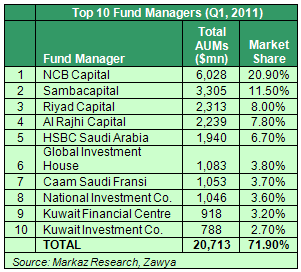
Asset managers had a torrid time for much of the year, especially in the first quarter when revolutions in the Arab World dented investor confidence.
"GCC Equity funds also mirrored the performance with majority of funds giving negative returns in 1Q11. Among equity funds, Al Safwa Investment fund (National Investments Company) was the best performer (in terms of Alpha) with 1Q returns of 1.58% and alpha of 11.1%," notes Markaz. "This was followed by Al Dar - Securities Fund with return of 0.41% and alpha of 9.88%."
Al Mal Capital may not have been one of the biggest asset managers, but it certainly turned out to be a stellar performer. Among fixed-income funds, its MENA Income Fund emerged as the top performer with return of 2.06% and alpha of 1.2% for the first quarter. Meanwhile, the Al Mal - Liquidity Fund (Al Mal Capital) topped the list of Money Market funds with a return of 0.76% and alpha of 0.62%.
On an asset-weighted basis, fixed income and money market turned in better returns than equity funds in the first quarter of the year. Islamic fixed income funds were top performers in GCC (+1.4%) and Saudi Arabia (+0.2%). Islamic money market funds topped in Kuwait (-0.3%) while conventional money market funds topped in UAE (+0.8%), says Markaz.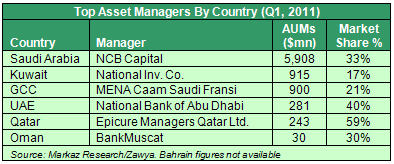
POOR RATIOS
The Gulf's AUM to GDP ratio remains poor, which highlights the lack of institutionally-managed funds in financial markets. While Kuwait and Saudi Arabia's AUM to GDP ratio stand at a respectable 4.1% and 4% respectively, the other four Gulf states are nowhere near that figure. Qatar (0.3%), UAE (0.2%), Oman (0.2%) and Bahrain (0.1%) show the mutual funds industry remains nascent in market participation. It also explains the high percentages of retail investors in the markets.
The cost of an equity fund is highest in the UAE, with 1.73% in management fee, compared to the GCC average of 1.48%.
And for all the talk of Dubai overtaking Bahrain as the region's financial hub, the UAE remains behind Manama and other Gulf states in domiciled-funds. There were 140 funds domiciled in Saudi Arabia managing $19.3-billion in assets, followed by Kuwait with 58 funds managing $5.7-billion.
"Bahrain, true to its reputation as a financial hub, has 39 funds with USD 1.1bn in assets. Most of the funds domiciled in Bahrain are mandated to invest in GCC/MENA region," notes Markaz. The UAE had 26 funds with $905-million under management.
PROSPECTS
Going forward, prospects remain grim for the regional stock markets. While the outlook for the Gulf's economies is bright, global market conditions remain bleak for the foreseeable future.
Year-to-date GCC markets have tracked their global peers, and in fact fared far worse. Kuwait has fallen 15.7% till end of August, Oman 15.1% and Bahrain 12%. Other Gulf markets such as Saudi Arabia (-8.4%), Dubai (-8.9%), Abu Dhabi (-4.2%) have failed to get out of the red, with the 'best' performing market being Qatar, down 3.9% year-to-date.
In contrast, the Dow Jones Industrial Average was down 2.9% for the year (till August 31), and the S&P 500 (-6.5%), as the global economic outlook turns darker.
However, the regional asset management industry is gaining ground. A BCG Consulting report estimates that, professionally managed assets amount to roughly USD 1 trillion, or a quarter of assets in the wider Middle East region. These include a wide variety of funds and not just the mutual funds covered in the Markaz study.
"While BCG expects total assets (both direct and indirect) to grow by around 8% in the coming years, professionally managed assets are estimated to grow at a slightly stronger rate of around 9%-10%."
© alifarabia.com 2011