The BRIC acronym, is celebrating its ten years of existence, after Jim O'Neill, who was then head of economic research at Goldman Sachs, coined the term.
The countries that make up the BRIC acronym - Brazil, Russia, China and India, - have led global growth over the past decade and become popular investment destinations thanks to Goldman Sachs' influential investment muscle and the four countries' own desire to be seen as economic dynamos.
Global investors picked up on the theme, rivetted by the success stories of these rising stars of the global economy, and especially as United States and European economies sputtered and took a nose dive.
"The changes in the world that we have discussed since 2001 have been a powerful influence on the way we have seen the global economy and global markets over the past 10 years," said Goldman Sachs in a note that examined the BRIC's performance over the past decade.
"Over that period, the rise of the BRICs and the emerging world has been one of the defining stories of the era. Their economic weight and growth contributions have risen sharply, and their equity markets have outperformed substantially."
Goldman Sachs is now taking stock of the BRIC investment model and expanding it to research to 70 countries globally, or 90% of the current world GDP - including the N-11 nations and what it calls the Expanding Middle.
The N-11, for the record, includes the new countries that Goldman Sachs thinks will be the new engines of growth. They are: Egypt, Iran, Bangladesh, Indonesia, South Korea, Mexico, Nigeria, Pakistan, Philippines, Turkey and Vietnam.
Interestingly, there is no Saudi Arabia, UAE, Qatar or Iraq - the four countries that Middle East analysts expect to be regional dynamos of growth. Goldman is silent on the subject, but one can speculate that the absence of the four countries is primarily to do with their small populations and an overwhelming reliance on hydorcarbons.
Regardless, Egypt and Iran are in the N-11 - fascinating choices given Egypt's economic destiny is currently on a knife-edge and could go either way (the way of Iraq or Turkey) and Iran, which is currently under a mountain of international sanctions.
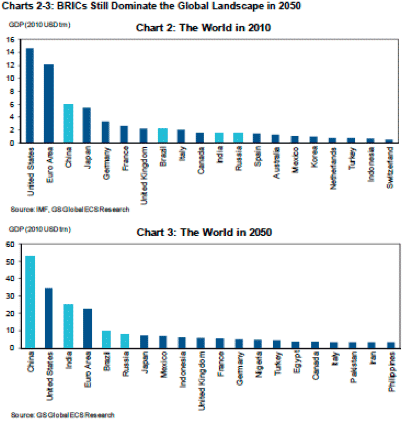
BRICS HALF WAY THROUGH THEIR GROWTH CYCLE
GS argues that the BRICs are halfway through their great economic cycle and the Great Transformation they have brought to the global economy is well under way.
"The relative importance of the BRICs as an engine of new demand growth and spending power may shift more dramatically and quickly than many expect. Higher growth in these economies could offset the impact of graying populations and slower growth in today's advanced economies," says GS.
But the global economy is shifting now towards the N-11 economies.
"The dangers of projecting far into the future are as large as they always were. But despite these risks, we remain deeply convinced of the value of pinning down the main drivers of growth, aggregating across countries and following the answers we get to their logical conclusions," says GS analysts.
"We still think of this less as a forecast and more as a method of uncovering broad global dynamics, the likely constraints that they may run up against and their implications. We see five major themes for the global landscape."
Given the new global economic dynamics, GS has five new investment themes:
Theme #1: At least halfway through the 'Great Transformation'.
BRIC economies have moved from 11% of global GDP (30% of all emerging markets) in 1990 to 25% of global GDP (50% of emerging markets).
"By 2050, we expect the BRICs to have reached close to 40% of global GDP and broad EM to reach 73%," says GS. "So, on that measure, the Great Transformation is only halfway done. In terms of contributions to growth, however, the change has been more rapid. Over the past decade, the BRICs have contributed close to half of the world's growth and emerging market more than 70%."
This is more than double the BRICs' contribution in the 1990s (23%) and the 1980s (18%), with a similar shift in the broad EM contribution too. This contribution is likely to hold at high levels for the BRICs and increase somewhat further for EM as a whole. But in terms of growth contributions, or more simply in terms of the role of the BRICs in driving global growth, the most dramatic change is behind us, says the bank.
Theme #2: The increasing importance of EM outside the BRICs
While BRICs are half-way through their growth, the N-11 and other emerging markets are going to take up the mantle. Goldman Sachs projections show the scope for the growth contribution of non-BRICs EM economies rising from 27% over the recent decade to about 40% by 2050.
Theme #3: A further rise in the 'Expanding Middle'
Growth within many of BRIC and N-11 has been uneven with tremendous income inequalities in India, China, Russia and Brazil. This will change as the middle class will rise within those economies and other emerging markets will see a similar rise in the population emerging out of poverty and 'expanding the middle'.
Theme #4: A peak decade ahead for global growth potential
GS's global projections show that the next decade is likely to be a peak period for global growth, as long as actual demand tracks potential. As the faster-growing BRICs and N-11 continue to increase their share of global activity, our projections are for world growth to average around 4.3%, well above the average of the last decade or the previous one. Beyond that, global growth should slow gradually by decade as demographics and diminishing returns outweigh the continuing rise in the EM share of overall activity. Strong underlying potential for global growth means that commodity pressures are also unlikely to disappear soon.
Theme #5: More tension between global and national perspectives
"Part of the difficult arithmetic of a rising weight for the large EM economies is that the global picture may on some fronts look better than the national pictures that make up the whole," says GS. "The story of global inequality is one version of that tension. Inequality has been rising within many countries -- both in the developed and emerging world -- even as the rise in average incomes in the EM narrows inequality globally."
BRIC: BLOODY RIDICULOUS INVESTMENT CONCEPT
While the world is enthralled by the BRIC acronym, another leading heavyweight of the financial world, Albert Edwards, chief economist at Societe Generale, says BRIC should stand for Bloody Ridiculous Investment Concept.
His reasoning?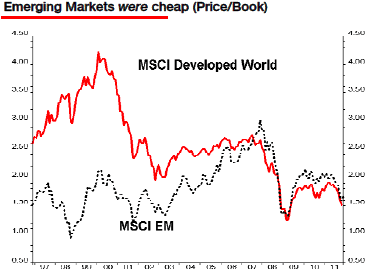
"The problem I find is that investors are desperate to believe the EM and BRIC growth story, for they have so little alternative. The story of superior growth for the EM universe is as entirely plausible as it is entirely misleading. Valuation is what matters for investing in EM, not their superior growth story. Certainly EM equities are not relatively cheap," says Edwards, noting that it was a former colleague Peter Tasker who came up with the alternative acronym for BRIC.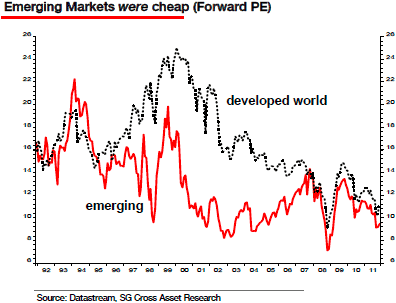
Edwards argues that investors are always suckers for a good story, but the evidence suggests there is absolutely no correlation between investment returns and economic growth because investors overpay for growth stories and there is no margin for error.
Edwards argues that research shows there is no correlation between GDP growth and stock market returns in developing countries over the period 1976-2005. China is the stand out where average nominal GDP growth since 1993 has been 15.6%, the compound stock markte return over the same period has been minus 3.3%.
"Yet investors persist in the BRIC superior growth fantasy. But it is no different from many of the other investment fantasies I have witnessed over the last 25 years only to see them end in severe disappointment," Edwards notes. "If growth does matter to investors, they should be worried that things seem to be slowing sharply in the BRIC universe, most especially in Brazil and India."
© alifarabia.com 2011