The Standard & Poor's downgrade of the U.S. economy was the great unthinkable just a few months ago. They are now a stark reality. While the short-term impact may not be immediate - save for market gyrations, it is long-term implications are clear: the U.S. economy is no longer the safest, the most dynamic and the most enduring in the world, and U.S. Treasuries - may be not tomorrow but certainly over time - will no longer the safe havens everybody counted on.
The Gulf states which have aligned themselves to the greenback in more ways than one, also need to think radically outside their dollar-filled box. While analysts don't expect Gulf states to publicly speak negatively about the U.S. economy or the dollar, one certainly hopes that behind closed doors, there is a concerted hope to realign the regional economies to the new realities.
Standard & Poor's damning verdict of the United States' approach to its fiscal crisis came after the markets had closed. It didn't matter as investors had been sensing a downgrade all week and moved like a pendulum on steroids, lurching from one piece of speculation and hanging on to every scrap of good news.
At one stage the old diversified Dow fell more than 500 points in the day, and their wild fluctuations throughout the week showed how investors clutched straws of hope only to be plunged deeper into the abyss of despair each time.
In the end the bears, who had beaten the bulls black and blue, felt vindicated as the S&P took away one of the U.S. coveted three As from its ratings.
Forget for one second why one ratings agency may have so much power over global financial markets, and focus on why it happened.
The S&P was deeply unimpressed by the weeks of wrangling and utter dysfunctionality of Capitol Hill.
The S&P noted:
"The downgrade reflects our view that the effectiveness, stability, and predictability of American policymaking and political institutions have weakened at a time of ongoing fiscal and economic challenges to a degree more than we envisioned when we assigned a negative outlook to the rating on April 18, 2011.
"Since then, we have changed our view of the difficulties in bridging the gulf between the political parties over fiscal policy, which makes us pessimistic about the capacity of Congress and the Administration to be able to leverage their agreement this week into a broader fiscal consolidation plan that stabilizes the government's debt dynamics any time soon."
But what does it mean for the Gulf economies?
The Saudi Tadawul index showed the first hint of panic by falling 5.46% on Saturday, and investors in other markets may want to brace themselves for a rollercoaster ride, which will probably have more dizzying descents than ascents.
FALLING OIL DEMAND
There is probably more to come. Lost in the din of the U.S. debt ceiling debacle and the eventual downgrade is that oil demand is falling.
Barclays Capital reduced its demand forecast for oil for both 2011 and 2012
Given the general state of the macro-economy, the state of oil demand does not seem particularly healthy," Barclays Capital oil analyst Amrita Sen said.
"Moreover, U.S. GDP is 2 percent lower than what everyone expected (or) knew of due to the revisions issued last week and our economists have reduced a cumulative 1.8 percent of U.S. growth over this year and next. Hence the revision."
Barclays has been typically an oil bull, and now its forecasts are below crude oil forecasting stalwarts, the U.S. Department of Energy and the International Energy Agency.
Worryingly for Middle East oil producers, the world's largest economy will need less of their most important export.
Deutsche Bank revised its forecasts for US 2011Q4 GDP growth from 4.3% to 3%. "On our estimates this will reduce US oil demand growth in the second half of this year by as much as 200k/d. Given expectations that US oil demand would growth by only 100kb/d in 2011 the latest downward revisions in US GDP growth imply US oil demand will actually contract by 100kb/d this year."
Over the past one year, U.S. crude, or the West Texas Intermediate (WTI) has become more closely related to the S&P 500 than before.
With a key U.S. benchmark expected to decline further after the U.S. downgrade, expect oil prices to drop as well.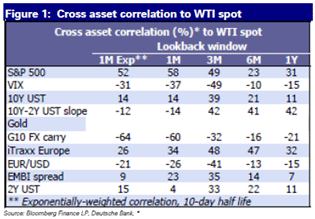
The price of oil will have a huge impact on the extent of Gulf surpluses. Saudi Arabia's oil price sweet spot is above $90-$100 and it has risen 23% to meet rising domestic investment spend. With oil prices hovering at that level already, another shock - such as recession in the U.S. or acceleration of debt problems in the EU - could see oil prices tumbling.
Also Read: Saudi and OPEC Breakeven Oil Prices Are Rising At Worrying Levels
"A complete collapse in global growth and a double dip recession, which would cause oil to overshoot its fundamentals and drop toward $60 per barrel," warns Religare Capital Markets.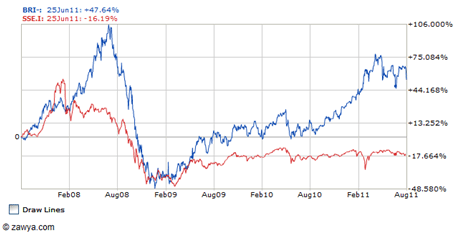
The chart above shows how the Saudi Tadawul Index correlates to Brent crude prices over the past three years. While the Tadawul index may often set on its course in times of high oil prices - such as during the recent crude rally in the first quarter of the year, when it remained flat to bearish - it almost certainly aligns itself when oil prices drift lower.
THE U.S. DOLLAR
Despite the UAE Central Bank's remarkable revelation that it has no U.S. Treasury bills in its reserves nor any other financial instrument issued by the U.S. government, a further depreciation in the greenback could erode the foreign assets of most Gulf governments.
"Despite the fact that the central bank foreign reserves are mostly denominated in dollars, they are invested mostly in non-US assets. Eventually these investments are not obligations on the US government," the bank said in a statement. "There is no direct link between the dollar-denominated assets and the US government debt."
China, one of the biggest foreign investors in U.S. Treasuries at $3.2 trillion of foreign exchange reserves has criticised the U.S. debt addiction. Its rating agency Dagong had already cut the U.S. rating long before the S&P did, citing that the onset of a third tranche of quantitative easing will see the "status of the U.S. dollar essentially shaken."
"The U.S. government has to come to terms with the painful fact that the good old days when it could just borrow its way out of messes of its own making are finally gone," noted Xinhua, the Chinese state agency.
According to the U.S. Treasury 'oil exporters' are the third largest buyers of U.S. debt, at $228-billion, or nearly 5% of foreign debt of $4.5-trillion. According to the Treasury definition, oil exporters include Ecuador, Venezuela, Indonesia, Bahrain, Iran, Iraq, Kuwait, Oman, Qatar, Saudi Arabia, the United Arab Emirates, Algeria, Gabon, Libya, and Nigeria.
While nobody expects the Saudis or Kuwaitis to publicly rebuke the U.S., privately expect them to worry. There have been murmurs of Gulf states expanding their foreign holdings into other currencies, and that just might be accelerated.
"Downgrading the US will have major effects on the world economy," says Capital Standards, an independent rating agency. "It is predicted that interest rates may increase sharply in the event of the downgrade, dragging down the value of the US dollar. Moreover, funds that limit their investments to 'AAA' rated bonds may dump the US holdings, causing the US dollar to further depreciate. 'S&P' had already changed the outlook to negative for five major insurance companies, which they believe are highly concentrated in the US."
INTEREST RATES
It is virtually a given that the U.S. interest rates will remain low for at least another year, if not more, given the fragile nature of the economy. That's handicaps Gulf economies which are tied to the dollar (except for Kuwait) and may have to raise interests are rising investment spending over the next few months put pressure on prices. While inflation remains subdued, there are signs that things may flare up soon. A recent CB Richard Ellis report estimates that Saudi residential property prices rose 60% during the first half of the year, and with all the investment pledges by various governments and handouts, inflation could spiral quite quickly.
But with the Gulf's monetary policy beholden to the Federal Reserves, the regional authorities may face a monetary tightening problem soon, as they in the early half of the previous decade.
CONCLUSION
America's return to Triple A rating may be a while away. John Chambers, managing director of sovereign ratings at Standard & Poor's told CNN that in the previous five times triple A sovereign ratings have been restored, it has taken those sovereigns anywhere between nine to eighteen years.
While it is important to note that U.S. Treasuries will not immediately lose their status as safe havens and investors will not immediately flee the safe investment instruments, in the long-term investors will look to diversify and that could well erode the value of the U.S. dollar.
Mohamed El Erian, the CEO of PIMCO, captured the significance of the downgrade, when he noted that the historic S&P downgrade means the global system must adjust: "There are consequences, uncertainties, and a silver lining... With America occupying the core of the world's financial system, Friday's downgrade will erode over time the standing of the global public goods it supplies - from the dollar as the world's reserve currency to its financial markets as the best place for other countries to outsource their hard-earned savings."
Global financial markets will reopen on Monday to a changed reality, says El-Erian. "There are immediate operational consequences, from re-coding risk and trading systems to evaluating collateral and liquidity management. Key market segments will be closely watched, including the money market complex and the reaction of America's largest foreign creditors."
The Gulf authorities also need to adjust to the new economic realities over the long-term. -Yadullah Ijtehadi
alifarabia.com 2011