While the Arab Spring has unleashed havoc on the region's economy, one country that has escaped the regional turmoil is Qatar. Posting stunning GDP growth of 16% last year, the tiny emirate is expected to reach 18% this year, even as other regional economies stumble and need government investment to stimulate growth. Qatar's economy has benefited from exploiting its formidable oil and gas resources over the past ten years. But as hydrocarbon-led growth tapers off, the country is embarking on a new set of challenges to stimulate its non-hydrocarbon sector. Can Qatar's non-energy sector replicate the success of the energy sector and lead GDP growth?
It could well be that the Qatari government is the luckiest government in the world. Sitting on the world's third largest natural gas reserves in the world, Qatar is the single largest supplier and exporter of liquefied natural gas (LNG), apart from being a significant oil producer.
"Qatar is one of the fastest growing economies in the world. Its LNG capacity will reach a peak of 77 million tons per year (mtpy) in 2011 compared to 30 mtpy in 2008, and less than 5 mpty in 1997. Hydrocarbon GDP grew at an average rate of about 11 percent between 1990 and 2009, while a non-hydrocarbon GDP grew at an average rate of 9.5 percent," says the IMF.
In addition, a robust sovereign wealth fund has assets of $85-billion invested in high profile projects across various sectors and around the world.
On the other side of its balance sheet, Qatar has few commitments. Of a population of 1.6 million, Qataris make up around 320,000, which makes it easy for the government to provide them free healthcare, education and subsidised living, and a GDP per capita of $74,400 - among the highest in the world. Of these roughly 72,000 Qataris are economically active. No wonder unlike their regional counterparts, Qataris are not out on the streets demanding political reforms.
But the authorities would argue that they are not lucky. They simply engaged in a 20-year investment plan which began in 1992 and started bearing fruit for the country in the past decade. Qatar National Bank estimates that the country's nominal GDP growth averaged a breathless 27.2% from 2005 to 2009.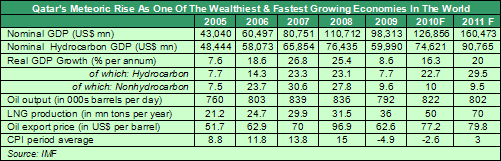
The sterling GDP growth is expected to calm down somewhat with growth in 2010 estimated to be around 16% in 2010 and 18% in 2011, and a further easing to 6% by 2012, as the country's LNG production reaches its peak during that time.
Of course, all the authorities' plans to invest in infrastructure, its people, its tourism and notable sports tourism and healthcare can not take away the fact that the economy rests solely on hydrocarbons - and is overwhelmingly dependent on its exports of oil and gas to the rest of the world.
Luckily for Qatar, the world's dependence on hydrocarbons remains intact and in fact, gas is the "fuel of choice" of the 21st century.
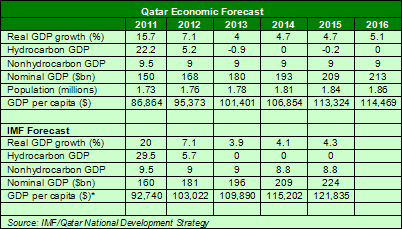
"A further expansion in LNG capacity, and activity in the non-hydrocarbon sectors will boost real GDP growth to 20 percent and further increase fiscal and external surpluses," says the IMF in a recent report. "Continued growth in the manufacturing sector, a pick-up in the construction sector, and sustained activity in financial and government services, transportation and communication will drive the non-hydrocarbon sector growth of 9.5 percent."
The New Strategic Plan
The Qatar National Development Strategy (NDS) for 2011-2016 sees development of the sectors that has yielded tremendous fortunes for the country, but also brings to the fore the country's non-hydrocarbon sector.
Missing will be the unbridled double-digit growth. However, at a projected 4-5 percent a year post-2012 real GDP growth will remain solid, and in nominal terms the economy will remain highly prosperous with national income conservatively projected to reach $213 billion by 2016 (the IMF projects nominal GDP of $224 billion by 2015) with an estimated per capita income of over $114,000.
"A key factor in the medium-term projections is the recognition that the contribution from the hydrocarbon sector to growth will drop off dramatically as the 20 year gas based investment program comes to an end and the last of the major projects come on stream in 2012," notes a Samba report. "This then leaves the non-hydrocarbon sector as the driver of future real GDP growth," says the Saudi bank.
The next wave of growth will depend on the $200-billion investment in the non-hydrocarbon sector and rest on stimulating projects such as the hosting of the 2022 FIFA Football World Cup.
The bigger question is whether expected private investment in the non-hydrocarbons sector will materialise as envisaged.
"The NDS expects that private investment will drive growth and under its baseline scenario envisages $107 billion will be invested in the non-hydrocarbon sector through 2016. This is a considerable sum, representing over 85 percent of current GDP. Much of this investment is expected to come from government linked companies such as Barwa, Qatar Diar and Qatalum which are expected to have ready access to finance. However, it would not be surprising if overall private investment levels fell short," says Samba.
Qatar's private sector has not shown much signs of robustness and remains beholden to government support. During the global financial crisis, Qatar stepped in to capitalise banks, support the stock market and merged entities. Not much has changed since the crisis to believe that the private sector will step in and lead growth.
But in the five-year forecast, the NDS projects hydrocarbons contribution to be around 42% by 2016 from its current level of 51%. That means that non-hydrocarbon GDP will grow at 9% each year till 2010.
"The authorities are hoping that expanding services activities will be a major driver of the economy accounting for close to 40 percent of GDP by 2016, with an emphasis on transportation, communications, business and financial services," says Samba. "Manufacturing activity is also projected to grow steadily in line with continued expansion in fertilizer, petrochemicals and metallurgy, accounting for 10 percent of GDP by 2016."
Also Read: Qatar's $225 Billion Bonanza Over Next Five Years
Long-Term Goals
Even though hosting the 2022 Football World Cup is outside the remit of the 2011-2016 plan, the economy is expected to be boosted by the major honour to host the world's most coveted and high profile sporting tournament, rivalling even the Olympic Games. A shadow though, has been cast by the recent scandals surrounding FIFA's governance in awarding the 2022 World Cup hosting rights to Qatar, with a few countries suggesting FIFA should withdraw the rights. For the moment, FIFA remains firm on its decision.
Winning the 2022 World Cup will help to sustain growth given the expected boom in infrastructure spending, says Standard Chartered Bank, which argues that the private sector has seen limited growth during the country's hydrocarbon drive.
"The planned infrastructure investments will have a better filter-down effect, enhancing private-sector growth in the years to come," says SCB. "The second benefit will be to provide Qatar with the infrastructure backbone that will enable the productivity gains needed for sustainable growth. This is particularly true of improvements to Qatar's transport network."
One cannot underestimate the experience, of building the infrastructure and hosting the event that Qatar will gain from the World Cup, says SCB.
Qatar plans to become a knowledge-based economy, able to create the jobs its young population will want to do. There has already been heavy government investment in education, with close to $10-billion committed to educational initiatives at the Qatar Foundation (a non-profit organisation focused on education and research).
"The stadiums present a novel engineering challenge given that this is the first time air-cooled, carbon-neutral technology will be employed for such a large-scale event. Clean and renewable energies will be used to achieve the first completely carbon-neutral World Cup games. The stadiums will be designed to reduce solar radiation and warm air, and to provide adequate climatic conditions inside the stadium for both spectators and players.
"Qatar plans to involve its students, engineers and academic institutions (the country is already home to a number of global institutions, including Carnegie Mellon and Texas A&M), and it plans to share the event-management experience it gains from hosting the World Cup with developing countries. Given the scale of the World Cup, hosting the event will help Qatar to build up a significant services sector," says SCB.
The country also plans to have 110,000 hotel rooms for the World Cup, more than doubling from its current capacity of 50,000, bulking up its tourism industry.
Qatar's air, sea and land transportation project is even more ambitious: it plans to spend close to $60-billion in transportation sector, which includes a 300-kilometre Doha Metro Network, a 345-kilometre railway linking Qatar to other GCC states.
Road transportation development of $20-billion that includes a highway to a few Gulf countries. A new Doha Port to be built at a cost of $7-billion with a capacity of 25-million TEUs when completed by 2025.
In addition, the new Doha international Airport is set to be ready by 2015 and serve 50 million passengers and 2 million tonnes of cargo.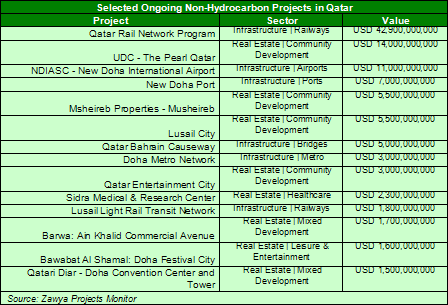
Debt Management
SCB estimates that Qatar's total debt (public and private) will reach a cumulative $103-billion as of end-2010. Qatar's debt redemption schedule is easily manageable in the near to medium term, and the state's returns on LNG exports should help it to build considerable reserve assets over the long term.
The government issued several tranches of bonds in 2009 to create a sovereign benchmark yield curve aimed at facilitating issuances by government-owned corporates and commercial banks. As a result, the external borrowings of the sovereign and corporates doubled to $70 billion between 2008 and 2010.
The IMF argues that Qatar's sovereign and guaranteed external debt is mostly long term and the debt servicing profile does not indicate potential refinancing difficulties in the foreseeable future, and notes that its analysis does not show any significant weakness that would expose Qatar to heightened downside risks from overburdened government finances
"Qatar will need to maintain a well co-ordinated issuance programme, particularly as it undertakes the FIFA-related development agenda, so as to avoid the near-term debt challenges faced by other states in the region. We are encouraged by the level of transparency on the government support profiles of various entities, with clear lines drawn between standalone and explicitly supported ones," says SCB.
Conclusion
With oil and gas prices expected to remain high over the long-term, Qatar's hydrocarbon growth remains robust. Qatar also needs lower oil prices than its regional counterparts to balance its books; indeed oil prices will have to fall to $40 a barrel for Qatar to start posting budget deficit from 2012 onwards.
Also Read: Opec's Breakeven Oil Prices
With such favourable fundamentals, Qatar appears to be doing no wrong. However, the next five years will test the limits of the authorities' creativity and its ability to generate non-hydrocarbon growth. Many economies like Abu Dhabi and Dubai have struggled to stimulate the private sector during this time. If Qatar can stimulate 8% non-energy GDP growth over the next five years, its people will not have to thank the hydrocarbon resources, buts its leadership for their windfall.
© alifarabia.com 2011