The Islamic Finance industry is estimated to be worth $1 trillion and is expected to double over the coming years. Sukuk bonds that are structured and issued in a Shari'ah-compliant manner are the main stream of this industry. However, issuing Sukuk needs certain regulatory framework and tax exemptions, which governments of many countries have been implementing to facilitate the issuance of Sukuk in the ever growing industry. Some governments diversify their sources of funds to make use of the Muslim wealth, among other reasons. The following article sheds the light on measures taken by different countries over the past years to allow issuance of Sukuk.
In the Middle East and North Africa region, which includes all the Arab states and which are mostly populated by Muslims, only few countries have issued Sukuk so far and these are 5 of the GCC states add to these Sudan. Levant and North Africa Arab Muslim states lag behind the GCC in terms of Sukuk issuance.
Recently, it was reported that Jordan's first ever law covering the issuance of sovereign Islamic Sukuk has been finalized. The draft law overcomes an impediment facing the government if it was to issue Sukuk to finance major projects under Islamic-compliant Sharia terms, which require Islamic banks to first buy an asset which they then sell to the borrower. By allowing the setting up of a special purpose vehicle (SPV) into which state assets are transferred, the law overcomes legislation, preventing the government from forgoing titles to assets or properties when it borrows. In April 2010, Central Bank of Syrias (CBS) Governor Adib Mayaleh said that the CBS is working to modify Decree No. 35 of 2005, which regulates Islamic banking in Syria, to issue Sukuk.
Also, Egypt, home to the Arab worlds largest Muslim population, was planning to issue its first Islamic debt guidelines in 2011 to catch up with the Persian Gulf and Southeast Asia and help spur sales. However, the recent developments could delay such plans till further notice. In Algeria, Ismail Noureddine, the president of Commission of supervision of stock exchange operations (COSOB), declared that the introduction of new financial products as Sukuk is under consideration.
Neighboring country Turkey has made major steps in developing Islamic Finance and facilitating issuance of Sukuk. The Turkish National Assembly in Ankara passed the Finance Bill 2011 in February which includes tax neutrality measures for Sukuk Al-Ijara (leasing certificates) thus paving the way for a spate of corporate Sukuk issuances in the country.
Moving North to Europe, despite opposition protests from the left, the French Parliament passed a law that authorizes the issuing of Sukuk. Meanwhile in Luxembourg, direct tax authorities have notably recognized that Sukuk have to be considered as debt instruments from a tax perspective. Consequently, the tax treatment applicable to yield on Sukuk will be the same than for conventional interest on bonds.
In Ireland, and under the Finance Bill 2010, which came into effect in January 2010, the Irish Ministry of Finance has introduced significant amendments to facilitate Islamic finance transactions in Ireland, especially in the origination and issuance of Sukuk. The legislation clarifies that the Sukuk certificate should be considered a security and confirms that the investment return on that certificate should be treated as interest on a security for the purposes of the Taxes Act (subject to restrictions). In addition, it confirms that the Sukuk issuer will be entitled to a deduction in respect of the coupon paid as though it was a conventional interest payment. The bill also introduces amendments to the stamp acts to ensure that no stamp duty will arise on the issue, transfer or redemption of a Sukuk certificate. Amendments have also been proposed to the VAT Act to exempt from VAT specified financial transactions i.e. Islamic finance transactions where those transactions correspond to financial services transactions as listed in the VAT Act.
Australia said it plans to change laws to ensure Islamic finance products are taxed fairly as the government seeks to attract investors from the Middle East and Asia, paving the way for Sukuk sales. Australias tax office will report by June 2011 on how the government can ensure the industry gets equal level of treatment, the government said on its website on October 13th 2010.
Japan too wants to pursue Islamic finance to woo investors demanding Shari'ah-compliant assets and will alter regulations to give foreign investors tax breaks on Sukuk dividends. Islamic bond dividends received by foreign investors may be declared tax-free as early as end-2011. Japanese regulations do not forbid the issuance of Islamic bonds but these funding instruments are often not commercially viable without tax breaks on dividends received. The transfer of assets tends to attract tax, which can make Islamic finance transactions more costly than conventional deals.
Other countries are still at earlier stages but showed interest in Islamic Finance and Sukuk. Indias Prime Minister Manmohan Singh said he will ask the central bank to learn more about Islamic finance from Malaysia, the worlds largest market for Sukuk.
Efforts to develop Islamic financial markets have met resistance in South Korea. Yet, South Korea will renew its push to allow tax exemptions on Sukuk issued by companies to help local borrowers tap growing Muslim wealth. Approval would follow Thailand, where the financial markets regulator said it has completed rules to permit institutions to sell Sukuk.
Kazakhstans government expects to pass legislation within the next months that would enable companies to sell Sukuk, said Deputy Prime Minister Asset Issekeshev.
The Monetary Authority of Singapore on May 7th 2009 released guidelines that would boost its standing as an Islamic financing hub. The guidelines build on previous moves to facilitate the sector, and the key regulation is the equal tax, regulatory and liquidity treatment of Singapore dollar-denominated Sukuk with government securities. The guidelines, which took effect immediately, would make Sukuk issuance in Singapore more cost-effective.
Even of equal interest, in January 2011, Brooklyn state Senator Kevin Parker said the issuance of Sukuk, or "alternative financial investment bonds," could help New York pull in foreign investment.
Even Indonesia where Sukuk are already issued, there is a plan to offer further tax incentives for Islamic finance which may spur corporate Sukuk issuance. While in Kuwait, the government is currently working on issuing a law concerning Sukuk, since Kuwait has the suitable environment and financial resources to issue Sukuk.
These were some of the countries amending their tax regulations to facilitate, speed up and increase issuance of Sukuk. Zawya Sukuk Monitor estimates number of countries where Sukuk are issued has doubled from 8 at end of 2005 to 16 by end of 2010 and could triple to 24 by end of 2013.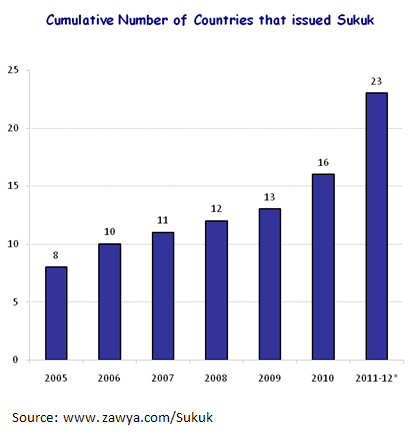
Adnan Halawi
Team Leader - Fixed Income
ahalawi@zawya.com
© Zawya 2011