Remittances to the Arab Spring countries have increased significantly from the Gulf Cooperation Council countries to Egypt, Tunisia, Yemen and Syria. Egyptians working abroad, for example, remitted 24% more cash during the fourth quarter of the financial year 2010/2011, to reach USD 3.5 billion, compared to around USD 2.8 billion during the third quarter ended March 2011. In Yemen, these remittances accounted for more than 6% of GDP.
A November report by the International Monetary Fund (IMF) noted a major economic slowdown in the Arab Spring countries for 2011, with the possibility of a continuing slowdown in 2012. The Tunisian economy, the IMF said, will not witness any growth in 2011, after increasing 3.1% in 2010.
Egypt's growth rate is pegged at 1.2% in 2011 compared to 5.1% in 2010. Syria is expected to grow by 2%. Overall, the Arab Spring countries lost nearly USD 20.6 billion of GDP and their balance sheets decreased by USD 35.3 billion.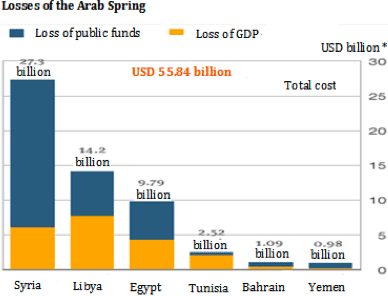
Source: IMF
The situation was complicated by the decline in foreign direct investment from these countries. A report by the Arab Investment and Export Credit Guarantee Corporation said Egypt witnessed 92% decline in FDI to a forecast USD 0.5 billion by the end of December, compared to USD 6.4 billion in 2010. FDI in Syria is expected to decrease from USD 1.4 billion in 2010 to USD 0.5 billion in 2011, while Bahrain is forecast to lose 36% and Tunisia 21%.
Egypt & Tunisia
At the same time, however, remittances to most of these countries have risen. According to the Manpower and Immigration Ministry, an estimated 6 million Egyptians work abroad, more than 3 million of whom are in the GCC countries. Banking expert Ahmed Adam said remittances from the Egyptians working abroad reached USD 9.8 billion during the first half of the financial year 2010/2011, compared to USD 3.6 billion during the same period of the previous financial year 2009/2010. The largest contributors were the Egyptians working in the Arabian Gulf.
Remittances benefit an economy in various ways: foreign exchange inflows against local currency as well as increased revenues for companies or banks handling remittances.
The situation in Tunisia may be different. Remittances from emigrants from most countries around the world and from Gulf countries to Tunisia increased, which had a positive impact on the Tunisian economy. Some Tunisian workers in Libya returned to their home country, negatively impacting the volume of remittances to Tunisia. The African Development Bank estimates that remittances to Tunisia will reach TND 125 million in 2011, compared to TND 50 million in 2009. ADB estimates the size of the losses resulting from the disruption of remittances from Tunisian migrants in Libya at around TND 145 million, of which TND 20 million is estimated as the cost of the social assistance program approved by the interim government for the benefit of the returning workers.
Yemen
The sub-governor of the Central Bank of Yemen, Ibrahim Al Nahari, estimates that remittances from Yemeni expatriates will decrease slightly by the end of 2011, influenced by the political crisis witnessed by the country since February 2011. The decline is mainly in the remittances made as investments, while those covering consumption by expatriates' families increased following the rise in prices in Yemen in 2011.
The preliminary data, Al Nahari said, indicate that net remittances will be around USD 1.2 billion by the end of 2011, compared to USD 1.26 billion in 2010. Remittances of are considered a main support to the national economy, accounting for 4% to 5% of GDP. The contraction in the Yemeni economy, however, will see this contribution increasing to 6% of GDP.
Al Nahari said remittances contributed to covering a large part of Yemen's balance of payments in the absence of foreign financial aid in 2011, preventing the deficit from ballooning. A World Bank report expects Yemeni migrants' remittances to improve in 2011 and 2012. The Bank says Yemen ranked seventh in the MENA region among the top recipients of remittances in 2010.
Mustafa Nasr, president of the Studies and Economic Media Center, says remittances had a positive effect during Yemen's year of crisis. Without them, "thousands of families would have been hunger-stricken", as some regions in Yemen depend by 50% to 60% on their relatives' remittances, particularly from Gulf countries.
According to statistics issued by the Sana'a Chamber of Commerce and Industry, the investments of migrants outside Yemen exceed USD 33 billion. This fact should motivate the Yemeni Government to make the process of attracting migrants to invest in the country its first priority. Unconfirmed estimates place the number of Yemeni expatriate workers at the 2 million mark, in more than 80 countries.
Syria
The World Bank estimates that Syrian expatriates remitted USD 1.4 billion in 2010, compared to USD 1.3 billion in 2009. This is expected to decrease in 2011 to USD 1.1 billion.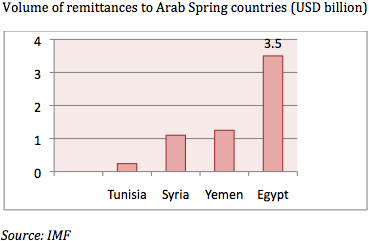
The GCC effect
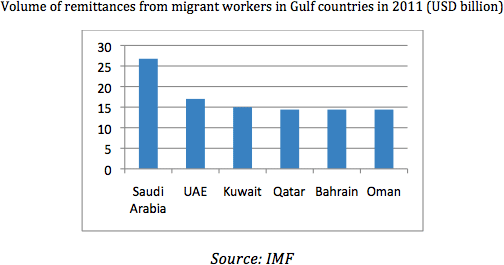
The Arabian Gulf countries lead the world in the volume of remittances sent to the MENA region, accounting for 17%, according to the IMF. The volume of remittances from migrant workers in Saudi Arabia increased by 182% from 2000 to 2010, to reach USD 194 billion. These are expected to exceed USD 26.67 billion in 2011, to be at the forefront of Gulf countries with 45.9%, followed by the UAE with 17.6% (USD 17 billion), Kuwait with 14.7%, then Qatar, Oman and Bahrain.
Nabil Al Mubarak, Director General of the Saudi Credit Bureau (SIMAH), calls for the need to provide easy ways to open bank accounts for the low-wage workers and savings accounts for the high-wage workers in order to take advantage of their wages within the KSA before they are obliged to transfer them abroad. Average remittances from Gulf countries are expected to increase by 10% per year, he says.
The largest part of remittances from the UAE goes to Southeast Asia, with the MENA nations a distant second in line. Some exchange companies operating in the UAE confirmed that remittances maintained their immunity against the political upheavals in the Arab region, rising in 2011 compared to 2010. Remittances increased by 10% to 20% during the days preceding Eid Al Adha in November 2011, addressed to Egypt, Syria, Jordan and Morocco, according to exchange companies. Remittances to Libya also improved, while those to Tunisia and Syria remained unchanged.
Dr. Akram Al Zubaidi, professor of economics, says remittances to Syria will decline as the Arab League and other countries impose economic sanctions against the Syrian regime.
Wadah Al Taha, a financial analyst, believes that any increase in remittances will not fulfill the needs of economies that are short of liquidity and foreign reserves, such as Egypt and Syria.
The economic revival witnessed by Qatar helped increase remittances to QAR 19 billion in 2008. Some bankers expect this number to increase to QAR 40 billion by the end of 2011. According to the latest statistical bulletin issued by Qatar Central Bank in September 2011, the total workers' remittances increased from QAR 14.2 billion in 2006 to QAR 28.8 billion at the end of 2010.
Qatari exchange companies say the value of remittances from Syrian workers in Qatar - of whom there are more than 40,000 - were estimated in 2010 at around QAR 1.1 billion before the revolution. They decreased to QAR 550 million a few months after the revolution began. Remittances from Egyptian migrant workers in Qatar, considered the largest in number at 85,000, exceeding QAR 3 billion in 2010. Jordanians in Qatar sent around QAR 1.2 billion.
With contributions from Radwan Al Hamdani in Yemen, Mohamed El Agamy in Egypt, Mustafa Salmawy in Kuwait, Samira Hoda in the UAE and Yasmeen Hannawi in Saudi Arabia.
© Zawya 2011