Saudi Arabia will spend SAR 83 billion (USD 22.1 billion) in 2016 on development of the food sector, compared to SAR 53.4 billion in 2012, to reduce food imports and employ up to 46,000 people, research indicates.
The Saudi food and beverages sector is the largest among the six GCC countries, followed by the UAE and Qatar. Saudi Arabia is expected to import SAR 132 billion worth of goods in 2020 if the kingdom does not expand the food industry by building more factories.
The Middle East food and beverages market is expected to reach USD 60 billion annually, of which the GCC nations will share USD 24 billion. Saudi Arabia spends about USD 16 billion on food each year, which is estimated to increase at the rate of 5% annually.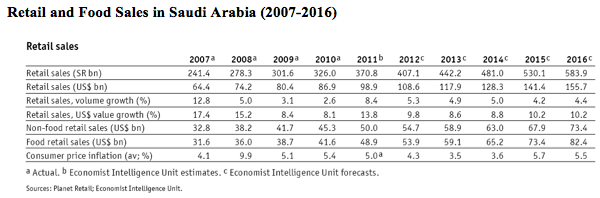
The Economist Intelligence Unit, or EIU, estimates that the volume of spending on food, beverages and tobacco witnessed an increase of 11% in 2011, up to SAR 48.9 billion, or 46% of all consumption spending in 2011. This figure is expected to rise to SAR 82.4 billion by 2016.
According to a report by the Saudi Industrial Property Authority, or Modon, the kingdom set up its first factories in the food and beverages sector about 50 years ago. Two were for ice manufacturing, one in Mecca and the other in Jeddah, and one made soft drinks in Jeddah. In the next 30 years, the number of factories jumped to 43, spread over five geographic regions.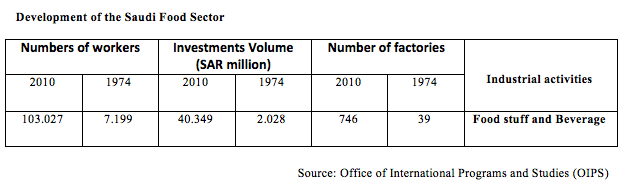
Badr bin Isa Al-Saadoun, CEO of Dar Juana Food in Saudi Arabia, said the volume of the restaurants market in Saudi Arabia is estimated at SAR 13 billion a year; fast food restaurants contribute by about 30%, while popular dishes restaurants contribute about 40%.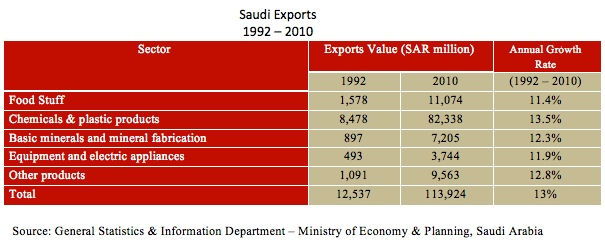
The food industry in the kingdom is distributed over 12 essential activities, the most important being the dairy industry and its products, followed by beverages manufacturing, fruits and vegetables packaging and wrapping, fish preservation, vegetable oils and animal fats manufacture, grain grinding, baking, sugar manufacturing and refining, animals and birds food, production and processing of meat, and the manufacturing of chocolates, sweets and candies, according to the Modon study.
According to the King Abdullah Institute for Research and Consulting Studies, Saudi Arabia has millions of acres of arable land, but lacks sources of fresh water. This forces the kingdom to maintain stocks of foodgrains in order to avoid any global disturbance in prices or production.
However, Al Ahli Capital believes the kingdom is still vulnerable to high food prices because of the heavy dependence on imports. Saudi Arabia will continue to rely on imports due to limited domestic production of crops due to water scarcity and lack of appropriate climatic conditions.
Any rise in global food prices would be a source of concern for Saudi food companies as a result of exposure and reliance on these basic materials. The impact of the recent rise in global food prices had a significant impact on the profitability of Saudi food companies.
Saudi Arabia imported 20 million tons of food in 2010, equivalent to 80% of the volume of food consumed, higher than the 15 million tons in 2006, according to the General Organization of Ports. According to research by NCB Capital, food and agricultural imports formed 15.8% of total imports, worth SAR 63 billion, in 2010. "The Saudi government has undertaken several initiatives to control inflation and ensure food security, but the global inflation and the recent weakness in the dollar pose a threat to domestic food prices," it said.
© Zawya 2012