The Saudi banking sector put up a strong performance in the first half of the year, driven by higher trading fees, strong lending and non-interest income, especially in the second quarter.
Collectively, the sector profits rose 3.4% quarter-on-quarter on the back of non-interest income which rose 25.7% during the same period.
However, deposit growth was poor, rising a mere 0.8%, while total asset grew by a mere 0.4% during the second quarter.
"A continuation of the low deposit growth seen during 2Q12 can restrain future lending growth, which in turn can also result in margin pressure, with banks possibly competing for greater deposit market share next year," noted SICO in a report. "This could lead to a rise in cost of deposits and funding. SABB, Samba and ANB were the only banks which reported deposit growth during the second quarter."
The less-than-stellar performance comes in an environment of excellent all-round growth. The Saudi economy grew 6.7% last year and is expected to post a strong 6% growth this year in the face of a global economic downturn, according to International Monetary Fund estimates.
During this time, the Saudi Government is also unveiled major expansion in public expenditure, as oil revenues continue to support growth. Close to USD700-billion worth of Saudi projects are under way and the government has also boosted consumer confidence by enforcing minimum wages and unemployment benefits.
The approval of the mortgage law in July 2012 is also expected to add a new revenue stream for banks, but it will take a while for its benefits to be realised.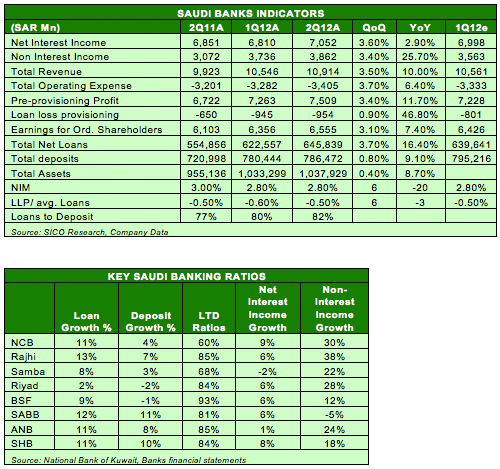
Here are the key takeaways from the banks' second quarter and first half performance:
1 RAJHI'S LENDING PROWESS
Rajhi Bank was the best performing Saudi banks in terms of loan growth with a 13% increase in the first half of the year. Meanwhile, at the other end of the spectrum Riyad Bank saw a paltry 2% growth.
"Going forward, we expect loan growth to remain high, driven by robust expenditures," notes a National Bank of Kuwait report.
2 RIYAD BANK'S DEPOSITING BLUES
Riyad Bank also fared the worst among Saudi banks in terms of deposit growth. The bank actually saw 2% contraction in deposits during the first half. Banque Saudi Fransi was the only other bank posting a contraction of 1%. Saudi Arabian British Bank (SABB) saw an 11% increase during the same period.
3 BSF'S LOAN-TO-DEPOSIT RATIO
All banks saw their loan-to-deposit ratios rise. Saudi Arabian Monetary Agency has a soft cap of 85% on LDRs. BSF's ratio is the highest among key Saudi banks, rising 93% during the first half. Meanwhile, National Commercial Bank saw its LDR rise to 60% - which is the lowest among Saudi banks.
4 RISING MORTGAGE EXPOSURE
Rajhi Bank has 36% of the country's small mortgage loans sector. The bank's has SAR10.53-billion in mortgages in its overall portfolio. The banks with the second highest exposure is Riyad Bank with SAR4.93-billion.
With the exception of Arab National Bank, all the other banks saw a substantial rise in their mortgage loan exposures. Saudi Hollandi Bank saw a four-gigit, 1,485.9% growth in 2011, admittedly from a very low base - the bank had a mere 0.8% of the mortgage market last year.
NCB, which has 7% of the market share saw its mortgage loans portfolio rise 147%, while BSF saw a 97.4% increase. Market leader Rajhi Bank also posted an impressive 46% growth last year.
5 EARNINGS FAIR TO MIDDLING
Most banks saw single-digit growth in net interest income in the first half, according to NBK estimates. "SAMBA was the only bank that witnessed a decline in net interest income (2%). In 2011, a common trend among the Saudi banks was generally flat net income as NIMs remain under pressure. However, we are slowly witnessed an improvement on that front as net interest income began to contribute positively to operating income growth in IH2012."
6 PROVISIONS ARE RISING
SICO's preliminary calculation show a significant 50% YoY increase in provisioning charges (up 50% YoY) for 2Q12, indicating possible asset quality deterioration for all Saudi banks.
"On the other hand Saudi banks' loan loss reserves, in our opinion, adequately cover their non-performing loans and we do not see any significant impact on profitability from a rise in provisioning expense."
7 RECOVERY UNDER WAY
The second quarter results show that Saudi banks profitability is recovering - 1H2012 annualised ROE rose to 16.1% from 14.5% in 2011 - while earning drivers are turning positive.
"We maintain our favourable view of Saudi banks and see strong re-rating potential. We highlight Samba, BSF and ANB as our top picks in the sector," said Murad Ansari, analyst at EFG-Hermes.
8 CONSUMER FINANCE ON GROWTH PATH
Bank Muscat data shows that retail credit grew at 18% year-on-year, although its sequentially slowing after a sharp run up in Q4'11.
"Relatively, the corporate credit expanded c11% during the same period," said M. Palaniappan, an analyst at Bank Muscat. "Our discussions with the Saudi banks indicate a growing demand for retail credit. Reiterating our view expressed in our initiation report, we maintain our positive view on the consumer credit demand as it moves into a structural growth phase backed by young demographics, rising income levels, job security and increasing Saudisation undertone and renewed focus of banks on this high yielding segment.
Retail credit accounts for nearly 28% of the total credit as of March 2012 and Bank Muscat believes the retail composition has a greater potential to expand given the relatively under penetrated consumer loan segment to GDP at close to 13% compared to GCC average of 22%.
9 LOW OIL PRICES COULD POSE RISK
The Saudi economy's fine run may come to an end if oil prices fall dramatically over the next few months. Worries about the EU crisis, emerging market slowdown and U.S. economic lethargy may push prices down due to lack of demand
"This could be the major downside risk to our estimates. However, given the huge accumulated surpluses, the low debt levels and the Government's committed stimulus package, we opine the long-term impact could be minimal," said Bank Muscat's Palaniappan . "On the other hand, possible deleveraging by some of the European banks, out of their total Saudi exposure of USD53-billion as of Mar'12 could open up opportunities for the existing local banks, though most of the banks are non-committal on this."
10 RAJHI'S PERFORMANCE
Al Rajhi's second quarter earnings of SAR2,093-million beat analyst expectation, even though net interest income rose by a mere 0.7% Q-o-Q, suggesting pressure on net interest spreads has sustained.
"However, the main surprise came from non-interest income, which was broadly stable Q-o-Q against our expectation of a decline on lower broking income," noted EFG-Hermes in a report. "Though loan and earnings growth are ahead of expectations, we remain concerned about pressure on net interest spreads and higher provisioning costs."
12 RIYAD BANK'S SME FOCUS
Even though Riyad Bank expanded its branch network, lending grew a modest 1.5% during the second quarter.
"Our calculations suggest a sharp rise in the bank's provisioning charges, as it looks to expand its business into the more lucrative SME and retail segment," said SICO in a report. "Riyad Bank benefitted from a strong 21% QoQ growth in non-interest income. We believe this is more sustainable, as it is primarily driven by off-balance sheet (Letters of credit, guarantees, etc) related activities, unlike its peers who are more dependent on more volatile stock market related activities."
13 SMALLER BANKS FARE WELL
Bank Al Jazira and Bank Al Bilad, the smaller Saudi banks, also posted good results.
Bank Al Bilad's higher non-interest income (3% of balance sheet) and lower cost of risk contributes to a return on asset of 2.1%. The bank's bottomline was boosted by retail and remittance business which rose 53% in the first half of the year.
"Remittance fee remains the key driver contributing more than c50% of the ROA, not a risk due to its sticky nature (unlike Bank Jazira) and offers scope for further ROA improvement as operations mature and trend towards industry averages," notes Bank Muscat, adding that the bank's lower loan-to-deposit of 69% offers scope for balance sheet growth.
Meanwhile, Bank Al Jazira's credit portfolio rose 17% in the first half of the year.
"However, brokerage leadership and increased trading volumes in the first half of the year contributed to higher non-interest income but lend volatility to the numbers and masks a poor core ROA (largely due to lower NIMs) relative to Bilad despite having a higher credit book," notes Bank Muscat.
CONCLUSION
In a strong operating environment, the Saudi banking sector has managed to repair its balance sheet in the aftermath of the global financial crisis of 2008, but the best appears to be yet to come unless a new global meltdown breaks the momentum. The new mortgage law would certainly help the banks build a new business, and rising trading volumes on the exchange could be the major boosters for the remainder of the year.
© alifarabia.com 2012