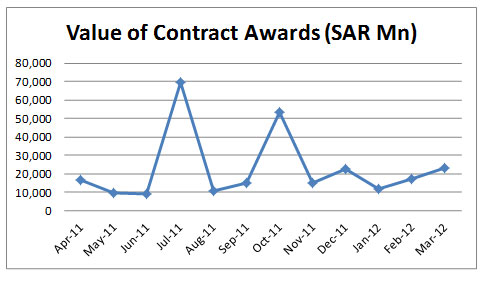
Saudi Arabia appears to be announcing construction contracts in an incredibly hurry. The Kingdom saw more than SAR52-billion worth of contracts announced in the first quarter of the year, compared to just over SAR49-billion during the same period last year, according to data from NCB Capital.
The first quarter came on the back of a strong 2011 when Saudi public and private sector announced contracts worth USD270-billion, as the Kingdom targets job creation and the improvement of the country's infrastructure.
Since 2008, Saudi Arabia has seen nearly SAR750-billion worth of contracts announced spread across all the key sectors of the economy.
After a brief period of uncertainty during the global financial crisis when SAR111-billion worth of projects were awarded in 2008, Saudi contracts picked up in 2009 with SAR207-billion, largely driven by the oil and gas and power sector.
The year 2010 once again saw a lull with SAR106-billion worth of contracts awarded, but the market roared back to life in 2011 with an astonishing SAR270-billion worth of contracts, NCB Capital data shows.
More importantly, the contracts were spread across a number of sectors including transportation, healthcare, residential and water, and not just the traditional oil and gas sector.
The first quarter started in a similar vein with power (18%), industrial (15%), residential real estate (11%), petrochemicals (10%) and education (10%) emerging as the main areas of focus, largely driven by investments by the public sector.
Indeed, government spending will remain the main stimulus to the economy, especially as oil prices have enjoyed a healthy run for the past few years.
"Our impression is that progress on awarding contracts and project implementation has been stepped up, major new projects have been launched recently and business surveys paint a generally strong picture," said Paul Gamble, head of research at Jadwa Investments. "This is in line with our expectations and we have not altered our forecast for non-oil growth, but the increase to our projection for oil production means we have raised our target for total real GDP growth to 5.1%."
Other investment banks are even more bullish. Citibank recently raised the Kingdom's GDP growth forecast to 7.1% in 2012, from 5.9% previously.
"Combined with the fact that we have raised our price estimate for Brent to US$124 per barrel this year, the surge in production will result in record revenues for the Saudi government," noted Citibank analyst Farouk Soussa.
"We estimate expenditures will once again overshoot budget (although will remain lower than 2011 levels due to the one-off nature of many such expenditures), but the net result will be a budget surplus in excess of 20% of GDP in 2012, up from just under 14% in 2011. We believe growth in the non-oil economy will remain strong, around 8.5%, on the back of continued high government expenditure and increased domestic demand."
It will be interesting to see the impact of the construction spree in key support sectors, raw materials and demand for labour.
Much of the civil construction in Saudi Arabia is handled by local contractors, such as Bin Laden and Saudi Oger, which then subcontract a good proportion to smaller players.
"The construction/contracting sector is therefore an important nexus between government spending and the non-oil economy," wrote Andrew Gilmour, senior economist at SAMBA.
"The sector should continue to thrive this year and next given the pipeline of major industrial projects (especially in the petrochemicals and refining sector) as well as the housing sector, which has become a political priority for the government."
The growth also represents significant opportunities for regional players like Arabtec Holding and Drake & Scull International, which are eager to diversify away from their home base of Dubai and focus on regional markets. Saudi Arabia has emerged as the most lucrative low-hanging fruit with plenty of opportunities ripe for the picking.
POWER PLAY
Investments in the power sector is a trend that has gathered momentum in the past few years, and the first quarter was no different as the sector attracted the greatest number of dollars, accounting for nearly USD9.5-billion worth of contracts.
The continued focus on the power sector is partly to offset an underinvestment in the overall energy sector for years.
"Long‐standing underinvestment in this sector has caused shortfalls in electricity supply and led to serious economic bottlenecks and social frustrations," said Ali Aissaoui, Senior Consultant at APICORP.
Much of the growth was driven by the Saudi Electricity Company (SEC) which has a mandate to invest between USD29 billion to USD41 billion from 2012 to 2014, although some of this capital expenditure is expected to be discretionary.
SEC has one of the region's most significant capital investment programme, especially as the Kingdom's expecting a 25% growth in generation capacity over the next four years.
The company has been utilising interest-free long-term loans from the Saudi government and on capital market debt issuances to address funding needs. Since 2007, SEC has issued USD5.2 billion worth of sukuks and has benefited from two USD8.2 billion, 25-year interest-free soft loans from the Saudi government, with a further material USD13.9 billion line granted in 2011.
It has deployed these funds to good use. Some of the key power contracts awarded in the quarter included:
* An SAR680-million contract to Al-Toukhi Company for Industry & Trading to construct an oil and gas power plant and supporting power generation to the areas of Wadi Al-Dawasir, Sharura and Najran, in the Riyadh region. The contract is set to be completed within 24 months.
* An SAR480-million contract to National Contracting Company to build two power plants in the Tabuk region. The first plant will have a capacity of 120 MW and the second 180 MW. Both are expected to be completed by the third quarter of 2013.
* An SAR940-million contract to ABB to build substations across the Kingdom. ABB will design, supply, install and commission the new substations including the supply of key equipment such as gas-insulated switchgear (GIS), transformers, shunt reactors and capacitor banks.
Apicorp expects the investment in the power sector to continue, especially as Saudi Arabia is still in a 'lift-off phase.'
"To be sure, future growth may take a more efficient and less intensive path," said Apicorp's Aissaoui. "But this depends on promoting demand‐side management (DSM) and eliminating electricity tariff subsidies, both of which will be hard to achieve in the medium term."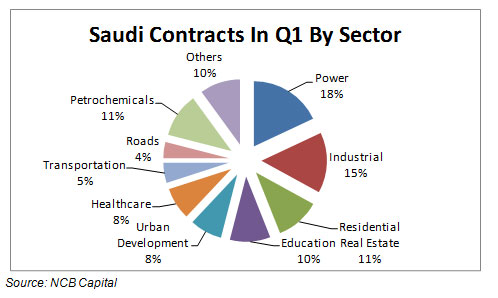
RISE OF REAL ESTATE
Real estate was a cornerstone of King Abdullah Bin Abdul Aziz Al Saudi's USD130-billion investment pledge last year, and that's reflected in recent awards.
NCB data shows residential real estate made up a quarter of the contracts awarded in February alone.
"As part of the King's Royal Decree to spend SAR250-billion on 500,000 homes across the Kingdom, the government has stepped up the construction of housing projects to meet pent up demand during the first quarter," said NCB Capital in a report.
"The Ministry of Housing awarded a SAR638 million contract to Mohammed Ali Al Swailem Group (MASCO) for the development of 1,236 residential units in the Al Dawadmi area in Riyadh. The development is expected to also have schools and mosques along with associated facilities. The project is expected to be completed by the first quarter of 2015."
The first phase of Saudi Arabia's major real estate project to build 500,000 units across the country is currently in design stage, according to Zawya Projects Monitor data.
The first phase comprises 11 projects across the country to construct a combined total of 25,000 to 30,000 units spread across 32 million square metres. The design phase is expected to be completed by the third quarter, Zawya Projects Monitor data shows.
Education-related construction projects are also expected to gain momentum especially after the Kingdom announced USD21.5 billion investment plan to build 328 colleges, 161 infrastructure projects and thousands of housing units for faculty members and staff.
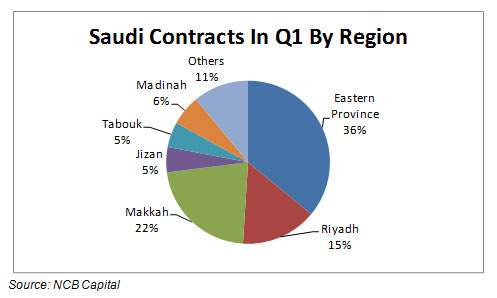
Regionally, the oil and gas stronghold of Eastern Province saw the lion's share of development, with 36% of all contracts awarded in the province in the first quarter.
But Makkah province also attracted 22% of the projects, as the government focused on urban development and the construction of affordable housing in Jeddah, which has been ravaged by floods in recent years.
CONCLUSION
Barring a geopolitical catastrophe and/or a substantial and sustained drop in crude prices, expect the construction momentum to continue.
"The value of awarded contracts during Q1'12 signals that 2012 is off to a rapid start as heavy spending across most of the sectors has led to an impressive beginning to the year," said NCB Capital.
Given the government's plan to increase capital expenditure for 2012, the Saudi bank anticipates the flow of awarded contracts to remain undisturbed as the demands for improved infrastructure still remains a priority.
"Additionally, the Kingdom's strategic goals to develop its non-oil sector will likely encourage heavy investments into the hospitality."
It will be interesting to see how the local and regional contractors cope with the rising demand and whether it leads to cost inflation as the rise in contracts puts pressure on raw materials such as cement, steel and aluminium and labour.
ALSO READ: KSA's USD21 billion education push
Regional Projects Outlook: Dubai Beats Abu Dhabi
Saudi Arabia's Jobless Growth
Gulf States' USD29-billion Power Bill
© alifarabia.com 2012