Iran's crude export earnings were down USD33 billion last year compared to 2011, according to estimates by The Rhodium Group.
The Washington-based think tank closely tracks Iran's economic and political developments and believes that Western sanctions against the country have significantly reduced the country's ability to export crude and generate market prices for its commodity.
"Assuming Iran was able to sell every barrel at the Official Selling Price (OSP) posted by the state oil company National Iranian Oil Company, export earnings were down USD33 billion last year," wrote Rhodium analyst Trevor Houser in a new report. "While a 35% decline from 2011 levels, historically high oil prices meant 2012 was still Tehran's third best year in recent history, despite a nearly 1 million barrels per day decline in export quantity."
However, payment delays and discounts, in addition to rising production costs and government revenue needs, means that as much as USD65 billion worth of invoices were not fully paid and kept balance of payments depressed.
"By the end of the third quarter the market value of the [Iranian] rial had fallen by two-thirds, prompting merchants to take to the streets in protest."
OPEC's latest report also notes that Iran's crude oil production fell to an average of 2.66 million barrels per day in the fourth quarter of 2012, compared to 3.6 million bpd in 2011.
Given the drop in revenues and weak tax receipts, the government is expected to tighten its fiscal stance, as the economy contracts again in fiscal year 2013/14 and posts anaemic growth in 2014-17, says the Economist Intelligence Unit.
"Iran's fiscal position is heavily reliant on oil earnings (which are estimated to account for around 50% of its fiscal revenue), and the sharp decline in export volumes in 2012/13 will have contributed to a substantial worsening of the public finances."
"Parliament has in effect blocked the next round of the subsidy removal programme initiated by the president at end-2010, but it is unclear whether it will reinstate the subsidies that were abolished (and replaced with cash handouts)," said the EIU."
The country's official net fiscal deficit is also forecast to widen from 5.2% of GDP in 2012/13 to 5.8% of GDP in 2013/14, if Tehran is unable to negotiate a deal with Western governments on it controversial nuclear programme.
In addition, the International Monetary Fund also expects the country's inflation rate to rise as a result of a fast depreciation of Iran's currency and sanctions-related increases in the cost of doing business.
The economic hardship comes at a time when President Ahmedinajd completes his second term, and is widely expected to be replaced with a more pliable candidate.
"We do not expect a repeat of the level of political discontent witnessed after Mr Ahmadinejad's re-election in 2009, as the conservative establishment around Ayatollah Khamenei will stage-manage the candidate vetting process much more closely." The EIU noted.
However, the country's political problems will not disappear with Mr. Ahmeinjad's departure.
The EIU believes the new president will be required to consolidate spending further in the face of weak revenues. That may be a politically tricky manoeuvre, especially as Iranians are dismayed by the country's economic decline.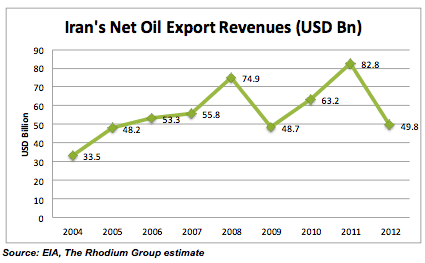
EVADING SANCTIONS
Some analysts think Iran is finding ways to avoid sanctions. Ayatollah Khamenei's rejection of talks with the United States also suggests that the Iranian regime may have a lot more staying power than Western analysts would like to believe.
In addition, U.S. President Obama's appointment of a number of potentially "dovish" politicians to key posts has stoked speculation that the new administration will take a softer tone towards Iran, notes Tom Pugh, analyst with Capital Economics.
"However, the White House is unlikely to ease the pressure on Iran too much, if only to prevent Israel from taking matters into its own hands.
The most recent sanctions, implemented recently and designed to prevent Iran repatriating any of its oil funds, essentially reducing it to barter terms with its customers, are further evidence that Mr. Obama has no intention of backing down, says the CE analyst.
But as the Middle East tensions add USD10-15 premium on a barrel of Brent crude, Iran's key customers are also looking to resume their crude imports.
China, India and Japan all reportedly increased imports from Iran in December.
"The recent purchase of tanker ships from China has also significantly boosted Iran's ability to deliver its oil. Iran exported around 2.2 million barrels of oil per day (bpd) at the end of 2011," notes Mr. Pugh. "Western sanctions then reduced this to a low of around 0.9 million bpd in September last year. But Iranian oil exports jumped to around 1.4 million bpd in December."
In addition, the European Court of Justice has also rejected EU sanctions against Iranian banks, making it easier for Tehran to process oil payments.
Despite the grandstanding, some analysts believe a deal between Iran and the United States may be in sight.
"It is not difficult to imagine a deal being done after the elections whereby Iran would accept some international supervision of its nuclear programme and limits on uranium enrichment in return for technical assistance and the easing of sanctions," said Mr. Pugh.
Others, like Mr Houser expects Washington to exert pressure on Tehran, especially in light of new sanctions that prevent countries that import Iranian crude from paying for the oil using hard currency.
"Instead, the money must be kept in an escrow account inside the consuming country which Iranian importers can tap to buy goods and services. This will significantly increase the macroeconomic stress imposed by the sanctions, will leave Iran short of a wide range of goods and services Iranian's expect, and raises the odds of a balance of payments crisis this year."
© alifarabia.com 2013