March witnesses just enough sukuk deals and announcements to maintain confidence despite MENA mayhem, writes Adnan Halawi
March was no different from the previous months as it was characterized by a fair amount of sukuk issued globally; the dominance of Malaysia geographically; sovereign issuers leading the market; new entrants shyly testing the market; and an absence of international, USD and listed sukuk.
However, the month witnessed the issuance and announcement of enough sukuk to keep observers, analysts and believers in Islamic finance optimistic about a bright future for this niche market.
The continued political unrest in various parts of the Middle East and North Africa has nonetheless pushed potential issuers to postpone their plans to enter the Islamic debt capital market. Even some regulators have shelved plans to speed up the tax breaks on sukuk.
MENA announcements make up for postponed deals
Perhaps the most interesting deal came out of Saudi Arabia when the Islamic lender Bank Al Jazira closed an SAR1 billion sukuk toward the end of the month, marking the first corporate sukuk out of the Kingdom so far this year.
The issue, which was met by huge investor demand and was oversubscribed four times, came in line with our expectations that Saudi issuers - along with issuers from Qatar and UAE - will most likely make up for the slowdown in sukuk issues out of the Gulf as opposed to continued predominance of Asia Pacific issuers like Malaysia.
Sukuk issuance from the GCC in the first quarter of 2011 was, however, poor and below expectations. Again, this comes as no surprise as the region witnesses one revolution after another. Bahrain, which is historically a major issuer of sukuk both on corporate and sovereign levels, has not seen any major deal thus far this year and will probably not see any for some time given the disturbed situation.
Yemen, which joined the club of sukuk issuers in February with a small USD18.5 million offering, is also experiencing a revolution and its plans to issue up to USD500 million by the end of 2011 are now unlikely to come to fruition.
But March saw some interesting announcements come out of the MENA region when shareholders of Masraf Al Rayan, Qatar's fourth-largest lender, approved the raising of USD1 billion from international markets by selling sukuk. This followed a similar announcement by Qatar International Islamic Bank in February.
Qatar Exchange, the Doha-based bourse, said it will introduce government bonds and sukuk for trading as part of its continuous expansion to support the investor community. Analysts acknowledged this as a very significant development that will shortly be followed by listing of corporate sukuk and bonds on Qatar Exchange.
Saudi International Petrochemical Company (Sipchem) said it is still on track to issue sukuk worth at least SAR1.5 billion (USD400 million) this year.
From the UAE, Sharjah Islamic Bank, a previous issuer of sukuk, said it is considering issuing non-transferrable long-term sukuk while an Abu Dhabi government official was quoted as saying it may find it cheaper to borrow through sukuk rather than conventional bonds and might sell as much as USD1.5 billion of sukuk this year.
March announcements included Morocco's central bank head unveiling that the bank is in talks with the country's banking industry group GPBM on regulations that would allow sukuk issues.
Last but not least, it is worth noting that Iran finally seems to be joining the club of sukuk issuers. It was repeatedly reported in the press that the oil ministry plans to issue sukuk which can be subscribed to for the first time by the littoral Gulf states and Middle East countries.
Malaysia and Asia
While the MENA region saw mixed signals in March, the Asia Pacific region continued to be upbeat. Malaysia's government, through the Bank Negara Malaysia, issued the second tranche of its Government Investment Issue in 2011 with MYR4 billion (USD1.3 billion) which is of Bai Bithaman Ajil (BBA) structure. The government also launched a new program called Bank Negara IDA Sukuk also of BBA structure and kickstarted the program by issuing a small tranche of MYR250 million on March 31.
The Malaysian government seems to be still convinced about issuing sukuk using the BBA structure, which is not shariah-compliant according to GCC standards, as long as the issue is targeted toward domestic investors.
The government said it may sell sukuk to fund its single biggest development project, a MYR48 billion (USD15.8 billion) commuter rail network in the capital, part of Prime Minister Najib Razak's USD444 billion 10-year initiative to spur investment and growth.
Major corporate issues out of Malaysia included Maybank's Tier 2 Capital Islamic subordinated MYR1 billion (USD330 billion) program issued in full - the largest of its kind to date - and Bank Pembangunan's MYR1 billion program launched in March and a small tranche of which was issued.
Pakistan issued a PKR47.54 (USD555million) trillion ijara sukuk, its first this year, while Indonesia raised in auctions on March 1 and 15 a total of USD288 million in SBSN sukuk. More interestingly, Indonesia - home to the world's largest Muslim population - unveiled plans to issue Islamic treasury bills maturing in three, six, and 12 months in the second quarter to help deepen its domestic financial market. The Islamic Treasury bill issuance would be the country's first, and would add a short-term debt instrument to the domestic market.
Data compiled by Zawya Sukuk Monitor showed USD6.2 billion of sukuk were issued globally in March, taking the total of sukuk issued in Q1 2011 to an all-time high of USD27 billion, including USD9 billion in domestic sukuk by the Qatar government in January.
The quarter saw new market entrants including Yemen, Iran and a comeback of Kuwaiti issuers and big announcements just enough to keep the year ahead exciting and worth anticipating.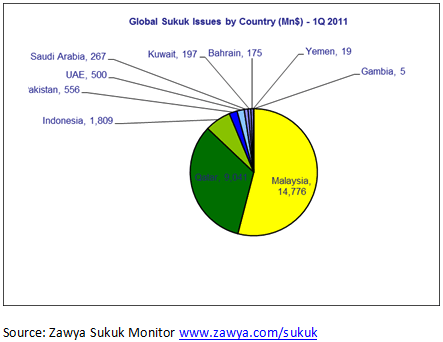
Adnan Halawi
Team Leader - Fixed Income
ahalawi@zawya.com
Zawya Select 2011