During Ramadan, the Arab markets witness a significant recovery of the consumer sector in general, and the food sector in particular. In contrast, most of the other sectors experience a significant decline as well as volatility in the shares of some companies, due to the fact that the month of Ramadan coincides with the summer vacation on the one hand, and the decline of activities of most businesses on the other, especially in the Gulf region.
According to some economic studies, data analysis and experts' expectations, Saudi Arabia is expected to spend around SAR 25 billion (USD 6.66 billion) on food commodities during Ramadan and Eid al-Fitr 2012, compared to SAR 10 billion in 2011.
Egypt will spend nearly USD 5 billion during Ramadan, compared to USD 3 billion in 2011. UAE will spend USD 1.9 billion, compared to USD 1.1 billion last year, while Qatar will spend around USD 700 million this year, compared to USD 495.5 million in 2011.
Expected Spend on Food Commodities during Ramadan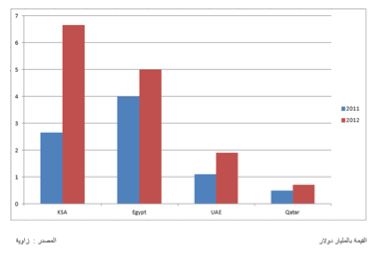
Source: Zawya.com
Saudi Arabia
Meteb Al Saraj, Secretary General of the Chamber of Commerce and Industry in the Northern Province, believes that most sectors' activities are suspended during Ramadan, except for the consumer sector that witnesses a great development, as the numbers of pilgrims and visitors to the House of God increase during this holy month, leading to the rise of the demand for food and consumption by more than 25%.
According to some economic studies, the commercial activity in the Saudi market is expected to increase during Ramadan by 30% of the overall commercial activity during the rest of the months, as it accounted for around SAR 60 billion (USD 16 billion) during the past few years. KSA is expected to spend around SAR 25 billion on consumer goods in Ramadan. This is not only limited to Saudis, but includes as well the visitors to the House of God.
The sales volume of food commodities increases by 7% during Ramadan, year after year, due to the population growth in the country.
Al Saraj confirmed that the prices of gold are also expected to increase during Ramadan, as the pilgrims tend to purchase gold items, leading to the revival of the gold market.
According to a report issued by the Saudi Ministry of Commerce and Industry, the Saudi markets started to witness some increase in the demand for food commodities during the days preceding Ramadan, around three times higher than the ordinary days. The average purchase rate per individual in Ramadan is expected to increase from SAR 100 to 500 per day. The report stated that there is some increase as well in the fabrics and readymade garments market activity, in preparation for Eid al-Fitr, as some merchants expected an increase in the volume of sales during Ramadan from 40% to 50%.
Jeddah Chamber of Commerce and Industry pointed out that the consumption of sweets increases in Ramadan. Furthermore, it confirmed that the size of the Saudi sweets market exceeds SAR 1.5 billion per year and the medical field in Ramadan increases by 80% compared to the other months of the year.
Some experts and economists stated that Saudis spend around SAR 100 million on chocolate during Ramadan only, i.e. they consume around 200 tons of chocolate. They also revealed that the Saudi market is at the top of the Arab markets in the consumption of sweets and chocolate during occasions and holidays.
Abdullah Balsharaf, Vice President of the Riyadh Chamber of Commerce and Industry's Food Security Committee, expected an increase in the prices of commodities during Ramadan between 20% and 25%. He pointed out that after Ramadan, the increase rates in the prices of the domestic market and the effect of foreign markets from which they import, become clearer.
Riyadh Chamber of Commerce and Industry noted in a report on the consumption of food commodities during Ramadan, that the intensive purchase of consumer goods is considered natural during the holy month of Ramadan in all the Islamic countries in general, and KSA in particular. The volume of expenditure on food and beverages during the past year reached around SAR 1 billion and it is expected to increase, compared to last year.
According to a report issued by Global Investment House, the Gulf stock markets witnessed a dramatic decline during May 2012 and some Gulf markets are expected to decrease during the summer months and the holy month of Ramadan.
Egypt
Dr. Hamdi Abdel Azim, the former Head of Sadat Academy for Management Sciences, noted that some studies confirmed that the Egyptians spend EGP 1 billion per day on food during Ramadan, i.e. more than EGP 30 billion (USD 4.94 billion) in the whole month. This figure is real as the banquets in Ramadan increase tremendously and are expected to reach 16,000 compared to 15,000 last year. The public banquets for Iftar in the streets and public places are unique in Egypt and unlike other Arab and Islamic countries.
The Information and Decision Support Center of the Egyptian Cabinet confirmed in last year's report that the Egyptian family spends 44.9% of its total annual expenditure on food. Economic experts expect that this figure will double in the coming years, especially within the poor and medium families, because of the sharp increase of food commodities' prices in Egypt.
The Egyptian consumer compounds' companies, namely the Nile, Pyramids, Alexandria and Egyptian Company for Wholesale Trade, in addition to Egyptian Company for Poultry and Meat and El Masreya for Fish Marketing Company, started to offer their products for Ramadan in all their branches throughout Egypt, amounting to 4,300 branches, in addition to 1,000 tons of frozen red meat.
According to the plan developed by the Food Industries Holding Company, the Government contracted to purchase 750 tons of Kamaruddin, 250 tons more than the same period last year. The quantities of other commodities remained unchanged compared to last year, as it contracted to purchase 500 tons of dried raisins, a minimum of 140 tons of dates of all types, 60 tons of peanuts, 100 tons of dried figs, 150 tons of grated coconut, 30 tons of nuts, 60 tons of mhamshah (apricot), 50 tons of prune, in addition to 150,000 tons of sugar in its different forms.
The compounds' companies offered 10,000 tons of flour, 4,500 tons of rice in its different forms, along with the sales surplus of the consumer compounds' companies before Ramadan, and allocated 5,500 tons of pasta, 1,000 tons of starch, 25,000 packs of natural margarine and natural butter of 1 kg and 2 kg packs, 500,000 packs of vegetable ghee, 350,000 packs of edible oils of all types, 45,000 packs of various tomato sauces, 35,000 packs of juices of various types and sizes, and 10,000 packs of canned food.
A study conducted by Egypt's National Center for Social Research confirmed that during Ramadan, 83% of Egyptian families change their dietary habits, pointing out that the expenditure rate is double. For example, the sweets consumption rate rises to around 5.66%, the consumption of meat and poultry reaches around 63%, in addition to two other changes in the dietary habits, i.e. the increase of nuts' consumption by around 25%, compared to the rates of the other months of the year.
This extravagance and increase in the food expenses during Ramadan entail an increase of the waste percentage in the Egyptian banquets to reach 60%, exceeding 75% in family banquets. These huge quantities are often not consumed, which means that this impacts the national economy negatively.
UAE
A study conducted by Business Monitor International last year confirmed that the UAE spent AED 28.3 billion on food products all over last year and the expenditure volume is expected to reach AED 7 billion (USD 1.9 billion) during Ramadan.
Dr. Hashim Al Nuaimi, Director of the Consumer Protection Department at the UAE Ministry of Economy, stressed on the importance of providing the Ministry of Economy with weekly reports concerning the prices of commodities, in order to verify that there is no unjustified increase of the prices. This surveillance will last throughout the year and not only during the holy month, especially after the increase of the prices by 10% and 15% to 80% for vegetables and fruits.
It was also agreed to respond to the merchants' demands and facilitate the entry of fruits and vegetables through the customs and speed up the health examination at the State's laboratories to avoid any shortage in the necessary consumer goods due to the high demand during Ramadan.
Mufid Al Kaheel, a businessman in Abu Dhabi, believes that the expenditure growth rate in Ramadan is revived compared with the rest of the year, especially during the second half and with the approaching holiday, where the sales increase by more than 60% of the average sales rates on normal days.
Qatar
Hussain Al Marikhi, the Qatari economic analyst, said that the nature and pattern of life change during the month of Ramadan, imposing radical changes on the usual activity of the various economic sectors forming the local Qatari market and any other market in the region.
He added that stagnation affects the real estate and stock sectors during Ramadan as most people distance themselves from working in these two sectors at that time.
According to the Qatari businessman, Ahmed Hussain Al Khalaf, an investor in the food sector, the level of expenditure, consumption and demand for food products increases by 200% during Ramadan, compared to the other months.
Al Khalaf estimated the expenditure volume of Qatar's consumers on food products only during Ramadan, at around QAR 1.8 billion (USD 494.5 million) last year, compared to QAR 600 million (USD 164.8 million) for the other months of the year, with an expected increase of up to USD 700 million.
The real estate broker, Abdullah Al Nuaimi, believes that the performance of the real estate market and its transactions' size decline by more than 70% during Ramadan.
According to a weekly bulletin issued by the Real Estate Registration Department at the Ministry of Justice in Qatar, the average transaction volume (sale and purchase) of the real estate market ranges between QAR 1.5 and 3 billion (USD 412 to 724.1 million) per week. Al Nuaimi believes that Ramadan leads to the reduction of these figures to below SAR 300 or 200 million per week.
Close Correlation
Due to the close correlation between the real estate sector and the stock sector, the stagnation is also reflected on Qatar Exchange, in which the daily trading activity decreases from around QAR 300 million as an average during the ordinary days, to less than QAR 100 million in Ramadan, according to Saleh Al Jasman, one of the largest investors in Qatar Capital Market.
He added that sometimes the size of the stock market transactions in Ramadan is far less than QAR 100 million; and therefore, the decline rate compared with the other days of the year is more than 70%.
High Prices
In addition to Ramadan, the causes of high increase of consumption rates of food products in the Qatari market are attributed to the steady increase of the population, expatriates and labor force required by the mega projects that are being constructed currently inside the country.
Nasser Al Suwaidi, an investor in the import of food products, said that the local market daily consumption volume of meat, vegetables and fruits in particular, increases by over 200% sometimes during Ramadan, compared with the other months of the year. He added: "The Qatari market consumes around 200 tons of vegetables and fruits per ordinary day, and around 1,100 sheep."
He added that during Ramadan the consumption increases to reach 600 tons of vegetables and fruits and 3,300 sheep.
The per capita income in Qatar is the highest in the world, according to reports issued by the International Monetary Fund and the World Bank. It is around USD 90,000 per year, surpassing the per capita income in many advanced countries such as Finland, Norway and Luxembourg, but this rate does not apply to the wages of the expatriates in Qatar.
According to the most recent report issued by Qatar Central Bank, the volume of loans and credit facilities offered by the Qatari banks to the private sector until the end of May 2012, amounted to around QAR 233 billion (USD 64 billion), of which QAR 72 billion (USD 19.7 billion) are direct consumption loans. The total credit facilities provided to the real estate projects amounted to QAR 80.5 billion (USD 22.1 billion).
Mohamed Alkuwari, a Qatari investor in the real estate market believes that the real estate financing is declining significantly and sometimes at high rates during Ramadan, due to the reduced demand for market transactions. He pointed out that Ramadan is completely inappropriate to the performance nature of the real estate and stock sectors, which justifies the decline in the performance of these two sectors during this month. Ramadan became closely linked to the food sectors and specifically the direct consumption sector.
Alkuwari believes that some investors in the real estate and stock markets transfer a portion of their invested monies between both markets, according to certain data imposed by the conditions of each market. However, the performance of both sectors during the holy month is at its weakest levels; and therefore, there is no benefit from transferring the monies as both sectors suffer from recession and total absence of major transactions.
The following writers contributed to this report:
Fatima Jamali, UAE; Mona Ibrahim, KSA; and Ayman Younes, Egypt
© Zawya 2012