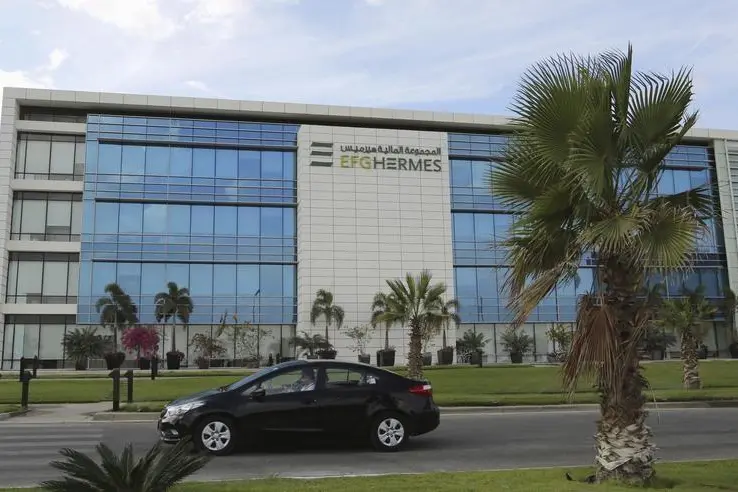
Hussein Choucri is the chairman and managing director of HC Securities and Investment, one of the country's leading financial services firms with operations in Egypt, the UAE, Syria and the UK.
Choucri established the company in 1996 as a small investment banking firm building on a wealth of experience he had gained while working as a managing director for Morgan Stanley in New York from 1987 until 1993.
Morgan Stanley then became a partner in HC with a 30% stake in 1998 and later the International Finance Corporation (IFC) came on board with another 10% in 1999. Choucri grew the company and today HC employs over 200 people and has assets under management valued at over LE 7 billion. Business Today had the opportunity to speak with Choucri who gave insight into the workings of his company and shared his views regarding the industry's and country's developments.
Q: Which of the company's lines of business is the biggest contributor to your bottom line? And which was the one most affected by the revolution?
Choucri: Having three lines of business, namely brokerage, investment banking and asset management, helps us to diversify our sources of revenue. I would say that typically each segment generates about a third of our bottom line. Sometimes that ratio would vary but never will any segment generate less than 20-25%.
In 2011, our brokerage business was the hardest hit. However, I believe the losses could have been much worse had we not been diversified in terms of instruments within the segment. Our company trades in stocks, treasury bills, Euro bonds and global depositary receipts (GDRs). So within the brokerage segment we have four sub-segments.
Q: In your opinion, do you think that the market suspension for six weeks with the onset of the revolution was a smart decision?
Choucri: The market suspension was much longer than needed. I was one of the advocates who called for the opening of the market as soon as was possible. The people who were demanding that the market remain closed were speculative investors who had bought into the market in the week of the January 25 protests. Those speculators were protesting in front of the Egyptian Exchange demanding it remained closed so that these trades are cancelled.
They were anticipating that as soon as the market opens it will crash and obviously it was a right assumption. If you saw the protests on the streets and you bought on the 26th it was your decision. It would be nice to have a market where you can make a decision and when proven wrong you say, 'I want to cancel the trade'.
So they were putting pressure on the regulator to create this impression of instability. I went to the regulators and told them you shouldn't listen to these people and should open the market as soon as possible. How do you think financial institution would react in the future to a country that simply closes its market and traps their capital? This was a mistake that could have cost Egypt a great deal of money and credibility. Markets can close for two or three days at the max, but definitely not six weeks.
Q: How would you characterize the trading behavior of investors after the reopening of the market? Can we characterize it as speculative?
Choucri: I wouldn't characterize trading now as speculative. It's a trading market and not an investment market and so transactions are very short term. It is also very difficult to trade as the market's moves are very sharp.
Q: I have been told that there is an unspoken agreement between the Central Bank of Egypt and asset managers to direct liquidity into the treasury bills' market. To what extent is this true and is it a main contributor to the low trading volumes in the equities market?
Choucri: This is not true. Asset managers like us have a mandate to invest in Egyptian pounds, all our funds are in Egyptian pounds.
Whenever there is non-utilized liquidity for example in the equity funds, we direct that to the treasury market because of the attractive yields.
And so we don't need someone to come and tell us to go buy treasury bills, we do it for the attractive yields. As for the fixed income and money market funds that we manage, the treasury bills and bonds are our first choice for investing this capital.
Q: There is a lot of attention from the media on the performance of the market and being used as an indicator of the state of the Egyptian economy. Losses are now reported in Egyptian pound figures instead of the usual percentage. How accurately does the market reflect the state of the Egyptian economy? And do you think that media coverage of the market shocks is a bit exaggerated?
Choucri: Obviously for the professional and the experienced investor the market behavior is anticipated and there are no surprises. When you have an economy depleting its foreign reserves and incurring an increasing budget deficit -- mind you we were the first to suggest that the deficit will reach 11% when the government was saying 8% -- its only natural to expect the market to reflect this deteriorating picture. I think the government media wants to direct attention to this economic problem; and by the way, rightly so, there are economic sirens all around us.
Q: There has been a recent announcement that short selling will soon be introduced to the market. Do you think that this is the right time for a trading tool that speculates on bearish markets?
Choucri: You cannot have short selling in these market conditions. Shortselling needs a liquid market and one that is functioning properly. I'm for introducing it eventually because it is the natural evolution of any market, but right now the volumes and the situation don't help us. We need to get the market back on track, then we can talk about shortselling.
Q: How is your investment banking division faring this year? How many deals have you completed and how does that compare to 2010?
Choucri: Investment banking deals were not plenty this year, and there were no IPOs. Companies typically list on the market and raise capital when they think their shares are properly valued. If a company is undervalued by a great deal, then there is no incentive for managers to sell shares at these prices.
However, when you have turbulence and dislocation in the market, mergers, acquisitions and divestitures become a major product for investment banking firms. Problems of some become the opportunities of others, and whenever a company wants to divest, another will see it as an opportunity and that's what makes a market.
We have seen the acquisition of Electrolux by Olympic Group; and we finalized the deal between Saudi Arabia-based Savola Group which acquired 100% of two Egyptian pasta firms: Al Malika and Al Farasha for around LE 700 million. We have a pipeline of similar transactions of corporations that want to enter the Egyptian market. Others however see this as a time to reduce risk and take money off the table, so there are opposing views.
Q: What kind of policy or market reform would you like to see from future governments?
Choucri: We don't need reforms as such; however you can make improvements to facilitate the functions of markets as a primary source of capital. The day-to-day trading of the market is fine and the basics are there. As far as the regulators are concerned, they need to be more vigilant and catch wrongdoers. They must take action and interfere more promptly; sometimes decisions are made later rather than sooner to correct certain actions.
I would say we don't need major reform but only better management. Perhaps facilitate IPOs and listings in order to encourage companies to enter into the market.
Q: How do you see the political situation developing in 2012 and in your opinion are we in a better place now than we were in say April of last year?
Choucri: I think things are going to get better, and we are definitely in a better position now than we were in April. Even though political progress did not go as many people wished, I for one was an advocate of putting a constitution in place first. We have to look forward and move on.
The results of the elections are not surprising; the fact that the Freedom and Justice party won most seats was expected. They are the only party that had regular contact with the people and actually visited their constituencies regularly and offered social assistance. They worked for it and so their wins did not come by coincidence.
What was surprising was the seats won by the Salafist party, however I don't think they'll have that much of an effect. They have revealed much of their views that do not make them an attractive option for many, even those who are conservative. Ideally we would like to see a partnership of moderation between the Muslim Brotherhood and the liberals. This is not very different from what the Turks have done. The ruling party in Turkey is an Islamic party but it is also very liberal. Don't forget that the ruling party in Turkey did not invent new economic theories nor has it undertaken major initiatives; what it did was fight corruption and we have an opportunity to do the same.
Q: Do you think Egypt will witness strong economic growth once the political situation is settled?
Choucri: Once the political situation is settled we can have stronger economic growth compared to pre-revolution times. We will be on more better and more solid ground with less corruption and a social safety net that never used to exist. A partnership between the Brotherhood and the liberals can give us the best of both worlds: a free economic policy with an eye on social issues.
© Business Today Egypt 2012