Power projects worth $277-billion are under way in the GCC, according to estimates by Kuwait Financial Centre, or Markaz, of which $45 billion are expected to be completed by 2015.
The significant developments in the industry come at a time when Gulf governments have realised that if they continue with their present consumption patterns they will end up using their oil production to satisfy domestic demand at the expense of exporting the black gold.
The pressures on the Gulf's power sector are enormous: regional populations are rising at a fast clip and billions of dollars are being invested across the various parts of the regional economy that will require cooling, heating and electricity.
Overall, power demand is expected to grow at between 7% and 8% annually over the coming years, and the GCC countries are expected to spend US$45 billion until 2015 in order to add an additional 32,000 MW of capacity, says Markaz.
But heavy subsidies of electricity, power and water is also a major burden on Gulf states, and the authorities are keen to at least reduce the costs and gradually wean the populace off subsidised utilities.
To meet the needs and ease some pressure on finances, the Gulf states are fast switching to gas and alternative energies, including nuclear, wind and solar power projects to reduce domestic consumption of precious oil resources - at least in theory.
Almost all the Gulf states are planning to counter temporary and seasonal shortages of gas through LNG imports, mainly using new, less-costly floating regassification technologies.
SAUDI ARABIA: ENERGY NEEDS RISING
Despite 7.6 trillion cubic metre of proven gas reserves - the fourth largest in the world - Saudi Arabia is struggling to meet rapidly rising demand for gas in the petrochemical sector, for water desalination and power generation. According to estimates by the Economist Intelligence Unit, Saudi demand for gas has been rising at an average annual rate of 6.7% since 2000.
"Domestic demand from power plants that burn heavy crude oil directly is growing rapidly, averaging around 500,000 barrels/day (b/d), sharply up from around 200,000 b/d in 2002-07," says the Economist Intelligence Unit. "Electricity generation accounts for 25% of petroleum consumption, and this share is likely to rise slightly up to 2020, despite efforts to promote alternatives."
In response to worsening shortages of natural gas, the Saudi government decided in 2006 to halt the construction of new gas-fired power plants, shifting to oil for future generation needs.
Indeed, Saudi Aramco has shifted its focus to gas exploration and development, rather than oil to meet the rising domestic demand and freeing up oil for exports.
The Saudi Ministry of Water and Electricity estimates that demand for electricity will grow at an annual rate of 4.3% till 2023.
"To meet this, the kingdom will need to raise its power-generating capacity to an estimated 60,000 mw, or by an average of 3,000 mw a year. The government plans to boost installed power-generating capacity in conjunction with private investors," notes the EIU.
With the Saudi population is estimated to reach 31.69 million in 2015, additional pressure will be placed on energy intensive desalination plants for potable water, as well as on electricity.
To meet this rising demand, the Kingdom has increased the pace of development in a sector that serves as a foundation for the developments of the Kingdom's diverse needs including housing, industrial and the wider non-hydrocarbons economy.
"In 2010, total contract awards in the construction sector alone amounted to SAR107 billion, led by the power sector at SAR38 billion, followed by residential real estate," notes Jeddah-based National Commercial Bank in a report on the Kingdom's power sector.
"The pace of the project market has assumed even a faster rate in 2011. Total contract awards amounted to SAR179.5 billion up to 3Q, with the power sector accounting for 14% share."
Apart from the government's efforts to reserve oil production for reserves, NCB says that low tariffs are hurting the industry and leading to inefficiencies.
Another key challenge in Saudi Arabia is the large amount of funding required for SEC's projects and independent power projects (IPPs).
"The private sector's finance, operation and management of the Kingdom's power sector are considered essential if Saudi Arabia is to meet its demand requirements over the forecast period," states the NCB study.
"Banks face concentration risks, which may be over-come through syndication, as well as the risk of an asset-liability mismatch. Nonetheless, from a bankability perspective, the appetite in project finance is strong for the Saudi power sector, given the nature of the PPAs which are strengthened by the credit-worthiness of SEC as the off-taker."
The Kingdom is also tapping into alternative sources of energy, such as nuclear and solar power, as a means of providing a more sustainable portfolio of energy sources.
However, an ExxonMobil report estimates that 97% of all Middle East energy demand will be met by oil or gas, and that figure will fall a smidgen to 95% by 2040 - suggesting that nuclear, hydro and other renewables such as solar and wind will have limited take up in the region.
HOME USE
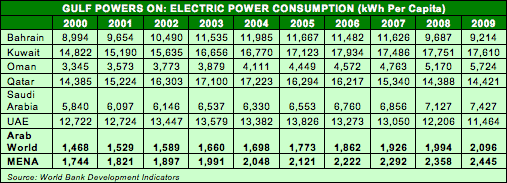
The GCC is one of the highest consumers of electricity per capita, which is largely due to a lack of awareness and subsidies that have fed a cavalier attitude towards energy.
In a matter of a few years, GCC residents may well be outright leaders in the per capita residential electricity use race, says consultancy Deloitte.
"In 2008, each person in the GCC countries consumed on average 9.650 TWh of electricity against a global average of 2.782 TWh and a Middle East average of
3.384 Twh. This consumption appears more reasonable when compared to the Europeans, North Americans, and the Japanese who respectively consumed on average 6.285, 13.985 and 8.063 TWh of electricity during 2008: but, some might say, only apparently," says a Deloitte report.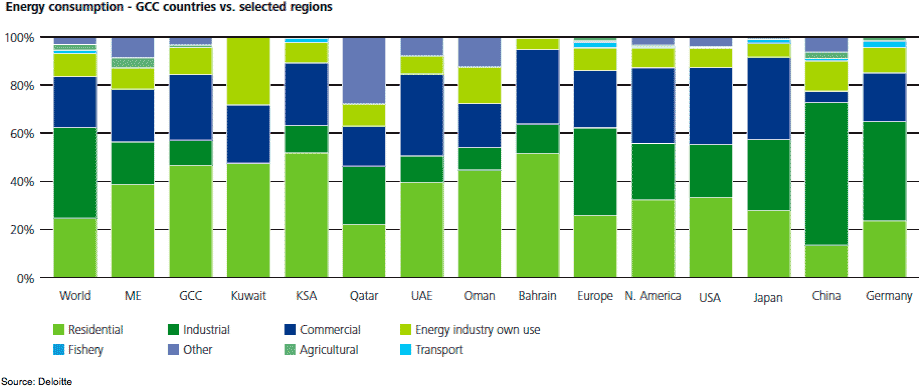
Click image to enlarge
STRAINED POWER INFRASTRUCTURE
In the UAE, electricity demand is expected to rise 5% each year till 2015, as rising populations make new demands on the strained power infrastructure, which is suffering due to heavily subsidised prices.
While Abu Dhabi has taken the independent water and power projects route, completing five developments, Dubai has only recently taken up the private sector path.
Some of the Dubai projects include the 1,600-megawatt Hassyan 1 indepdentne power project, apart from a USD550 million Jebel Ali M Desalination Plant, according to Zawya Projects Monitor. Meanwhile, a Hydogen Power Plant and a Solar Plant are on hold.
Meanwhile, a $20-billion nuclear power projects is also being planned in Abu Dhabi, but is unlikely to be ready by 2018, according to industry observers. Abu Dhabi's Masdar project, which aims to be carbon-free city when fully built is only slowly coming on line.
Many analysts believe the project is more of a showcase development rather than a project that would help the emirate reduce its carbon footprint in a meaningful way.
Meanwhile, Kuwait is also due to award a series of power projects, according to Citibank, with around six projects ranging from $70-90m each.
Kuwait's summer blackouts are well documented and the country's ministry of electricity is looking to expand power production by 50% in the next five years.
But the country is mired in political logjam and analysts are sceptical that the country can increase production levels any time soon.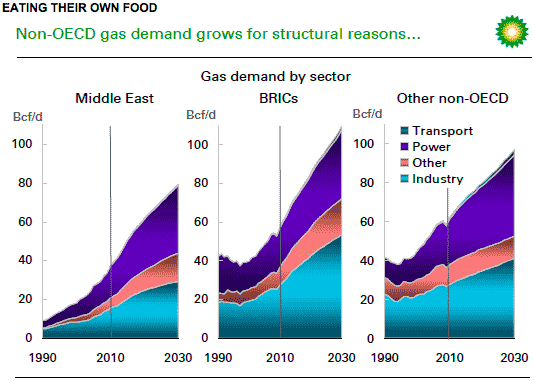
According to BP, Middle East demand for gas will grow by 3.9% each year till 2030.
"The power sector accounts for 44% of this growth as domestic gas and imports in some countries displace oil burning. Petrochemical industries are contributing to the projected 3.2% p.a. growth in industrial gas use," notes BP in its Energy Outlook 2030.
Indeed, the Middle East has the world's second largest production and consumption increments, the energy firm notes. "The region's share in global consumption is expected to expand from 5% in 1990 and 12% in 2010 to 17% in 2030. Its share in global production grows from 15% in 2010 to 19%."
According to investment bank Rasmala, that electricity generation in the region grew strongly by 6% during 2000-10 on average annually, and Qatar (+10%) and the UAE (+8.3%) also showed some of the highest growth rates globally.
"Gas has been the major source of fuel (almost 60%), but differs from country to country: 100% gas in Qatar, 80% in Egypt and, in the peak summer months, operators in the UAE have shifted to heavier fuels when not enough gas was available," notes Rasmala in a note on natural gas.
Rasmala notes down three major power-related developments in the region:
1 Saudi Electricity (SEC) has plans to increase power capacity from 48GW in 2010 to 80GW by 2020, or average growth of 5%, in line with the historical average of 5.4% for 2000-10. Of the five plants currently planned by SEC, a 1.2GW power plant in Rabigh will use oil as feedstock, two of the plants will use gas, whereas no decision has been made on the remaining two as yet. Of the existing power plants, about 40% use gas as a feedstock.
2 In the UAE, the power sector accounts for around 20% of gas consumed in Abu Dhabi and two-thirds in Dubai. According to consultants Wood Mackenzie, gas usage in the power sector will show a CAGR of 7.5% and 5% from 2010 to 2032 in Abu Dhabi and Dubai, respectively. Abu Dhabi has also looked into other forms of energy: in 2009, the emirate awarded US$40bn in contracts to build two nuclear plants and is making progress in solar energy.
3 In Egypt, the EIU expects growth of 7%. However, not all of the electricity generation will likely come from gas-powered plants: the Supreme Energy Council in Egypt aims to increase the share of renewable energy to 20% of total energy generated by 2020 (hydro power 8%, wind and other resources 12%).
The three countries above will have the greatest activity over the next few years, to meet more pronounced economic activity and rising populations.
Markaz notes that the first wave of major power projects, at least in the GCC, are online with installed capacity doubling from nearly 46,600 MW in 2002 to almost 98,000 MW in 2009: a CAGR of 10%.
The year 2009 saw a massive 23% increase in capacity as several plants in Qatar and Saudi Arabia started operations. Currently, the GCC operates with a reserve margin of about 19% with an excess reserve mainly in Qatar and Abu Dhabi (43% and 30%, respectively).
"Furthermore, the GCC power grid has successfully passed through two phases and now entered its third and final phase: the inclusion of Oman," says Markaz. "Saudi Arabia, with the largest installed capacity, is expected to be a major player in the selling of power and has begun studying the possibility of linking the grid to North Africa and even Europe."
In Qatar, the Qatar Electricity Water Company (QEWC) is bidding to construct a 72MIGD water desalination unit in Ras Abu Fontas. If approved, construction will start immediately, and the company expects the plant to become operational in 2015. The new project would increase QEWC's desalinated water output to more than 330MIGD, equivalent to 83% of total water production in Qatar.
CONCLUSION
Deloitte notes that the exponentially rising numbers suggests that the governments will need to implement "effective demand management" especially for residential electricity.
"Not only will this help in reducing some of the demand for installing more generation capacity, but it will also divert some of the saved energy towards the industrialization or commercialization agendas of these countries. Particular note should be taken of the fact that it is also likely that the 'Energy Industry Own Use' of electric power is also likely to increase in the coming years as the 'Easy Oil' age for the GCC countries also draws closer as it has in the West," says Deloitte.
While the governments are moving towards greater rationalization, subsidies remain firmly in place and are unlikely to be removed in the immediate future, given that the authorities are loathe to make politically unpopular moves in the current regional environment.
But that could hurt the Gulf. This is probably the best time - when the coffers are full - to bring in some kind of energy management within the region. Otherwise, the economies will not be able to bring in the efficiencies and waste their precious resources - not just oil but also water - just to keep up with exponentially rising demand.
© alifarabia.com 2011