Saudi SEC to be split under new power sector deregulation
Saudi Arabia is taking the first steps to private investment in the power sector by separating generation, transmission and distribution, writes Lara Zankoul, Senior Analyst, Zawya.
ZAWYA
September 25, 2011
25 September 2011 Saudi Arabia's power sector regulator will separate the generation, transmission and distribution of electricity into distinct companies as it takes strides to deregulate the sector and attract private-sector investment.
As a first step, the Electricity and Cogeneration Regulatory Authority, or ECRA, plans to divide the government-owned Saudi Electricity Company, or SEC, into separate companies each in charge of a different activity. Abdulsalam A. Al Yemni, senior vice-president of public affairs at SEC, confirmed the new strategy to Zawya, saying: "Within the framework of the strategies aimed at developing and restructuring the Saudi Electricity Company, a national company for electricity transmission has been established as an independent company owned by the Saudi Electricity Company.
"Studies dealing with restructuring power generation and distributing and customers services are currently under way," he added, saying the outcome will be officially revealed when approved by the board of directors.
The National Company for Power Transmission is expected to begin operations in 2012, and four others will be established by 2013. All of these will be subsidiaries of the Electricity Holding Company.
With a total capacity of 48,553 megawatts generated through 45 plants, Saudi Arabia is considered one of the world's largest power markets. In 2011 alone, power projects under construction and/or under tender totaled 16,600 MW.
Saudi power demand is expected to double in the next decade, from 44,523 MW in 2010 to 79,930 MW in 2020. This forecast increase will require an expansion of the country's power generation capacity. The country has already begun to face such challenges due to its fast-growing population, mega developments of industrial cities and real estate projects and other initiatives. The weather's harsh reality in terms of temperature extremes also requires increasing dependence on energy. During the summer of 2009, SEC had to hold back electricity supply to industrial users for three-hour periods in Jeddah and other regions -- clearly demonstrating the challenge the country faces to meet demand.
Saudi Arabia's deputy minister for electricity, Saleh Alawji, said at a recent industry event that he anticipates having to increase capacity by 50% more than previously expected over the next decade. An SEC report states that it expects to add 51,160 MW from 2011 to 2020, which would amount to a cumulative power generation capacity of 90 gigawatts.
To cope with the population boom, the Saudi government has had to issue housing grants, recently, which are expected to push power demand by 4 to 5 GW, by 2016. This planned additional capacity would be generated through conventional plants: 58% using heavy fuel oil; 25% using gas as a feedstock; 15% from crude oil, and 2% from diesel. Notably absent from SEC's equation is any significant project using renewable energy.
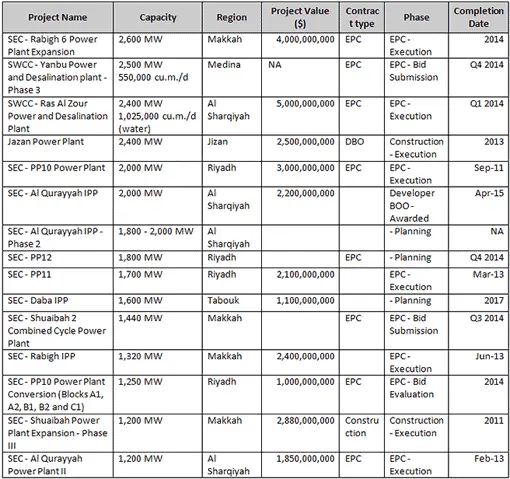
In 2010, the Ministry of Electricity and Water estimated investments of USD 80 billion in power generation over the next decade. Conventional power plants already under construction include:
A 1,700 MW PP11 power plant by Hyundai Heavy Industries, due to be completed in March 2013
The Al Qurayyah IPP by Samsung Engineering and Construction, which will would add capacity of 2,000 MW when completed by April 2015
The Shuaibah 2 Combined Cycle Power Plant, expected to be operational in 2014 with a capacity of 1,440 MW
The Ras Al Zour Power and Desalination plant that will add capacity of 2,400 MW when completed in 2014.
In the planning stages at the SEC are:
PP12 (1,800 MW) expected to be completed in 4Q 2014
Phase 2 of Al Qurayyah IPP (1,800-2,000 MW) whose completion date is not yet unavailable
Al Daba IPP in Tabouk, which is expected to add 1,600 MW when completed in 2017
Saudi Arabia's power sector "lacks competitiveness" and "shows no solid steps" towards privatization, Business Monitor International said in an April 2011 report. However, the ECRA has already begun implementing privatization initiatives through the formation of a national company for the transmission of electricity. In effect, privatization will play a significant role - up to 40%, according to Alawji's estimates - in funding the USD 80 billion investment required.