"My father and grandfather used to spend their days on the land, pruning and plowing it, keeping it fresh," said Faruq Radad a Palestinian farmer who had been cut off his farmland by Israel, according to a Human Rights Watch. "They plowed the land five times a year. I get to do it once. I feel like I'm choked."
While American bias towards Israel is the stuff of legend, Mitt Romney, the presumptive Republican candidate for the U.S. Presidency, went the extra mile and credited Israel's 'culture' for its success during this recent trip to the region.
"As you come here and you see the gross domestic product per capita, for instance, in Israel which is about $21,000 dollars, and compare that with the GDP per capita just across the areas managed by the Palestinian Authority, which is more like $10,000 per capita, you notice such a dramatically stark difference in economic vitality," Romney said, adding that it was the Israeli culture and the 'hand of providence'.
Of course, Palestinian Territories' GDP per capita is actually USD1,331, but that's the least of the problem with his statement.
Farmer Radad's economic plight highlights why Palestinians may not be doing as well as the Israeli side. A Human Rights Watch investigation showed that 30,000 residents in eight villages were subjected to Israel's arbitrary barrier system that has hemmed them in from three sides.
The barrier has cut off Palestinian farmers there from 50% of their farmlands and 70% of their grazing lands, on which their livelihood depends, according to residents and United Nations reports.
According to UN monitors, Palestinian farmers from the enclave were unable to access their lands on the other side of the separation barrier for 268 days in 2009, 282 days in 2010, 328 days in 2011, and 84 days in 2012 as of April 3.
It's hardly an environment to foster innovation or build wealth.
"Palestinians working for Israel settlers are promptly vetted for security concerns and allowed to cross, while Palestinians trying to access their own lands are held up while their crops rot in the fields," said Joe Stork, deputy Middle East director at Human Rights Watch.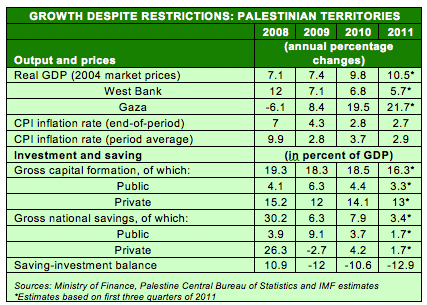
But Mr. Romney's Israeli trip gave the Middle East a glimpse into his foreign policy: How things are going to be if he becomes the President of the United States.
What Mr. Romney omitted to mention was that President Obama recently approved a three-year extension of loan guarantees to Israel worth USD3.9-billion, or that the U.S. Government paid USD205-million in 2011 to help create its Iron Dome Programme, specifically against Iranian threat, or that Israel has received USD13-billion in direct aid to Israel since 2007, in addition to the USD3-billion a year in military aid.
According to the U.S. State Department's website, U.S. military aid to Israel in 2009 totalled USD2.55 billion. This will increase to USD3-billion in 2012, and will total USD3.15 billion per year from 2013 to 2018.
The State Department also goes on to add that relations between the United States and Israel are 'continually strengthening in every field'. In addition to the Joint Political-Military Group, there are: bilateral science and technology efforts, the U.S.-Israeli Education Foundation, which sponsors educational and cultural programs; the Joint Economic Development Group, which maintains a high-level dialogue on economic issues; the Joint Counterterrorism Group, designed to enhance cooperation in fighting terrorism; and a high-level 'strategic dialogue.'
It is tough to find the same kind of assistance to Palestinian Territories on the Department's website, but it does note in a separate report that "Israel exercises varying degrees of legal, military, and economic control in the Occupied Territories."
Mr. Romney also didn't highlight why the Palestinian side may not have been prospering as much as the Israeli side. All he had to do was read the World Bank's last report on Palestinian Territories published in April which puts to bed the enviable success of Israel's economy compared to the decrepit infrastructure also called as the Palestinian economy:
"While the Palestinian Authority (PA) has had considerable success in building the institutions of a future state, it has made less progress in developing a sustainable economic base. Following a deep contraction in the first half of the decade there has now been five years of economic growth," notes a World Bank report.
"However, the Government of Israel's (GOI's) security restrictions continue to stymie investment and the recent growth has largely been driven by donor aid. This situation is unsustainable and aid levels have already begun to fall."
This was echoed by Palestinian businessman Munib R. Masri, who wrote in his op-ed for the New York Times: "As one of the most successful businessmen and industrialists in Palestine today (there are many of us), I can tell Mr. Romney without doubt or hesitation that our economy has two arms and one foot tied behind us not by culture but by occupation," he wrote.
"It's hard to succeed, Mr. Romney, when roadblocks, checkpoints and draconian restrictions on the movement of goods and people suffocate our business environment. It is a tribute to the indomitable spirit of our Palestinian culture that we have managed to do so well despite such onerous constraints."
Saeb Erakat, the Palestinian Authority negotiator, slammed Romney calling his comments 'racist'.
Another key issue for Palestinians is the lack of land resources, which hinders the private sector. About 60% of the West Bank is under Israeli control and effectively off limits to Palestinian development. The Palestinian Auhtiority has not helped its cause as it has not implemented a framework to register land. "This limits the extent to which Palestinians can develop, sell and collateralize their real property.
However, Gaza Strip, which entirely under Palestinian control, does not face the same restrictions since Israeli settlements were evacuated in 2005. Only 2% of the land in Gaza is not registered and titled, which suggests that left to their own devices, Palestinians can manage their affairs.
Of course, lack of land resources also means that housing activity is restricted, which inhibits wealth creation and collateralization of property.
A FAIR CHANCE
The World Bank believes that the establishment of a Palestinian state and a comprehensive peace agreement can be expected to lead to rapid growth in the Territories and generate tax revenues for the Palestinian Authority.
Despite the problems, the West Bank and Gaza gets some praise from the Bank:
"Given WB&G's lack of natural resources, but well educated and entrepreneurial population, it is likely that high value added services could play an important role in its growth, thus the service sector should not be neglected as the Palestinian Authorities develops its policies."
The Palestinians have not helped their cause either. Hamas and Palestinian Authority have internal accountability issues to contend with. Both have been accused of corruption and nepotism and failing to create structures that encourage accountability and efficient deployment of their resources.
The World Bank note the Palesintian authorities need to enforce the following:
- Implementing the pension reform plan adopted by the Council of Ministers
including expanding efforts at public outreach to develop support for the reforms.
- Developing and implementing a medium term civil service reform plan as called for in the Palestinian National Development Plan that will rationalize the growth and deployment of the PA work force to reduce costs and improve service delivery.
- Improving revenue collections by widening the tax base and increasing the efficiency of tax collections by implementing the reforms set out in the IMF's assessments.
- Improving coordination with the Government of Israel to ensure all taxes due to the PA are transferred.
- Improving the public financial management systems by continuing to implement the PA's public financial management reform plan.
In fact, if the Palestinian statehood issue is resolved, Israel could serve as a huge market for Palestinians. In turn, a new Palestine could serve as a platform for Israeli exports to the Arab World.
But Palestinian sovereignty is a long way, especially after the history of the conflict is littered with negotiation by Quartets and negotiators.
"The parties most directly concerned, the Israeli and Palestinian people, appear long ago to have lost hope," notes the International Crisis Group.
"Substantive gaps are wide, and it has become a challenge to get the sides in the same room. The bad news is the U.S. presidential campaign, Arab Spring, Israel's focus on Iran and European financial woes portend a peacemaking hiatus. The good news is such a hiatus is badly needed."
The ICG says that the expected diplomatic lull is a chance to reconsider basic pillars of the process - not to discard the two-state solution, for no other option can possibly attract mutual assent; nor to give up on negotiations, for no outcome will be imposed from outside.
"But to incorporate new issues and constituencies; rethink Palestinian strategy to alter the balance of power; and put in place a more effective international architecture."
CONCLUSION
Mr Romney's recent Israel trip clearly shows the Palestinian situation will not improve if the former Massachusetts governor is elected president come November 2012.
While Mr. Obama's approach to the Middle East has been nuanced, he has nevertheless has made little effort in bringing the Palestinians and Israelis close together. He has also continued and increased aid to Israel and blocked the Palestinian Authority's bid for statehood at the United Nations.
Perhaps his hands off approach to the region is just as well, as decades of American meddling in the region has done little to bring peace and calm to the region.
"Nineteen years after Oslo and thirteen years after a final settlement was supposed to be reached, prospects for a two-state solution are as dim as ever," notes the International Crisis Group.
Until then, Palestinians can not be expected to conjure up economic miracles and match Israeli success. One side has been cruelly handicapped while the other is on steroids.
© alifarabia.com 2012