Global private equity funds are scouring Sub-Saharan Africa for opportunities as the region blossoms as one of the fastest growing in the world.
"[The year] 2012 has been an extremely formative year for growth market countries and regions outside of the more traditional BRIC nations," said Sev Vettivetpillai, Executive Chairman and Chief Operating Officer at Aureos Advisors, the Abraaj Group, in a report.
"It has seen the emergence, out of the shadows, of a number of serious contenders on the private equity landscape. Most noticeable of these has been the rise of Sub-Saharan Africa. The continent has seen more than 20% compound growth in FDI projects over the last few years and this figure is set to grow."
Indeed, Africa's rise comes at a time when the stalwart emerging markets China, Brazil and India are going through a rough patch.
Still, there is a long way to go.
Figures from the Emerging Markets Private Equity Association (EMPA) show
Sub-Saharan Africa region raised USD1.45 billion in 2012, a USD100 million more than last year, but nowhere near the USD2-billion-plus it raised before the global financial crisis.
Meanwhile, PE funds invested more than USD1.16-billion in Africa last year, higher than 2011 and 2010, but still far short of the USD3-billion poured into the African companies in 2007 and 2008.
PE capital raised in Africa accounts for 3.5% of all funds raised in emerging markets last year, and suggest there is plenty of head room for growth.
Ten of the twenty fastest-growing economies in the world are in Africa and there is new optimism among African consumers, thanks to relative stability and greater effort by governments to pursue inclusive growth.
But private equity funds remain circumspect about Africa's prospects.
"In African markets, challenges around navigating governmental involvement and enforceability of contracts are compounded by legal systems that are highly varied, as well as regulatory structures and legal procedures that may be under-developed or fall outside the norm of the investment process in other jurisdictions," said EMPEA in a November note on SSA's prospects.
It's difficult for investors to consider Africa as one economic bloc given the range of legal frameworks in effect, including Shariah law, English common law, Roman-Dutch law and French and Portugese civil law established in various African countries.
Institutional investors are especially wary of regulatory and compliance breaches, conflict of interest issues and problems of corruption and bribery.
To avoid the issues, many investors try to steer clear of companies that don't have clearly structured ownership rules and are dependent on government contracts.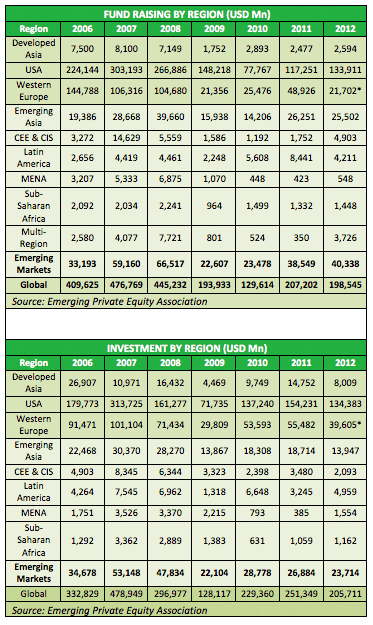
"We only invest in private companies with limited or no government shareholding.
We prefer to deal with retail-facing companies doing a large number of transactions with a large number of private clients rather than business-to-business where you may have few clients and government may be one of them," said Gerben Dijkstra of Investec Asset Management, in a roundtable organized by EMPEA. "We avoid certain sectors where tenders are involved, material licenses have to be renewed and government approvals have a repeated and significant impact on the business."
Global investors have been recently stung by a series of corporate governance issues and country risks. In South Africa, global mining companies are worried about potential nationalisation of parts of the mining sector or greater control of the government in light of the recent mining strikes in the country.
In Eriteria, a Canadian company has been called out by Human Rights Watch group for using forced labour in the country.
"International mining firms rushing to invest in Eritrea's burgeoning minerals sector risk involvement in serious abuses unless they take strong preventive measures," said Human Rights Watch. "The failure of the Vancouver-based company Nevsun Resources to ensure that forced labour would not be used during construction of its Eritrea mine, and its limited ability to deal with forced labour allegations when they arose, highlight the risk."
Such issues mean private equity investors need to do their own homework, which is especially difficult in the absence of reliable data.
"The thing that would cause us to walk away, even late in a deal, is when we see opaque structures, where there may be undisclosed beneficial owners," Ralph Keitel of the International Finance Corporation.
"Unless we are convinced otherwise, we have to assume that at the end of the line there is a beneficial owner that wishes to remain unknown, either one deemed to be a politically exposed person (PEP), such as a high-ranking government official or a member of the ruling family that we don't wish to deal with, or someone involved in some sort of criminal activity such as corruption or money laundering.. The overruling principle for any investor, including IFC, is that we don't want to see our names in the headlines of the newspaper in a negative context."
Still, the International Finance Corporation partnered with Abraaj Capital in January to invest in Vine Pharmaceuticals - Uganda's largest pharmacy chain.
The investment is part of Abraaj's Africa Health Fund, which also counts the African Development Bank and Gates and Melinda Foundation as its key investors.
The investors hope to capture the country's rapidly growing pharmaceutical market, where expenditure is expected to grow at an annual rate of 13% and reach USD 545 million by 2014, according to Abraaj.
Abraaj said it will support Vine in extending its branch network outside the capital city of Kampala, and build the capacity of its wholesale distribution business serving clinics, hospitals and other pharmacies.
In November, international PE giant Carlyle Group and its partners took a minority stake in Tanzania's Export Trading Group (ETG) for USD210 million.
"ETG offers a unique combination of strong management and access to both the agriculture supply chain in Africa as well as key markets in China and India," said Herc van Wyk, CEO of Pembani Remgro Infrastructure Managers, one of the investors. "We look forward to supporting the expansion of the company's supply chain footprint and believe that it offers an exciting growth opportunity."
In addition, South African funds Ethos Private Equity and Helios Investment Partners have successfully raised funds over the past year, highlighting investor appetite.
"Africa remains an appealing capital destination with significant demand for infrastructure, and high quality products and services," said Paul Fletcher, senior partner at Actis, another PE firm. "In October 2012, Actis closed Sub-Saharan Africa's largest private equity real estate fund and we expect intense activity in this sector during the next 12 months."
© alifarabia.com 2013