Bahrain will struggle against the more attractive political and regulatory environments and market opportunities in Dubai, Qatar and even Saudi Arabia, according to the Economist Intelligence Unit.
The kingdom's economy was rocked two years ago when Shiite opposition groups rose up against the Sunni-regime to protest against discrimination and lack of opportunities, in the midst of wider Arab Spring protests.
The ruling family has struck back hard to quell the opposition, with the help of its Gulf counterparts, especially Saudi Arabia. Apart from using its military might, the authorities have also made numerous political and economic overtures, the stalemate with the opposition remains.
While the authorities have managed to contain the opposition, the recent sporadic violence has highlighted the Kingdom's fragile state.
Reuters reported that Bahrain security forces killed a teenager and injured dozens more protesters on the second anniversary of the protests, while a security officer was also killed in the episode.
The latest incident suggests that Bahrain is far from resolving its political tensions, which could hurt its economic attraction in the long run.
"In our view, the political, economic, and fiscal situation in Bahrain, while still unsettled, has improved such that we now view it as less risky," said Standard & Poor's in late January but revised its outlook on Bahrain to stable from negative.
"We also believe that Bahrain has emerged from its 2011 crisis with a more subdued but also more stable economy, primarily driven by a buoyant hydrocarbons sector and higher public spending."
The Bahrain Economic Development Board says the Kingdom's economy grew 3.9% in 2012 and is set to gallop ahead to 6.2% in 2013.
Much of the growth this year will be led by the hydrocarbons sector, which is set to grow by 13.4%, compared to a 6.5% decline last year.
The oil sector was dragged down by lower production in the Abu Sa'afa oil field last year.
"The challenges of 2012 will likely pave the way for a fairly significant improvement in oil sector growth in 2013,' said the EDB in its quarterly report.
"Output in Abu Sa'afa is expected to remain at full capacity, which would make Bahrain's share 150,000 b/d. At the same time, Tatweer is expected to continue to make gradual progress in boosting output levels in the Bahrain field to an estimated 47,500 b/d in 2013 according to the government's budget statement."
The International Monetary Fund has a much more subdued outlook for Bahrain, expecting the Kingdom to post 2.6% real GDP growth in 2012, and 2.8% in 2013.
The IMF estimates that Bahrain also has one of the highest breakeven oil price among MENA exporters. Breakeven price is expected to reach USD111.4 per barrel in 2013, compared to USD77.5 per barrel in the UAE and USD56.4 per barrel in Kuwait, making the Kingdom vulnerable to crude-price correction.
Bahrain's fiscal strength will suffer if Brent crude prices fall below USD100 per barrel, especially as oil- and gas-related revenues make up 88% of central government revenues.
"In the event of large but short-lived oil price fluctuations, all GCC countries, except Bahrain, would be able to maintain a countercyclical stance," said the IMF.
As the smallest Gulf economy with the smallest crude output, Bahrain is counting on its regional counterpart to provide an economic bump.
"The GCC economy looks well positioned for another year of strong growth which should provide an additional impetus for growth also in Bahrain," said the EDB.
"While continued regional growth should generally support confidence it will also likely bring concrete benefits to sectors with exposure to the rest of the region."
These include greater tourism numbers from Saudi Arabia, investments in real estate, and a boost for Bahraini financial service providers from the strong pipeline of regional investment projects.
The EDB also expects investment activity to accelerate as the funds promised to Bahrain and Oman by their GCC counterparts finally make their way into the economy. The GCC had pledge USD10-billion to Bahrain and Oman in 2011, which are expected to start trickling into the system by 2013-14.
"The funds will be allocated to infrastructure projects but will not constitute part of the government budget," said the EDB.
"The government is reportedly planning USD2.5bn worth of infrastructure projects using the GCC funding. These would include investments in roads as well as new schools. The Saudi Fund for Development in early January announced its plan to remit USD448mn for development projects as part of the GCC fund following six agreements with the Bahrain minister of finance."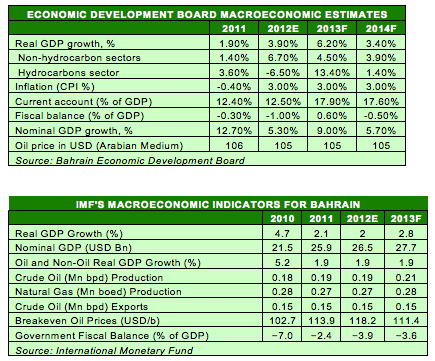
ANALYSTS NOT CONVINCED BY BAHRAINI OPTIMISM
Market observers and analysts do not share Bahraini authorities' positive economic outlook. The S&P expects a far subdued 2% growth in the next few years as it expects political issues to weigh down the economy.
Bahrain Air, a small carrier flying to around 12 destinations, closed down as it struggled to gain traction and compete with more deep-pocketed Gulf airlines. Meanwhile, struggling national carrier Gulf Air announced in January it cut eight routes and is targeting savings of 24% as part of a restructuring process.
"Gulf Air's main objective in the restructuring process is to reduce its losses through various cost-cutting measures across its business functions while improving yield and increasing revenue," the airline said in a statement.
In addition, privatisation efforts are likely to remain on the backburner and Mumtalakat, the sovereign wealth fund could be weighed down with the problems at subsidiary Gulf Air.
The EIU notes that Bahrain's reputation as a safe, stable financial hub has been severely damaged by the political unrest.
Robust financial regulations in Saudi Arabia will also hurt Bahrain, turning the country which once considered as the region's financial hub, into a place for 'back office' operations.
"Although there has been no major exodus from the kingdom by international institutions, it is notable that total assets of the wholesale banks (comprising investment banks and offshore banks) have declined by one-quarter since end-200," the EIU said.
Equally important, while the government has taken some initiatives to reduce the political tension with its Shiite-majority population, there are no major reconciliation efforts that would remove the poltical overhang over the Bahrain economy.
"In addition, regional geopolitical competition between Iran and Saudi Arabia, as well as heightened regional sectarianism, does not bode well for national reconciliation and an improvement in the policymaking environment, in our view," said S&P.
© alifarabia.com 2013