Oman was not immune to the Arab Spring that swept the region last year. Like Bahrainis, Egyptians, Tunisians and Libyans, Omanis were out in the street protesting greater social and economic freedom. But unlike other regional governments, Oman's authorities have managed to resolve the differences and found a way to pull through and keep the economy humming.
As a result, the Omani economy is positively robust and expecting impressive growth on the back of high crude revenues.
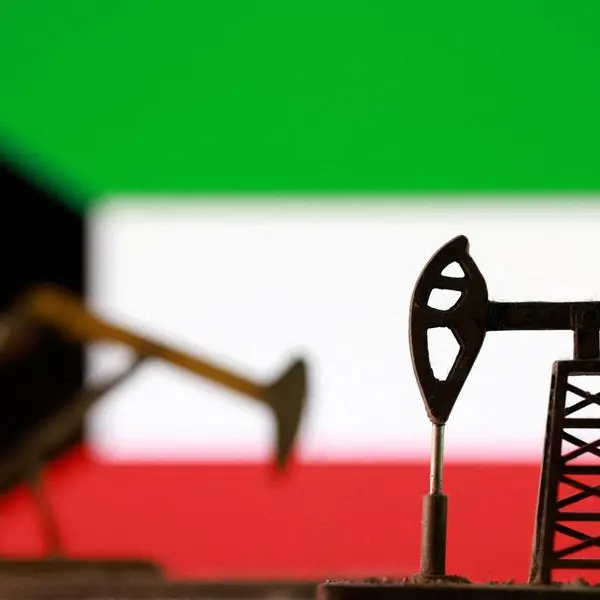
High oil prices and increased crude production has widened the budget surplus to an estimated 9.5% of GDP last year, according to the Institute of International Finance (IIF). The banking group also expects another large surplus of 6.5% this year.
Real growth would accelerate to 6.4% in 2012 driven by the expansion in the non-oil sector, which is forecasted to rise to 7.0% in real terms and now comprises around 70% of real GDP, with the oil sector expected to post real growth of 5%, says the IIF.
Oman's crude production stood at around 880,000 barrels per day, a 2.4% increase from last year, and is set to grow in coming months with additional output coming on line. Meanwhile, natural gas production rose 4.4% in 2011.
"Overall output is tweaked slightly higher in 2012 due to an earlier-than-expected ramp up of EOR [enhanced oil recovery] projects, but our forecast still assumes that Oman will fall short of the government's 1 million bpd target for the foreseeable future as water shortages hinder the amount of steam that can be used for steam-flooding," said the International Energy Agency in its monthly report. Oman is forecast to increase crude and condensate production by 20,000 bpd to 910,000 in 2012, the IEA notes.
The country has benefited from a squeeze in Iranian exports, with countries like Sri Lanka replacing Iranian oil with Omani crude to comply with western sanctions on Tehran.
Gas sector has also picked up steam as the government looks to develop its domestic deposits of gas reserves. The most promising of these is the Khazzan field being developed by BP, with up to 100 tcf of reserves.
However, the depth and tightness of these deposits make them difficult to exploit, and the extent of commercially recoverable gas (if at all) will depend on ongoing discussions between BP and the Omani government over price. BP expects to complete its feasibility review of the field in 2012, with a decision regarding investment to made potentially in early 2013.
The mining of local deposits is important as Oman is a gas importer, despite being an LNG exporter.
According to the US Energy Information Agency, Oman exported 408 billion cubic feet (bcf) of gas in 2009, and consumed 520 bcf, meaning a total gas demand of 928 bcf. Total production was around 875 bcf, and growing rapidly. The shortfall in gas is made up in imports, mainly from Qatar through the Dolphin pipeline.
"The lack of gas severely constrains power generation, with outages occurring during peak season (summer), and is constraining the Sultanate's ability to expand industrial production," notes a Citibank report. "Work has begun on the GCC grid, which will allow Oman to import energy from its neighbours, but this will not be completed for a number of years."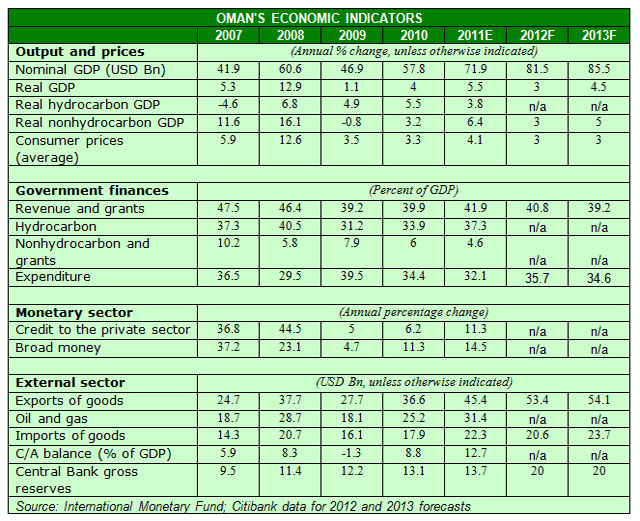
DIVERSIFYING
The oil export windfall has done much to keep social unrest at bay as the government is using the revenues to invest in infrastructure and pay for some of the short-term measures.
The International Monetary Fund contends that Oman's hydrocarbon reserves are limited and alternative sources of income will need to be developed. This would mean greater private and foreign investment in the non-oil sector and job-creation.
"Effectively addressing the problem of high unemployment among Omani nationals is linked to progress on economic diversification," said the IMF in a March report on the country. "Meeting the need for more well-paying jobs for Omanis outside the public sector will require boosting job creation in the less-capital intensive and more knowledge-intensive parts of the private sector."
This includes education and training for the labour force and resolving the yawning gap between public and private sector wages. The difference widened even further after the Omani authorities reacted to the social unrest in 2011 by increasing the number of public sector jobs, raising the minimum wage for Omani workers in the private sector and introducing a new unemployment benefit.
While that stemmed popular unrest, it has made it especially difficult for the private sector to keep costs down.
LOOKING AHEAD
As crude production reaches a plateau, Citibank expects Oman's real GDP to rise by 3% in 2012, compared to 4.9% last year. Meanwhile, real non-oil GDP would scale down to 3% growth, compared to the 6.3% recorded last year.
And while the oil sector remains crucial to the economy, its contribution to the economy has fallen from 51% in 2000 to 30% in 2011 - as the authorities have pushed hard to diversify away from crude revenues.
As part of that diversification, the government is speeding up new projects and is expected to award new contracts from a healthy pipeline of developments this year. By taking equity stakes in some of the projects, the government is hoping that the push towards diversity pays off in the long-term.
These include the Frontier Town tourism and real estate project jointly owned by Oman Tourism Development and South Korea's Daewoo Shipbuilding and marine Engineering Company, and the Ministry of Transport and Communication's USD10-billion railway project, apart from a string of airport, free zones and other infrastructure projects.
Such developments would create the much-needed, high-paying jobs that Omanis were demanding when they came out on the streets last year.
© alifarabia.com 2012