What if the Israel-Iran conflict is taken out of the oil equation? How low will prices go?
That's the question gnawing at Jim O'Neill, Chairman at Goldman Sachs Asset Management.
"I find myself wondering, if we could ever put this Iran-Israel talk out of the market's minds permanently (probably a ridiculous notion), how much would oil prices drop?," said Mr. O Neill in his monthly Viewpoint report.
The Goldman Sachs executive believes the idea of an Israeli attack on Iran at a time of great regional conflict elsewhere seems unlikely.
"In view of the events percolating elsewhere in the region, especially Syria, it is not clear to me why this would be an especially wise thing to do, but what do I - or perhaps anyone - know about such matters?," said Mr O' Neill.
A bigger concern, however, is the rapid ramp up of North American oil apart from rising output from Libya and Iraq. A report by Harvard Belfer Group contends that oil prices at record levels has caused sufficient supply-side responses (as well as demand side), so that the last problems people should be worrying about are oil supplies and oil prices.
"The U.S. shale/tight oil could be a paradigm-shifter for the oil world, because it could alter its features by allowing not only for the development of the world's still virgin shale/tight oil formations, but also for recovering more oil from conventional, established oilfields - whose average recovery rate is currently no higher than 35%," notes Leonardo Maugeri, of the Belfer Center for Science and International Affairs, Harvard Kennedy School.
Mr Maugeri believes that oil supply capacity is growing worldwide at such an unprecedented level that it would outpace consumption. This could lead to a glut of overproduction and a steep dip in oil prices.
Within the space of eight short years, more than 25 million of additional production would come to the market - the most significant increase any decade since the 1980s. Adjusted for reserves, the figure comes to 18 million barrels.
The analyst believes Iraq, United States, Canada and Brazil - in that order - would see the biggest increase in their production during that period.
"This is a novelty, because three out of four of these countries are part of the western hemisphere, and one only - Iraq - belongs to the traditional center of gravity of the oil world, the Persian Gulf," the analyst notes.
The Harvard Belfer study suggests that American oil output will eclipse Russian supply by 2020 to emerge as the second largest producer in the world after Saudi Arabia.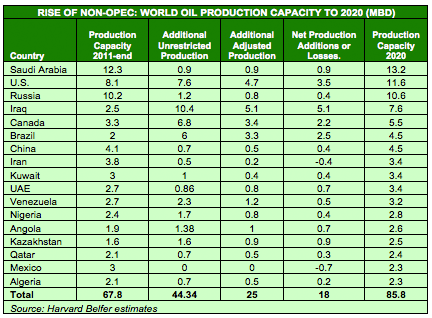
CIBC'S VIEW
The Harvard Belfer study chimes with another study on North American oil, which suggests that North American oil could make a major impact on global markets, negating some of the influence of OPEC countries and diffusing some of the volatility in the Middle East markets.
"If we extend the analysis to the implied call on OPEC (i.e., leaving all other parts of consensus unchanged but updating to reflect our range of North American deliverability), it becomes quite apparent that North American growth can have an impact on medium-term markets," noted Andrew Potter, analyst at CIBC World Markets. "Using our assumptions for North American supply growth would reduce the consensus call on OPEC through 2015/16 from 600,000 barrels per day to 300,000 bpd - a very significant change."
In CIBC's view, this change implies that as global forecasters move to more realistic North American supply growth assumptions would lead to a more bearish consensus view. The weaker medium-term balances are the key reason CIBC recently trimmed its long-term Brent assumption from US$100 per barrel to US$95 per barrel.
"This is not to say that the political premium, which is variable but ever-present in oil prices, will evaporate," warns Mr. Potter. "After all, OPEC will still make up around 40% of global oil production through 2015 (i.e., OPEC remains extremely important) and, while unpredictable, odds are high that political turbulence in the Middle East is not going to disappear anytime soon."
More importantly, American energy independence remains a pipe dream. In fact, after years of decline, Saudi oil exports to the United States recently shot back up, as the Kingdom launched its Motiva refinery in Texas in collaboration with Royal Dutch Shell Plc earlier in the year - in fact, the refinery could arrest a decline in Saudi crude exports to the United States.
Much as right-wing media would like us to believe, Saudi and American oil producers and refineries are driven primarily by commercial interests, rather than any overarching geopolitical consideration.
But in the medium term, all the major producers are trying to expand capacity, which is not being matched by rising demand.
Indeed, American and European oil consumption patterns are going through a structural decline due to regulatory issues and a whole host of energy efficiencies. Meanwhile, rising production from a few Opec states and countries in the Western Hemisphere means there is enough crude sloshing around in the market to sate demand from emerging economies - at least for now.
And new production continues to come to the market. Global oil companies spent USD406-billion in 2011 on exploration and production (E&P) spending, a 10% increase over last year, according to IHS CERA, an energy consultancy - a number it expects to see rise last year, as oil companies chase high oil prices. That seems like a recipe for an oil glut.
ALSO READ:
Big Oil's Kurdish Ambush
ME's Great Gas Slowdown
Qatar's LNG Threat
Iraq's Oil Exports Surge
© alifarabia.com 2012