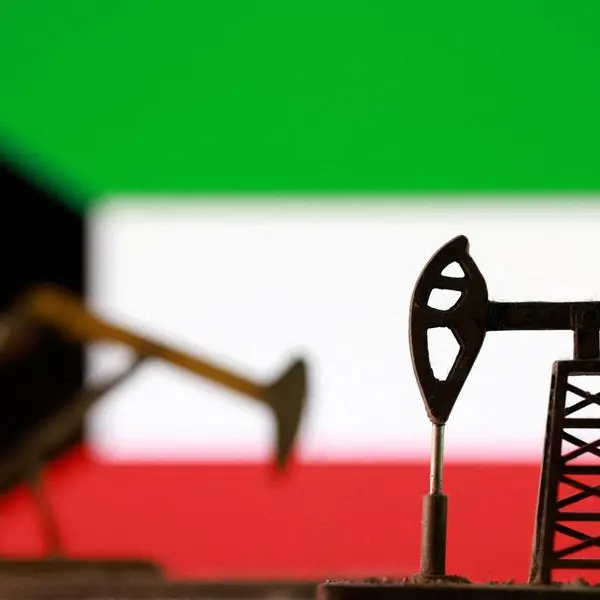
While the overwhelming general consensus is that oil prices could head north of USD140 per barrel before the end of the summer, a small group of analysts are suggesting that the market may pause for breadth and climb down.
"We expect prices will weaken by as much as $10/bbl in the near-term as higher Saudi output begins to take effect. Our long-term forecast remains at $95/bbl, reflecting the budgetary needs by key OPEC producers and the relatively high cost of the marginal non-OPEC barrel," wrote analyst Jon Rigby of UBS in a note to clients.
Like all analysts, Mr. Rigby is worried that international sanctions on Iran would reduce its oil exports by as much as 1 million barrels per day, or 40% of its total, from the middle of the year. The Eurozone embargo is set to kick off on July 1 and some EU states such as Spain have already reportedly cut off their imports of Iranian oil.
Paradoxically, that has worked in Iran's favour as Brent crude prices have shot up, allowing Tehran to offer discounts to willing buyers.
Still, the Zurich-based bank has raised its overall average 2012 Brent price from $105 to $112/bbl on recent price strength. "Crude prices will remain in a tug of war between prospects of a near-term supply overhang on the one hand, and a sustained risk premium due to Iran worries as well as a deterioration in Syria and Sudan on the other. With production also curtailed in the North Sea and China, and looming resource nationalism in Argentina, risks remain overwhelmingly on the supply side and price-supportive," said Mr. Rigby.
Toronto-based CIBC World Markets, which has traditionally been less exuberant on crude prices than its peers, also believes we are in for a correction at least in the short-term.
"For over a month now, we have warned of a downward correction for crude, but prices have stayed stubbornly rangebound at peaky levels. We are still structurally bullish oil on average this year, but continue to believe that a temporary down move is in the cards in the next 1-2 months, followed by a move back up in 2H'12," said Katherine Spector, analyst at CIBC.
The investor community seems to lack conviction about price direction, and perhaps with good reason -- fundamentals seem at a potential turning point for the second time in less than six months, says Ms. Spector. Escalating strategic petroleum reserve (SPR) talk seems to have lit a fire under OPEC's top producer. Saudi Arabia has been eager to reassure the market that it is a reliable supplier, and not just rhetorically, with Saudi March production approached 10 million barrels per day.
"The bearish take on today's oil balance is that, for now anyway, Saudi Arabia is giving the market more oil than it needs, and inventories should build over the next couple of months. OECD inventories are low on an outright basis, but right around normal in terms of days of demand cover," wrote Ms. Spector in a note to clients.
The bullish take is that, even with persistently anemic global oil demand growth, and even with Libyan production now nearly back to pre-revolution levels, it is taking close to 10 mbd of Saudi production to keep that floor under stocks. Roughly 1.5 million bpd of Libyan production has returned to market, but a cumulative 500,000+ bpd is offline between Syria, Yemen, South Sudan, Iraq and, at any given time (now, for example), in the North Sea as well.
PESSIMISM CREEPING IN
There are other reasons to be slightly pessimistic. The International Energy Agency anticipates Chinese consumption to grow at an average 3.9%, or 9.9 mb/d, which is lower than other estimates. "Underpinning our relatively cautious Chinese growth estimate is the assumption that economic growth will fall below 8.5% for the year as a whole," the IEA noted in a March report. "The weaker outlook gains support from reports that the Chinese government has decided on a lower growth target, of 7.5%, as opposed to the 8% target previously assumed."
The global crude oil market continues to struggle with various fundamental forces which could result in more or less of a stalemate for prices - now and for the near term.
"The only upside has more or less come from geopolitical factors, and which could either force immense price upside very quickly, and then just as quickly dissipate, or simmer and then slowly fade as new issues come to light and become the new "worry du jour" for the market," said Martin King, an analyst with First Energy.
Some of the downside pressures include the rapid return of Libyan production, which has beaten virtually all estimations with the speed of its recovery.
With production and exports almost back to pre-war levels, the return of Libya's highly prized light sweet production should carry some weight in easing supply constraints in Europe and the Atlantic Basin.
Meanwhile, demand destruction is also working its way into the system.
"We feel that there remains genuine concern over further demand erosion as a result of the higher prices during the first quarter of this year," said First Energy's King. "We have further trimmed our global oil demand growth expectations into the 700,000 to 900,000 bpd range for 2012 and 2013, respectively, cuts of 100,000 to 300,000 bpd compared to our previous outlook. Moreover, the global oil burden, should Brent prices hover near or above US$125 per barrel, is only increasing our expectations of further lagged negative demand effects."
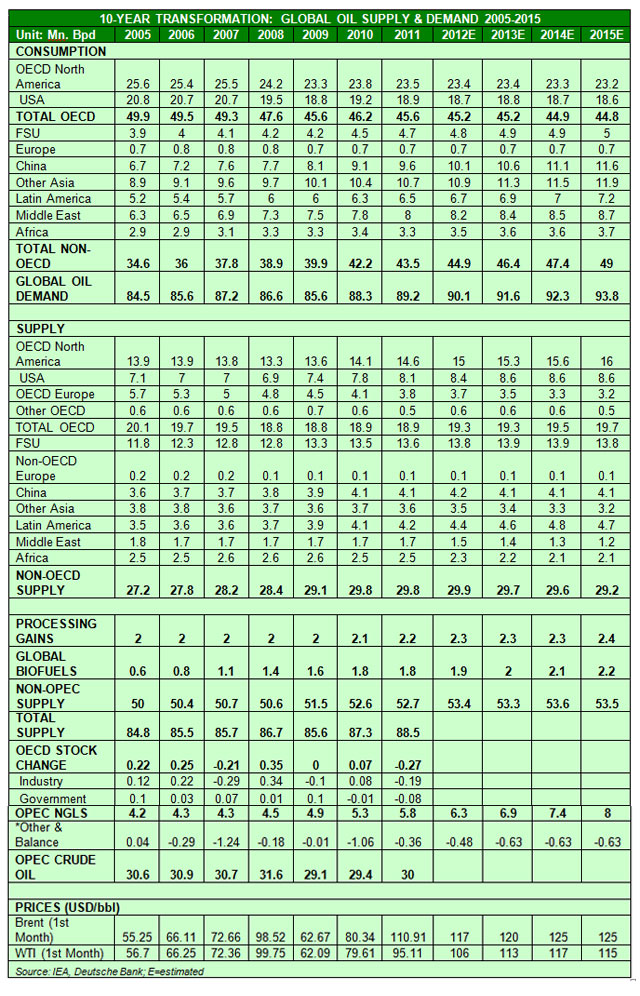
TRILLION-DOLLAR WINDFALL
One reason why the Saudis and other OPEC members are pumping oil at record levels is to avoid a quick run-up in oil prices as it would depress global demand and eventually lower the prices of all other commodities, says the International Monetary Fund in a recent report.
The 'Goldilocks' phenomena - not too hot and not too cold - is perfect for OPEC producers, which are raking in record revenues.
Citibank notes that the revenue windfall, considering that in mid-2010 the IMF was predicting that oil prices in 2011 would average USD75 per barrel, runs into a trillion dollar.
"As it turned out prices were in reality around USD110 per barrel last year. The difference in revenues implied by the two puts the 2011 windfall from the rise in oil prices at USD183-billion. Extending this logic, by 2015, the difference between oil revenues based on IMF assumptions from 2010 and Citi's current assumptions on oil prices would put the cumulative windfall at over USD1 trillion."
These record oil earnings are having a profound impact on the economic fundamentals of most Gulf countries. And the improvements are not merely cyclical, either.
"One could make the argument that in the absence of political risk, oil prices would fall and deficits would open up where surpluses have been in the past few years," notes Citibank analyst Frank Soussa.
"While this is certainly true, it misses the point that the oil windfall has resulted in a structural strengthening of sovereign balance sheets to the extent that they could absorb a fall in oil prices while maintaining efforts to diversify their economies, and also upgrade infrastructure, education, healthcare etc. The benefits will thus be apparent for years to come, long after oil prices have once again abated."
CONCLUSION
Ali Al Naimi, the Saudi oil minister, has been on record saying he would prefer oil prices to be closer to USD100 a barrel, rather than the current prices of USD124. That would be to the benefit of all parties concerned, but with many countries stockpiling crude oil for fear of a Strait of Hormuz incident, prices are set to remain well above USD100 on perceived threats to supply.
© alifarabia.com 2012