The world is using up its natural resources at an alarming rate, and this has caused a permanent shift in their value and we all need to adjust our behaviour to this new environment. It would help if we did it quickly, says a global investment firm managing USD107 billion in client assets.
April 27, 2011
27 April 2011 Worried about 'peak oil'? How about 'peak everything'? A GMO analyst crunches the numbers to show why the structural shifts in the world's consumption patterns will alter the way we view and invest in commodities. Mother Of All Commodity Paradigm Shifts
The world is using up its natural resources at an alarming rate, and this has caused a permanent shift in their value and we all need to adjust our behaviour to this new environment. It would help if we did it quickly, says Jeremy Grantham, co-founder of GMO, a global investment firm managing $107-billion in client assets.
Grantham looks at how commodities are going through a new cycle which will change the way we view and invest in commodities.
Here are some of his key points:
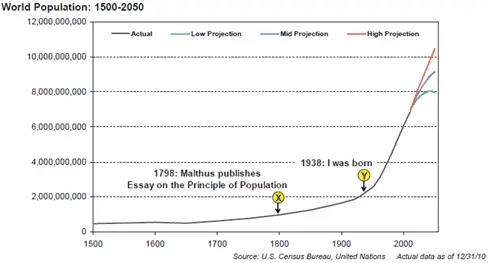
Since 1800, the population has surged from 800 million to 7 billion, on its way to an estimated 8 billion.
The rise in population, the ten-fold increase in wealth in developed countries, and the current explosive growth in developing countries have eaten rapidly into our finite resources of hydrocarbons and metals, fertilizer, available land, and water.
Now, despite a massive increase in fertilizer use, the growth in crop yields per acre has declined from 3.5% in the 1960s to 1.2% today. There is little productive new land to bring on and, as people get richer, they eat more grain-intensive meat. Because the population continues to grow at over 1%, there is little safety margin.
The problems of compounding growth in the face of finite resources are not easily understood by optimistic, short-term-oriented, and relatively innumerate humans (especially the political variety).
The fact is that no compound growth is sustainable. If we maintain our desperate focus on growth, we will run out of everything and crash. We must substitute qualitative growth for quantitative growth.
But Mrs. Market is helping, and right now she is sending us the Mother of all price signals. The prices of all important commodities except oil declined for 100 years until 2002, by an average of 70%. From 2002 until now, this entire decline was erased by a bigger price surge than occurred during World War II.
Statistically, most commodities are now so far away from their former downward trend that it makes it very probable that the old trend has changed - that there is in fact a Paradigm Shift - perhaps the most important economic event since the Industrial Revolution.
Malthusian Theory Out The Window After 100 years of decline, resource prices are rising and have gone up significantly in the past eight years, and we seem to be consuming these precious resources at an alarming and unsustainable rate.
The old Malthusian theory of how resources and the population manage to find a balance no longer applies.
"For a small window of time, about 250 years (starting, ironically, just in time to make Malthus' predictions based on the past look ridiculously pessimistic), from 1800 to, say, 2050, hydrocarbons partially removed the barriers to rapid population growth, wealth, and scientific progress," says Grantham.
"World population will have shot up from 1 to at least 8, and possibly 11, billion in this window, and the average per capita income in developed countries has already increased perhaps a hundred-fold (from $400 a year to $40,000)."