Thirty-three Middle East banks are among 500 of the world's most trusted banks, according to a new study.
The global financial services community has had a torrid few years with tremendous deleveraging and poor asset quality effectively sucking growth out of their operations.
Troubles in Europe has also not helped international banks as they find themselves holding problematic Greek, Portuguese and Spanish debt amid faltering economies and greater regulatory oversight.
The FT Banker magazine's Top 500 Banking Brands reflects that trend and shows a new order among global that are seen as trusted and stable, with banks from OECD countries slowly start to give way to more promising banks from emerging markets.
"It is perhaps no surprise - given the current global environment - that brands from some countries are performing better than others. For example, the aggregated brand values of financial institutions from Greece do not feature highly in the table of brand value by country of origin," the report notes.
"The crisis has thrown up the issue of the brands' origin," says David Haigh, CEO of Brand Finance, the company that produced the rankings for The Banker.
True, the global financial crisis has taken its toll on banks' reputation. As such, banks from Singapore, Canada, Australia and China have seen their brands rise while Greeks, Italian and Spanish banks have suffered.
To be fair, some of the world's largest banks - HSBC, Citibank and Bank of America - continue to feature prominently, but emerging market banks are slowly creeping up the charts.
MIDDLE EAST'S MOST TRUSTED
Middle East banks have also benefited from the fall of other international banks, although they face their own set of troubles.
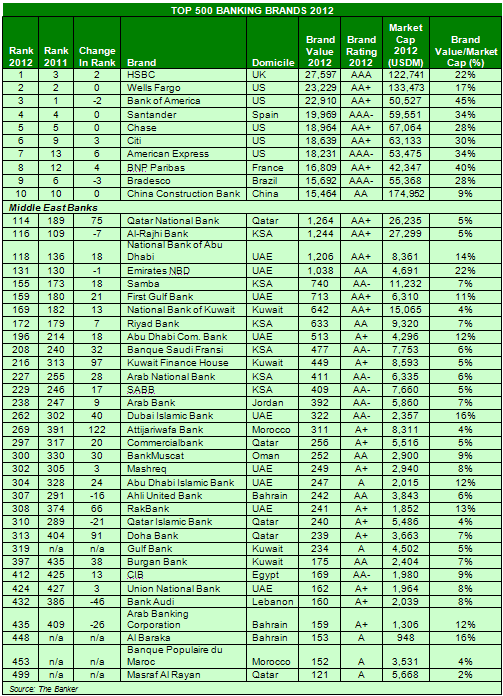
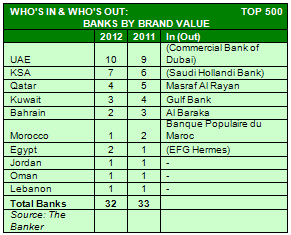
Thirty-three Middle East banks made it to the top 500 Banking Brands, with only six falling in ranking. This is only a marginal improvement over the 32 Middle East banks that were featured in last year's ranking.
Qatar National Bank led the Middle East, ranked 114 out of 500 as the most trusted brand in the region. The Doha-based bank jumped 75 places from last year's ranking to leapfrog other Middle East stalwarts such as Al Rajhi Bank, National Bank of Abu Dhabi and Emirates NBD.
QNB's rise also reflects Qatar's growing prowess in the regional financial circles.
Qatar's largest bank already accounts for 47% of its banking sector's total assets and 52% of all deposits, and is effectively a pillar of the country's natural gas-based economy.
Al Rajhi Bank, which is the largest in the region in terms of market cap, was placed second among Middle East banks, and placed 116 in the overall ranking. The Riyadh-based bank is one of the six Saudi banks in the top 500 - all of which are in the top half of the list.
The biggest jump, however, came from Morocco's Attijariwafa Bank, which rose 122 places to finish at 269 in the global ranking.
Attijariwafa Bank (AWB), the leading bank in Morocco, has benefited from the relative stability, even though growth in the country is expected to slow down.
As a result, the bank has begun looking abroad for growth and has secured an investment banking license from the Dubai International Financial Centre.
IN AND OUT
Saudi Hollandi Bank, EFG-Hermes and Commercial Bank of Dubai slipped out of the Top 500 list as their total brand value was overtaken by newer players. But Kuwait's Gulf Bank, Bahrain's Al Baraka Bank, Banque Populaire du Maroc and Qatar's Masraf Al Rayan made the cut at the expense of many European banks.
While many Gulf banks can look forward to climbing up these rankings over the next few years, many in the troubled states of Egypt, Bahrain, the Levant and North Africa are expected to fare poorly in such lists.
An indication of that trend was evident in the number of Middle East banks in The Banker's List of Top 1,000 World Banks. Total number of banks in the list fell to 83 last year compared to 90 the previous year. The Middle East banking industry may fare even worse in the next edition of that list as the full impact of Egypt's political issues becomes apparent in its beleaguered banks.
Also Read: Middle East's Top 25 Banks
NOTE:
How banks are rated: Brand ratings are calculated using Brand Finance's ßrandßeta analysis which benchmarks the strength, risk and potential of a brand, relative to its competitors, on a scale ranging from AAA to D. It is conceptually similar to a credit rating. The data used to calculate the ratings comes from various sources including Bloomberg annual reports and Brand Finance research.
© alifarabia.com 2012