Jul 18 2011 |
more articles from
|
MENA DCM: UAE Bonds In Focus
By Nancy Mitri, Research Associate - Bonds, Zawya
18 July 2011
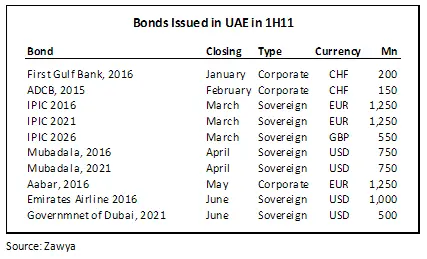
UAE's bond market activity was the highest in the MENA region during 1H11, boosted by sovereign borrowers. Nancy Mitri, Zawya's Bond Analyst, examines the reasons behind this upsurge and the direction in which the UAE bond market is heading. During the first half of 2011, UAE was the biggest issuer of conventional bonds in both the GCC and MENA regions, according to data compiled by Zawya Fixed Income Research. Aided by political and economic stability and supported by huge project finance requirements, expansion and growth plans, and by the need to refinance existing debt in other cases, the UAE witnessed the issuance of USD9.6 billion of bonds in 1H2011.
Corporate bonds represented around 23% of the total value of bonds issued in the UAE while the remaining share went to government-owned entities. The three corporate bonds came from First Gulf Bank (CHF200 million) in January, Abu Dhabi Commercial Bank (CHF150 million) in February, and Aabar Investments (EUR1.25 billion) in May. Despite the corporate nature of these companies, it is worth mentioning that the government of Abu Dhabi is the biggest shareholder in all these corporations. Nevertheless, the UAE was the sole issuer of corporate bonds in the GCC in 1H2011.
International Petroleum Investment Company was the biggest issuer of bonds with a dual-tranche issue of EUR2.5 billion equally split, followed by a third GBP550 million tranche as part of its GMTN program. The oil and gas company was initially planning to sell the Euro tranches but the sterling tranche was added in response to strong demand during the roadshow. IPIC used the funds to acquire Spain's Compania Espanola de Petroleos, or Cepsa.
Similarly, government-owned Mubadala Development Company issued a USD1.5 billion bond comprising two equal tranches of USD750 million that were listed on the London Stock Exchange. Mubadala 's head of capital markets, Ali Najafbagy, said at the time: "On the corporate level, there are no issues of bonds any time soon, but we are looking to issue project bonds that are liquid, benchmark-type transactions."
June was a remarkable month as the UAE bonds market hummed with activity. After it last tapped the market with its dirham-denominated bond in 2006, Emirates - the Middle East's largest airline - made a strong comeback with an issue of USD1 billion. The bond was closed on June 1 and received an extremely positive response from international investors. Since then, the wheels were set in motion and a series of bond issuances and announcements took place. Also in Dubai, the government sold a USD500 million 10-year bond under its USD4 billion EMTN currently upsized to USD5 billion. The oversubscription of 360% demonstrated the investors' renewed confidence in Dubai.

A healthy pipeline
A major announcement came from Dubai-based Majid Al Futtaim Holding ( MAF ) which set up a USD2 billion GMTN program, proceeds of which will be used to facilitate the company's expansion in the MENA region. Under this program, MAF is eying a five-year benchmark bond.
Dolphin Energy - which has previously issued a USD1.25 billion bond in 2009 - held its last meeting with fixed income investors on June 22 and will soon release the final terms of its dollar-denominated benchmark bond.
Tourism Development and Investment Company hired five banks to arrange a roadshow between July 5 and 8. Back in April, Waha Capital announced plans to sell convertible notes worth AED500 million.
While Dolphin , TDIC and Waha postponed the closing of their deals partly due to the euro-zone debt crisis and the Federal Reserve's downbeat assessment of the US economy, the National Bank of Abu Dhabi announced the issuance of a JPY10 billion Samurai bond that was closed on July 12.
Bonds a way to finance deficit?
Two questions come to mind: Why is the UAE issuing so many bonds lately? And why are these issuances international and targeting foreign investors?
The majority of the issuing companies are backed by the government. Dolphin and Waha count Mubadala as their major shareholder, and IPIC owns 86.6% of Aabar shares. Emirates , Mubdala, IPIC and TDIC are fully owned by the government. Is the UAE running a budget deficit and needs additional liquidity?
Younis Al Khoury, Undersecretary in the Ministry of Finance, said: "It is a very minor deficit. It's not a concern as of yet, and definitely we will be looking for alternatives throughout the year."
Are these bond issuances what Al Khoury was talking about, an alternative to loans and an effective debt management strategy? Then again, how effective is this strategy if the UAE is relying on foreign investors at a time when European nations, for example, prefer to use their capital to help Greece decrease its public debt? Perhaps it is time for UAE to start encouraging local investors to purchase its bonds. Fortunately, a new public debt law is being issued in order to allow the UAE to raise its first federal bond and stimulate the domestic bond market. But this will not happen before next year, as Obaid Humaid Al Tayer, Minister of State for Financial Affairs, has said.
The UAE is among MENA states that have no issuance of treasury bonds on record and where the domestic bond market is under-developed. Two major steps have been taken to change this situation. One is the progress on a UAE public debt law. Two, the Abu Dhabi Securities Exchange (ADX) will for the first time start listing fixed-income instruments, and is now seeking the first volunteer. It is reported that the Abu Dhabi government will issue a bond in the next six to 12 months to be listed on ADX .
Zawya Fixed Income Research estimates that the UAE issued USD9.6 billion in conventional bonds during 1H2011, representing 77% of the amount it raised in 2010, and more than three times the amount of USD2.57 billion issued in 1H2010 which means this year's total issuance could easily exceed the previous year's.
This trend is expected to continue to the second half of the year, when at least all the above announcements will materialize, increasing the aggregate primary issuance of bonds in the UAE by approximately USD2.2 billion. Two major things to watch in the future would be whether we will witness increased issuance from the corporate sector and what steps the government will take to enhance the bond market.
Click here for MENA Bonds: Out Of Tune In June
Nancy Mitri
Bonds Analyst
nancym@zawya.com
© Zawya 2011
© Copyright Zawya. All Rights Reserved.


Post Your Comment