Mena Bond Panorama: September 2011
September 2011 did its best to put a brave face on a dull third quarter. Announcements, regulations and a couple of issuances were recorded, raising hopes of a more active final quarter of the year.
As the third quarter wound to a close, the Middle East and North Africa hustled to add depth to its bond market. HSBC Middle East anticipates a USD 1 billion project bond issued with a tenor of 15 years and above out of Qatar or Abu Dhabi in the coming six months. A project bond is used to fund long-term greenfield projects which might include water, power and infrastructure.
In the GCC, the first nine months of 2011 witnessed the issue of USD 20.862 billion worth of bonds compared to USD 21.48 billion in the same period of 2010.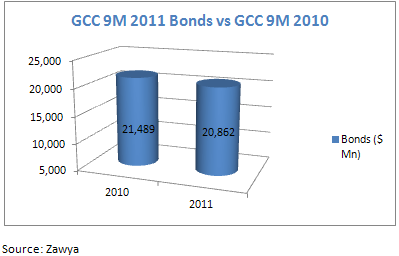
Qatar
As a last gasp before September kicked off, Qatar National Bank announced its desire to set up a USD 7.5 billion Euro Medium Term Note program to fund its banking operations. The Qatari bank appointed Barclays, HSBC and its financial arm (QNB Capital) as arrangers.
UAE
National Bank of Abu Dhabi made a milestone 25-year private placement of USD 20 million under its EMTN program. Standard Chartered acted as sole book runner. The bond is due in 2036 and represents the longest tenor issued by a GCC bank. It carries a fixed coupon rate of 4.80% per annum. The issue underscores NBAD's standing in the international markets and the strong investor confidence in the bank regardless of market instability. NBAD reiterated that it will continue to diversify its funding sources.
Abu Dhabi's Union National Bank mandated Citigroup, Deutsche Bank, HSBC, NBAD and Standard Chartered for a potential bond issue under its EMTN program. Road shows ranging from Asia, Middle East and Europe should commence soon.
In rating news, Fitch has withdrawn the rating for Dolphin Energy's proposed new senior secured bonds as no bonds were issued 90 days after the provisional ratings were assigned. Nevertheless, Fitch confirmed the existing USD 1.25 billion, 5.8% secured bonds due June 2019 at A+.
The Dubai Electricity and Water Authority's (Dewa) vice chairman, Saeed Mohammed Al Tayer, said the utility has "ample funding" and doesn't need to issue bonds. The core debt of Dewa was restructured successfully and the unit can tap the bond markets when necessary. Dewa last sold USD 2 billion of bonds in October 2010.
Dubai's Emirates airline is planning to issue USD 1 billion in bonds to finance aircraft acquisitions. This follows the hugely oversubscribed bond issue of a similar mount in June, continuing the carrier's drive to diversify its capital sources.
Oman
Al Omaniya Financial Services has approved a proposal to raise an unsecured OMR 10 million compulsorily convertible bonds. The issue will have a tenor of five years and a coupon of 5.5% paid semi-annually. As much as 20% of the bonds will be converted into equity shares to meet the minimum capital criteria specified by the Central Bank of Oman. Gulf Baader Capital Markets will act as the lead manager. Proceeds from the issue will be used to cover the long-term investment needs of the firm.
Bahrain
Despite the rating downgrades of Bahraini banks during recent months and the downgrade of the country's sovereign debt by one notch to Baa1 - possibly due to the political unrest it witnessed this year - the Kingdom of Bahrain has laid the grounds to issue up to BHD 3.5 billion worth of bonds. A royal decree issued simultaneously with the consensus of the central bank gave the green light for the issuance of treasury bonds to local as well as overseas investors within the overall BHD 3.5 billion program. The Central Bank of Bahrain said it plans to issue a USD 1 billion sukuk, or Islamic bond.
Concurrently, CBB also announced that its BHD 100 million issue of 12-month treasury bills was oversubscribed by 219%.
Jordan
The Hashemite Kingdom's elevated public debt will oblige it to pay approximately JOD 500 million this year as interest. Bond issuance might take place in 2012 on international markets seeking cheaper borrowing options.
Inflation expectations and the government's fiscal position could drive interest rates upward. Currently, the inflation rate is around 5%, lower than the long-term average. The Kingdom's fiscal stance is presently based on selling hundreds of millions of Jordanian dinars in debt to finance its subsidy schemes and enhance economic growth.
The Central Bank of Jordan recently issued a three-year bond with a coupon of 7.3%, nearly three percentage points higher than the rate earlier in the year. The funds are being used to service outstanding government debt.
The expansion of public debt and the rise in interest rates are forcing the private sector to issue bonds at higher yields to lure borrowers which will ultimately increase the cost of servicing the debt.
Joey Geadah
Research Associate- Bonds
joeyg@zawya.com
© Zawya 2011