Why have regional capital inflows remained well below their 2007 levels, even though emerging markets have since investments surged since then? The IIF says there are four good reasons for the low inflows.
The Middle East North Africa's capital inflows continue to languish after they peaked at a high of nearly USD150-billion in 2007.
In sharp contrast, other regions have prospered since the global financial crisis.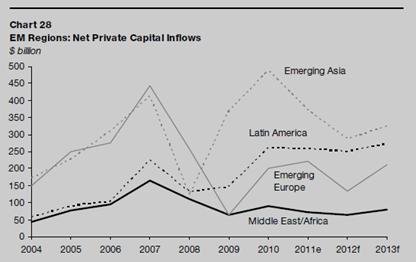
The Institute of International Finance (IIF) says that while international capital flows have resurged in Latin America and emerging Asia in the past two years after plunging to new lows in 2008 and 2009, they remained weak in Middle East and North Africa region.
The institute believes the following factors are to blame:
1. Tight supply conditions related to lower risk appetite following the Dubai debt crisis in late 2009;
2. Corrections in real estate market in some countries;
3. The regional political turmoil in early 2011; and
4. Relatively undeveloped bond and capital market. The share of bonds in total financing in the region is less than 5%, the lowest among emerging economies.
CAPITAL FLOWS
The outlook remains far from robust.
Net private inflows - the amount of capital coming into the country - fell last year in selected Middle East and Africa countries, according to the Institute of International Finance (IIF).
Private inflows in Saudi Arabia, UAE, Egypt, Morocco, Lebanon, apart from African nations South Africa and Nigeria, fell from USD91.3-billion in 2010 to USD72.5-billion in 2011, and is expected to fall further to USD63.7-billion in 2012, according to the IIF.
The picture will start improving in 2013, according to the IIF forecasts, when inflows rise to USD80.2-billion as the investment climate improves.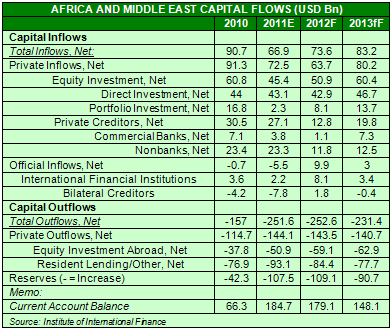
There were major differences between the various countries.
High oil prices have boosted oil exporting countries (Saudi Arabia, the UAE and Nigeria), ongoing political uncertainty continues to adversely affect some MENA economies (Egypt and to a lesser extent Lebanon and Morocco), and global capital market developments and the crisis in Europe have tended to impact the more mature economies (especially South Africa).
However, current account surplus for the selected countries rose sharply on the back of higher oil prices and is estimated to have reached a record USD185-billion, equivalent to 9.2% of GDP.
"A similarly large surplus is forecast for 2012 followed by some moderation in 2013 as oil earnings level off and imports continue to rise," said the group that represents the global banking industry. "A projected combined surplus of USD205-billion in the oil exporting countries in 2012 comfortably offsets relatively modest deficits in South Africa (USD16-billion), Lebanon (USD8-billion), Morocco (USD4-billion) and Egypt (USD3-billion)."
While the private investors are running for cover, the official capital inflows rose as multilateral institutions stepped in to support countries such as Egypt, Tunisia and Morocco.
Official flows to the region are forecast to be the highest in over a decade. The projected USD9.9-billion of net inflows in 2012 compares with USD5.5-billion in net repayments last year,
USD1.5 TRILLION FOREIGN ASSETS
Not surprisingly, petrodollars ensured that Saudi Arabia and the UAE remained strong sources of foreign investment. The IIF expects the two economic powerhouses' foreign assets to reach USD1.2-trillion in 2011 from about USD1-trillion in 2010, and is expected to increase to USD1.5 trillion by 2013.
"In addition to providing foreign investment flows to the rest of the world, the oil exporters of the region will continue to be a source of positive spillovers both within and outside the Middle East, through imports and outward remittances," says the IIF.
In Egypt, the departure of Hosni Mubarak impacted the country's finance as capital fled, foreign direct investment dried up and economic activity halted.
Official reserves, excluding gold, nearly halved from USD32.6-billion to USD15.4-billion.
The interim government is seeking funds from Gulf states, the IMF and other international parties including the European Union and the United States, among others.
If these investments come through, the IIF expects Egypt to receive official capital inflows of up to USD7-billion this year.
In Lebanon, total net private capital inflows rose from USD4.6-billion in 2010 to USD7.8-billion in 2011 (or 19% of GDP), even though FDI declined due to the unstable regional environment.
"This is explained mainly by the increase in non-resident deposits in domestic banks, which rose to USD6.5- billion at end-November 2011 from $4.5 billion at end-2010, partly reflecting outflows from the more troubled countries in the region. We expect private capital flows to decline in 2012 to $5.4 billion," says the IIF.
Morocco, which avoided the worst of the unrest that troubled its North African peers, also saw private capital inflows rise to USD3.6-billion in 2011 (4% of GDP) from USD1.8-billion in 2010.
French car maker Renault's decision to open a subsidiary in Morocco will pump USD1.8-billion into the economy, and hover around USD3.5-billion in 2012 and 2013.
© alifarabia.com 2012