Connecting intelligence with intelligence

×
×
Advertisement

Sep 03 2012

GCC rail projects: Locomotives of growth

By Sona Nambiar GCC rail projects: Locomotives of growth
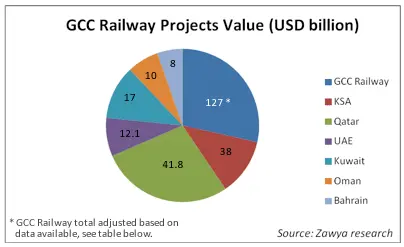
As much as USD 149 billion worth of rail projects are in the planning or construction stages in the Arabian Gulf up to 2030, according to Zawya data. These projects include plans for national railway systems, city rail systems or metros, and trams. Some of these will ultimately converge to form part of the ambitious GCC Rail project, which aims to unify the region and enhance people connectivity and freight movement.

Since conservative budget projections have always left room for larger surpluses, it firmly underpins the GCC governments' wider commitment to sustaining long-term development in infrastructure, education, healthcare and social and economic projects in keeping with the growing demographics in the region.

The population of the six Arabian Gulf countries is expected to grow to 49.4 million in 2016, according to research by Riyadh-based Samba Financial Group. With crude oil prices averaging around USD 115 per barrel in the first half of 2012, the GCC governments will fundamentally remain committed to spending on surface transportation, specifically rail, when one considers all the drivers of growth.

Freight and People Connectivity

The GCC economies continue to be the energy powerhouse of the world. While geopolitical forces triggered anxieties about supplies from Iran, GCC oil production proved that demand for oil, especially from emerging Asia, remains adequately met.

"The initial push for all rail projects in the Middle East is movement of the economy through freight. The second aim is to move people and making connections faster and easier," said Arash Aghdam, director of rail and transit for the Middle East and North Africa at Parsons Brinckerhoff.

The combined GDP of the six countries would have risen from USD 1.075 trillion in 2010, to nearly USD 1.380 trillion in current prices in 2011, according to research by the Kuwait-based Gulf Investment Corporation. This would mark the highest level ever and significantly above the previous peak GDP of USD 1,138 trillion in 2008. An expansion of 5.8% to USD 1.6 trillion in 2012 continues to provide the Gulf governments with the firepower to invest in infrastructure.

The recent decline in oil prices will not affect the economies of Gulf hydrocarbon exporters. Qatar will still lead growth in the region with around 8.7% followed by 6% in Saudi Arabia, 4.5% in Kuwait and the UAE, 4.2% in Oman and 3.1% in Bahrain, GIC has forecast.

While the GCC countries have been affected by the global financial crisis, the high levels of oil prices have reflected positively as a surplus in the budgets.

"Fundamentally, the governments are committed to connectivity by rail for a long time to come and each member state is responsible for its own financing and building its own infrastructure," Aghdam told Zawya.

"The current estimated value of actual GCC rail projects is led by Saudi Arabia at an estimated USD 40 billion with projects that cover more than 4,000 km in length. Qatar follows with USD 25 billion, then UAE with an announced USD 11 billion worth of rail projects followed by Oman with USD 10 billion.

"Kuwait will invest USD 7 billion while Bahrain's rail investments will run to around USD 1 billion." This includes both the rail and metro projects in all the GCC countries, according to Aghdam.

"The governments are all building for a future. They have done their due financial analysis but everyone is building an industry that does not exist, to provide movement to their economies and people," he said.

Zawya's figures included projects in the planning stage and announced by GCC governments up to time of writing this report.

Each country has a different reason to invest in rail projects. "In Oman, it will assist tourism, while the UAE is focused on goods and services and passengers. Saudi Arabia's focus is freight/mining and passengers. In Qatar, it is the mandate of the government to secure the football World Cup while the Kuwait Metro and the National Railway will assist with city traffic and connectivity to Saudi Arabia and Iraq. Bahrain has also announced that it will invest in the LRT system for the city to alleviate transportation issues," Agdham said.


Source: Zawya

Unifying the Region

Detailed engineering designs of the GCC Railway are expected to be completed by 2012, according to Dr Ramiz Al Assar, senior adviser to the GCC General Secretariat. While the initial costs of the GCC Rail were estimated at USD 10 billion in November 2011, he said costs would run to USD 15.5 billion if diesel is used or even reach USD 25 billion for the electric option.

Zawya estimates the project costs to go up to USD 30 billion if one bears in mind the spikes in prices of raw materials over the years plus the actual implementation process of interconnectivity of operations.

Construction is expected to commence in 2013 or 2014, to be completed by 2017. A GCC Railway Authority will be formed to oversee the overall implementation of the project and coordination with the GCC member states.

The project is expected to generate significant employment for GCC nationals, promote social integration and economic development, advance the GCC initiatives on the common market and customs union and facilitate trade. It will also support building national railway industries in the GCC member states, alleviate congestion and reduce maintenance costs on roads.

But the path ahead is not easy. Al Assar noted that there is a need for institutional capacity building and setting up an adequate institutional framework. This would include enabling policy, strategy and regulations as well as setting up of an economic and safety regulatory authority. There is also a need for private sector participation in the development.

Above all, there has to be efficient coordination between the rail authorities of the different countries - such as SRO, Etihad Rail, Qatar Rail, Kuwait Transport Company and so on. In terms of financial liability, the GCC member states will have to examine the cost of railway (capital and rolling stock) and determine the cost-sharing process and government subsidies as well as the costs of building extension lines and the introduction of high-speed passenger services.

It will also be necessary to have more stringent procurement guidelines to ensure selection of required skills and quality consultants/ contractors.

Additional responsibilities will include but not be limited to the need to streamline the decision-making process amongst the GCC member states, the need for a strategic GCC transport sector review and assessment focusing on regional networks integration (transport logistic perspectives) and above all an understanding of the GCC national environments while adopting international best practise, Al Assar has said in his recommendations.

"The technology is not new but all the governments want the best. Fundamentally, the environmental issues must be considered when selecting the technology. And, of course, the public. In terms of the metro, it has to be also considered that people need comfort when they move from one station to the next. Providing public comfort is very important and has to be borne in mind when designing the LRT and metros. It is very important to consider the local conditions," added Agdham.

"The Dubai model of the metro is an excellent system. However, at present, it provides limited connectivity options. The railway industry in the GCC is at its early stages of development. It is a privilege to be part of creating this industry though it is not without its challenges. It has to fit the purpose of the GCC and its various member countries. The timeframe is unknown (for the projects) but the mandate is huge. It is an interesting time to observe the development of the strategies. The clients are informed and ambitious. They would like to receive the best that they can get and they should. We need a system that is looks good in 10 years time and is sustainable in 20 years to come."

© Zawya 2012


© Copyright Zawya. All Rights Reserved.


Be the first to comment

Send This Article To Your Friends

All fields are required.

Use commas for multiple email addresses

We'll use your email address to send the article on your behalf and it will not be collected or used for any other purposes.

X