New faces in Kuwaiti parliament are set to face the same old challenges: lack of economic diversification, stalled development and a political environment that does not allow any meaningful progress.
All of these problems were masked by a 4.4% growth in real GDP with the hydrocarbon industry leaping ahead with a 7% growth last year.
And while earlier estimations suggested the country's economy would slow down in 2012, Kuwait is expected to benefit from Iran's oil exporting problems, propping up its oil revenues this year, and further kicking the reform can down the road.
"Real GDP should advance 3.8% in 2012, with CPI inflation relatively moderate at 4.0%," notes the latest research from NBK Capital, the investment banking subsidiary of the country's largest bank. "We expect oil prices to remain relatively supported thanks to very moderate world growth (but escaping a recession), as well as tight supply conditions though Libyan oil should be coming back gradually."
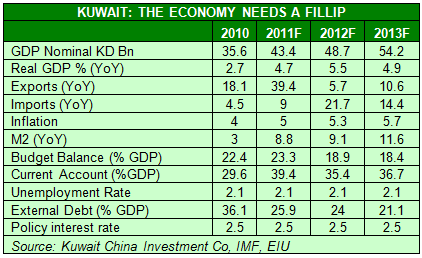
The bank said the rest of the economy, especially construction and business services, showed signs of stirring late in 2011 and should improve somewhat in 2012, but will be very sensitive to the momentum, or lack thereof, of the government's current development plan.
Don't raise your hopes. The latest elections - the fourth in six years - have seen the Islamist-led opposition flex their muscles by winning 34 of the 50 parliamentary seats.
Liberals, along with the four women who came to power in the last elections, were routed and lost their seats.
The Arab Spring waves, that engulfed many of the poorer Middle East economies, also lapped up on the shores of wealthy Kuwait last year. Years of political indecision, infighting and corruption allegations came to a head with increasing public dismay and protests.
A corruption scandal involving at least 14 out of 50 MPs triggered a renewed backlash against Sheikh Nasser Mohammed and contributed to the resignation of the foreign minister, Sheikh Mohammed Sabah al-Salem al-Sabah, in mid-October. Given the large number of MPs facing allegations of corruption, the emir had little option but to dissolve parliament and call a new election.
Kuwait also experienced its own version of the "Occupy" movement, when protestors stormed the Kuwaiti parliament and briefly occupied the building, demanding the resignation of Prime Minister Sheikh Nasser Al-Mohammad Al-Sabah.
The protests are somewhat of a surprise, given that Kuwait has a cradle-to-grave welfare system and the only elected parliament in the Gulf region. But it also highlights the state of dysfunction and corruption in the political system, which has seen four governments in six years.
The rise of Islamists - the fourth country in the region to see Islamic parties come to power in an election after Egypt, Tunisia and Morocco - has been the result of a public backlash due to lack of political reforms.
Some analysts hope that the new MPs may push for more government spending to stimulate the economy.
"The Arab Spring has reached Kuwait, but in Kuwaiti style... calm, peaceful and legal," a Islamist MP Mubarak al-Duwailah wrote in an op-ed in a local paper.
"The people have expressed their support for the Islamist forces."
But the Islamic led group which also include many tribes, remains divided over a host of issues and is expected to face challenges to meet the citizens' demand for a constitutional monarchy and political reforms.
Most analysts are doubtful that Islamic parties can succeed - especially as it pits them against the Western-backed rulers headed by Emir Sheikh Sabah al-Ahmed al-Jabr al-Sabah.
LOSING PROMINENCE
Kuwait, which enjoys immense wealth, has seen its dominance in the region recede with other Gulf economies such as UAE and Qatar galloping ahead of the country, in many areas including telecommunications, infrastructure, stock market development and economic diversification.
A Kuwait Development Plan is expected to address some of the shortcomings.
The 2010-14 development plan carries a $104-billion price tag and aims to increase the role of the private sector in the economy. But Citibank notes that the ever-present threat of political tensions re-emerging represents a significant challenge to the government's ability to implement its ambitious investment plan.
"It is unlikely, in our view, that full execution of the plan will occur, with a more realistic scenario of around US$70bn of the projects actually being implemented, at best," noted Citibank in a report last year.
After a promising start in 2010, including the passage of the much-delayed privatisation law, progress appeared to stall in the second half of the year, with fiscal data suggesting very little in the way of capital expenditure.
NBK Capital reports that the four-year KD31 billion (USD104bn) development plan called for spending KD5 billion (USD18 billion) on infrastructure in the last fiscal year.
"The government managed to spend an estimated 60% of that amount. In the current fiscal year 2011/12 (ends in March) plans are to spend KD5.4 billion (USD19.5 billion). We expect a higher spending (or execution) pace of 70-75% for 2012 though recent early signs are not very encouraging and we could still end up near 60%."
The bank expects infrastructure spending to pick up once the new public-private companies (PPPs).
"Progress has been somewhat disappointing on that front, and it is hoped that the first two (large) such ventures are not further delayed beyond 1Q2012," says the bank.
SHORT-TERM INDICATORS
While the country is struggling with implementing long-term reforms, the short-term indicators are not great either.
EFG-Hermes estimates that credit growth was up a mere 1.6% year-on-year.
While retail segment grew by 6% year-on-year, due to salary increases in several economic sectors, corporate lending growth rose just 3% year-on-year, driven by a similar expansion in real estate and construction, which is by far the largest corporate lending segment (making up 67% of the total).
"Lending to financial institutions fell by 16% year-on-year as banks reduced their exposure to the troubled investment companies segment," said the bank. "System loan growth failed to pick up last year, as weak government capital expenditure led to scarce lending opportunities for the banking sector and as banks remained cautious. We forecast loan growth to remain at low single digits in 2012, with our base case scenario being weak infrastructure spending."
BEYOND OIL
Beyond the oil economy, the non-hydrocarbon economy grew by 2.9% last year, according to Institute of International Finance estimates - the lowest in the Gulf after troubled Bahrain. The Instiute expects 2012's non-oil economy to grow by a mere 2.6%, even lower than Bahrain's non-oil economy.
"Over the medium term a higher level of growth, close to the pre-crisis level, requires a political consensus on much-needed reforms, and a shift in government spending to support increases in non-hydrocarbon productive capacity in the private sector," notes the IIF.
But there has been some signs of a turnound.
Real estate sales rose 35% in 2011 to reach KD2.7 billion. In 2011, the rise in sales was led by the investment sector which gained 52%, followed by the residential sector up 32%. Not surprisingly, sales in the commercial sector underperformed gaining only 3%.
OIL TO THE RESCUE
Kuwaiti oil production has surprised on the upside, with capacity boosted 300,000 barrels per day over the 2010‐2011 period, as the Gulf states stepped up to make up for loss of Libyan oil. Saudi Arabia, Kuwait and the UAE are the only Opec members with spare capacity and their oil-pumping services will continue to be needed as Iranian oil disappears from the market due to the crippling sanctions being imposed on that country.
But even in this area of relative advantage, Kuwait has no major new projects lined up. This is quite incredible for a country sitting on the sixth largest oil reserves in the world at nearly 101.5 billion of crude, and where oil income accounts for 90% of its budget revenues and exports.
While the Kuwaiti Petroleum Corporation has earmarked a USD90 billion expansion plan encompassing both the upstream and the downstream, progess has been slow. The plan includes upgrading Kuwait's production and export infrastructure and its tanker fleet, expand exploration, and build downstream facilities, both domestically and abroad, which is expected to boost oil production capacity to four million bbl/d by 2020.
Central to this major expansion is USD7-8 billion Project Kuwait that was initiated 13 years ago, focused on attracting foreign oil companies to the country. But the move was seen as unconstitutional and remains a victim of parliamentary deadlock.
"Kuwaiti capacity is forecast to rise just 100,000 bpd over the 2010‐2016 period, to 2.72 million bpd," noted the International Energy Agency forecast in December. "Indeed, the latest rise in capacity levels reflects a marked increased in active drilling rigs and debottlenecking at the Mina al‐Ahmadi oil terminal, which has enabled increased production from its giant Burgan oil field."
That's a pity given that Kuwait's breakeven oil price is around USD55- which makes it a cost-effective jurisdiction to explore for oil compared to the costly unconventional oil exploration exploding across the world.
Oil is Kuwait's cash cow, has a tremendous impact on its economy and funds much of its non-oil development. This is evident in an NBK Capital report that notes if oil prices average between 104 and $107 per barrel this year, the country could post another budget surplus.
"If as we expect, spending comes in at 5-10% below the government's forecast, the budget could see a surplus of between KD 8.5 billion and KD 10.5 billion before allocations to the Reserve Fund for Future Generations. This is KD 3-5 billion higher than last year's surplus, and would represent Kuwait 13th successive budget surplus."
How Kuwait can afford not to develop this resource, and fail to implement robust plans to diversify away from oil, is beyond the pale.
CONCLUSION
The frustration regarding the Kuwaiti economy is acutely being felt by the citizens even though they enjoy a much better lifestyle than their regional counterparts and benefit from a strong welfare system.
Kuwait has lagged other Gulf states in virtually every social and economic indicator, from foreign direct investment to ease of doing business. The country is also vulnerable to oil price volatility, especially at a time when oil prices are being propped up by geopolitical tensions, not greater oil demand.
It also suffers from a bloated public sector - more than 90% of Kuwaitis are employed by the government - which continues to eat away into revenues, and overshadows the private sector.
Things need to be turned on their head in Kuwait, but unfortunately, indications are that the new government may be unable to make any headway and the political deadlock will resume.
© alifarabia.com 2012