Jordan's increasing demand for power coupled with a uranium reserve of 140,000 tons and phosphate reserves of 59,000 tons has turned the kingdom's focus toward generating nuclear power.
It has signed an agreement with the French Areva group to invest EUR 8 billion over the next five years in the nuclear power sector. Other agreements include those signed with Britain in June 2011 and with SNC-Lavalin and the Canadian Atomic Energy Agency. Jordan has signed similar agreements with China and the United States.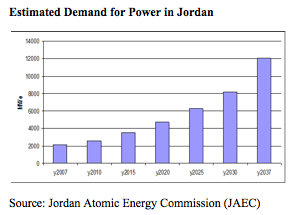
Jordan depends heavily on the private sector to invest in expanding power generation, transmission and distribution. In the nuclear energy segment, the government tends to build strategic partnerships with international companies and institutions to ease the investment burden. The kingdom may also receive aid from the European Union to cover a part of the expenditure.
Developing nuclear power capability would also lower Jordan's oil import bill. Jordan imports 95% of its power needs at a cost of at least JOD 2.5 billion, which is 24% of the value of imports and 20% of total GDP. Local sources produce only 5% of the total power needs.
Dr. Khaled Toukan, chairman of the Jordan Atomic Energy Commission (JAEC), said the kingdom is now doing a feasibility study on the building of the first nuclear power plant. The study, which will specify the best technologies to extract uranium from phosphoric acid in addition to making engineering designs for the institution and determining the capital and operational costs, is expected to be completed next year.
Media consultant to the JAEC, Fayez Aboqaoud, said nuclear power projects are being viewed as mega industrial projects. Their benefits include providing a reliable new source of energy at a reasonable and stable cost. Nuclear power also has the benefit of zero emission of global warming gases and also provides increased employment.
Unemployment in Jordan is currently about 13% of the population. "We are expecting to employ 5,000 persons during building the nuclear reactor besides permanently employing 1,000 engineers, technicians and workers," Aboqaoud said.
The nuclear initiative will also have the spin-off benefit of creating new companies to support and supply the reactors. The first such company is Jordan Energy Resources Inc (JERI) owned by the JAEC with a capital of JOD 100 million. This company is responsible for exploration work to find uranium and other natural sources.
There is also Nabattean Energy Company which was established as a joint venture between JAEC and Areva, headed by the JAEC chairman with three members of the board being Jordanian and two French.
The Jordanian French Uranium Mining Company was established as a joint venture between JERI and Areva to follow up exploration and mining.
"The government faced the lack of ability to provide power due to the gap between supply and demand. In this regard the Jordanian government is studying new projects besides some of them under construction which all use natural gas as a fuel," said economist Ebrahim Khoraysat.
Building the Al Qatrana power station is one such project, with a capacity of 373 MW. Additions to the Al Samara power station will convert two gas turbines to a combined cycle plant with a capacity of 300 MW. A steam generator will be added to produce 100 MW.
However, these and other conventional energy initiatives will only provide temporary relief, Khoraysat said. "A long-term solution is necessary," he added.
© Zawya 2012