The Saudi cash registers may be ringing incessantly as barrels upon barrels of Saudi crude reach the global oil market, but its impact on the Saudi non-oil sector economy has been less than stellar - at least for now.
While the non-oil sector may take some time to warm up as new projects are awarded, even the medium-term estimates don't suggest a rapid reduction in unemployment.
Almost in defiance of the rest of the world, Saudi Arabia's economic prospects keep getting revised upwards.
Saudi-based Jadwa Investment Bank is the latest to raise Saudi real GDP estimates this year from 5.6% to a whopping 7.1%, much higher than the International Monetary Fund's estimate of 6.5%.
The recent flow of data coming from the Saudi economy has led to this revision, primarily on the back of Saudis producing oil at an all-time high coupled with elevated crude prices.
The country has been reportedly producing 9.38 million barrels of oil per day in September, compared to 8.1 million around the same time last year.
Jadwa has revised Saudi oil production as Libyan oil returns to the market, but it will still remain high at 9.2 million barrels of oil per day.
While oil prices remain high from a historical perspective, they have taken a hit over the past few weeks, falling $10-15 on the back of bleak global economic outlook.
But supply constraints and tensions in oil producing nations is set to ensure that commodity prices don't fall off a cliff. On the back of oil traders' minds is also the threat that Opec could cut production quotas to ensure prices don't freefall.
Based on the oil outlook, Jadwa has raised estimates for budget surplus to 10.5 percent of GDP (SR213 billion) from 6.4 percent of GDP.
"This is due to the increase in our oil production, and therefore oil revenue, forecast. It is also notable that domestic consumption over the first seven months of the year is down slightly on the same period of 2010, lifting the proportion of total production that has been exported," note Paul Gamble and Brad Bourland, Jadwa Investment economists.
High oil production and exports has also pushed up Jadwa's forecast for the current account surplus, which it now expect to see at 27.3 percent of GDP ($147 billion) up from 24.6 percent of GDP.
"Over the remainder of the year we expect a slowdown in export growth owing to falling oil, petrochemical and plastics prices. The weaker global economy could also pull down export volumes, though some of this could be offset by increased petrochemicals production."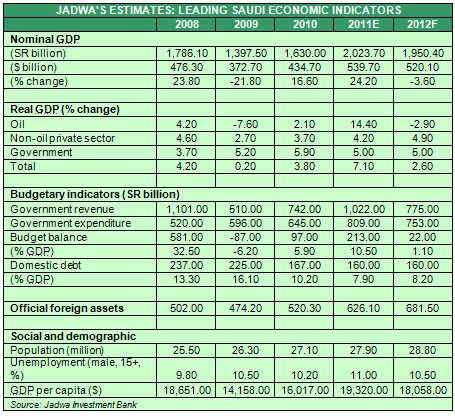
Riyad Bank Estimates: 4 Factors
In a similar vein, Riyad Bank also remains fairly optimistic about the Saudi economy, and expects overall growth at 6.9% for the year.
In addition to high oil production, the Saudi economy will benefit from four key factors, notes Dr. Khan Zahid, chief economist at Riyad Bank:
1) The upcoming Haj season;
2) Year-end boost in government spending to meet fiscal targets;
3) The government budget announcement; and
4) Year-end earnings expectations.
Other indicators have also given Dr. Zahid cause for optimism, such as bank loans to the private sector which continue to set new records and new letter of credit and point of sales, which remain robust.
"On a year-over-year (y-o-y) basis, broad money supply recorded a growth of growth 14.8% in August following two months at 13.1%," said Dr.Zahid in a note to clients. "We believe that this phase of growth will be more sustainable as it is driven by banking sector lending instead of temporary cash flows from the government to the public. We maintain our bullish outlook going forward."
Meanwhile, bank lending to the private sector extended its two-year winning streak by showing a new record y-o-y growth of 9.3% in August.
Oil Vs Non-Oil Growth
While the Kingom's real oil GDP is expected to rise 14.4% this year, according to Jadwa estimates, non-oil is estimated to lag far behind at a relatively mediocre 4.2%.
That's clearly not enough.
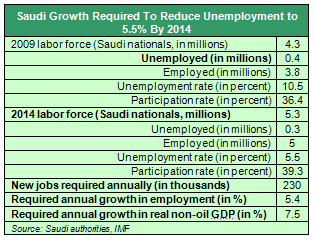
The IMF estimates that Saudi Arabia's real non-oil GDP should hit 7.5% each year, especially if it wishes to create jobs to keep up with new Saudis joining the workforce, and reduce its dependence on the energy sector.
Addressing the unemployment problem will require a sustained acceleration in growth and an increase in the share of new jobs filled by nationals, says IMF in a September report on the Kingdom.
"Given existing population dynamics and based on recent labuor market behaviour, staff estimate that to reduce unemployment by 5 percentage points over the next five years would require acceleration in non-oil growth to about 7.5 percent a year, a significant increase relative to historical trends," says the IMF.
"This estimate is highly dependent on the evolution of the labuor market participation rate, and the proportion of new jobs that are filled by Saudi nationals versus expatriates."
Between 2004 and 2009, the economy generated an average of almost 200,000 jobs a year, almost twice the recent pace of increase in the labour force of Saudi nationals, but this had limited impact on unemployment rates as more than half of new jobs have typically gone to foreign nationals.
Jadwa estimates show that Saudi unemployment will actually rise from 10.2% in 2010 to 11% in 2011.
This is partly due to a poor global economic environment, but more worryingly, Jadwa is not optimistic of future employment prospects, expecting only a slight drop of 10.5% in unemployment by 2012.
Alifarabia.com has argued in an earlier report that the Saudi Government could be unwittingly undermining its Saudisation (Nitaqat) programme by making the public sector a far more rewarding place to work for [read full story here: Undermining Nitaqat]
The IMF notes that to date job creation has been heavily dependent on government spending - a formula that needs to reduce the stubbornly high unemployment in the country.
"While raising public sector salaries and expanding public sector employment opportunities can enhance short-term social outcomes, they may also provide a disincentive for nationals to seek private sector employment," the IMF says. "Similarly, an unemployment benefit scheme needs to be designed carefully to ensure that it does not create an additional disincentive to private sector employment."
In their defence, the Saudi authorities have told the IMF that the unemployment benefit scheme was still under design and was intended to be temporary and a transitional step to a more comprehensive social safety net.
The fund has identified the housing development plans could emerge as a key job creator, "but it will likely have limited impact on employment of nationals as the construction sector tends to be dominated by expatriate labor."
The IMF has made two strong recommendations which could jumpstart job creation in the country:
1) Increased economic integration within the GCC and deeper trade relations with emerging partners in the Middle East beyond the GCC, as well as Asia. While aggregate trade data for both exports and imports point to limited growth in intra-GCC trade, the authorities noted that intra-GCC trade in services, including tourism, was growing rapidly. Both emerging Asia and certain countries in Middle East--including Egypt, Jordan, and Syria--were becoming increasingly important trade partners and further trade facilitation efforts could provide a stimulus to growth.
2) Access to finance has been an important constraint on private sector activity. Recent initiatives to stimulate SME credit through a system of partial guarantees have eased access issues for this segment of the market, but broader capital market reforms to foster the development of corporate bond markets and Islamic products could also enhance financial intermediation.
Conclusion
The Saudi economy just does not needs jobs from government and handouts, but a robust private sector that trains and employs Saudis in the long term.
That piece of the puzzle is taking time to fall into place. But the Saudi authorities are working hard to change that dynamic. They have the financial muscle and the political will to initiate change - and they have amply demonstrated this year that they can move quite fast when the situation demands it.
But the unemployed youth needs jobs - and government action - now.
© alifarabia.com 2011