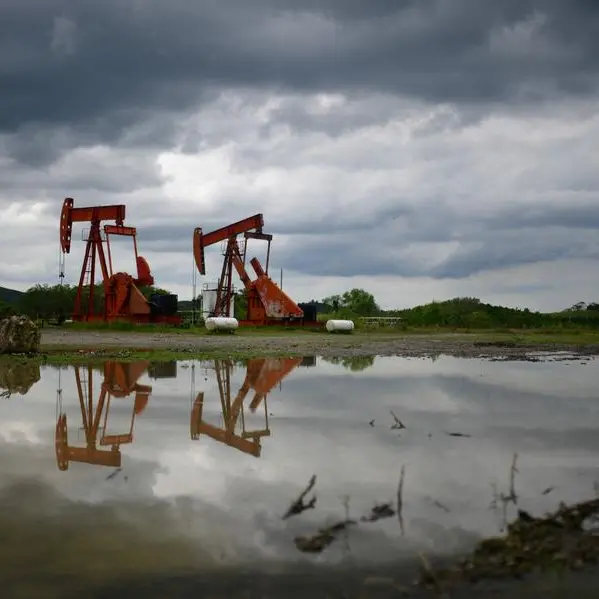
It should be a moment of pride for the Nour Al-Maliki government. Iraq's oil production crossed three million barrels per day - the last time production was so high was in 1979, when 3.49 million barrels per day rolled out of the country's oil wells just as President Saddam Hussain came to power.
The country's crude production rose by 195,000 barrels per day in April to 3.03 million, according to the International Energy Agency (IEA), with oil exports rising to 2.51 million bpd - the highest since Iraqi tanks strolled into Kuwait for one of the greatest misadventures in the country's history.
In fact, Iraq has been leading the rise in OPEC supplies this year.
"OPEC crude supply in April rose by 410,000 bpd, to 31.85 m bpd, with Iraq, Nigeria and Libya providing around 85% of the increase. Indeed, higher Iraqi exports accounted for half of the incremental supply," the IEA noted in its latest report.
Iraq's ascendancy in the global oil sector comes at a time when its former rival Iran is facing considerable decline.
OPEC producers are ramping up output to meet increased customer demand in response to the potential disruption in Iranian crude flows in coming months as the EU's 1 July oil embargo nears. EU and U.S. sanctions are expected to ultimately impact upon 800,000 barrels per day to 1 million bpd of Iranian exports compared to 2011 levels.
"It's historic - really tells the story of the historic struggle over who will dominate the Gulf," said oil historian Daniel Yergin in a conference. "And, of course, now it is a Shia-Iranian more friendly regime in Iraq. And as soon as Iraq raised its estimates of its reserves, like the next week Iran said, well, our reserves are larger and the Iranians are not going to particularly welcome a big increase in Iraqi production...."
To be sure, Iran's crude output remained unchanged at 3.3 million barrels per day last month, but its key importers such as Japan and South Korea are gradually reducing their purchases of Iranian oil.
There are also reports that Iranian crude is languishing in floating storages.
It appears that much of the unsold March production ended up in onshore and floating storage in April. Estimates of crude held in floating storage at end‐April ranged from 20‐35 million barrels, compared with 8 million barrels in March. That is equivalent to a rise of between 450,000 to 800,000 bpd held offshore. A further 20‐25 million barrels has reportedly been stored at onshore facilities in recent months.
Analysts believe that Iraqi crude production would surpass Iranian output before the end of the year. Iran's decline and Iraq's rise is an important dynamic in the global oil market and certainly that for the region.
With Iraq set to unveil the fourth round of oil auction on May 30-31, there is tremendous hope in the air that Iraq would embark on a strong growth path that would benefit global supplies and help the country earn the revenues to build its infrastructure, via its 143 billion of oil reserves - the fifth largest in the world.
On offer this time around is 12 large exploration blocks with an average size of 6,500 square kilometers. Winning companies, or consortia of companies, will carry out exploration, appraisal, development and production activities within the assigned areas.
The aim of the fourth round is primarily to expand Iraq's natural gas production capacity to satisfy the power generation sector and create gas-based industries, as well as increase the country's oil reserves. The auction covers 12 new exploration blocks, which could add 29 trillion cubic feet of gas and 10 billion barrels of oil to Iraqi reserves.
"We are looking forward to welcoming all participating companies in Baghdad. The fourth licensing round will be conducted in a transparent and public manner and according to the same procedures as the first three rounds," Abdul Mahdy Al-Ameedi, director general of the Petroleum Contracts and Licensing Directorate.
Forty-seven of the world's largest companies including Chevron, BP, Shell, Total and CNOOC are short-listed for the bids. A notable absentee was Exxon Mobil, America's largest publicly listed oil company, which was barred because it struck a deal with Kurdistan Regional Government (KRG).
KURD PROBLEM
The Exxon Mobil issue is a microcosm of the tensions between Iraq and Kurdistan Regional Government, which strongly believes it should have the right to strike oil deals with companies. Baghdad disagrees and has used its clout with international oil companies to contain Kurdistan's ambitions.
In fact, by striking a deal to explore six blocks with KRG, Exxon Mobil was in danger of losing its West Qurna field deal with the central government. The field contains 43 billion barrels and is considered the second largest in the world.
While Baghdad has maintained that Exxon's West Qurna deal is not under threat, and has even signed a few smaller deals with the American oil giant since then, it does have a bone to pick with the KRG government.
Of the six explorations blocks, two, along with a corner of a third, lie across the Green Line, which divides KRG from the rest of Iraq. Exxon thus placed itself at the heart of the conflict, potentially accelerating the centrifugal forces that are tearing at the Iraqi fabric, notes the International Crisis Group.
"While ExxonMobil may have calculated that by doing so it could help bring Baghdad and Erbil to the table and effect progress on a federal hydrocarbons law, the likelier outcome is that both sides will further entrench their positions, thus increasing the chances of violent conflict," the ICG noted. "From Baghdad's perspective, the Kurds are making mincemeat of any attempt to have a unified federal oil strategy; increasingly, it views them as untrustworthy partners in government who are seeking to break up the country."
Baghdad's iron-fisted approach to Kurdistan's deal is having the intended effect: France's Total, along with American giants Chevron and Conocco Philips were also reportedly eyeing deals with KRG but now have cold feet as they fear being excluded from the greater Iraqi oil play.
HYDROCARBONS LAW
But the skirmishes with KRG and the absence of a hydrocarbons law could dampen Iraq's desire to form a unified country that could rival Saudi Arabia.
Iraq had once targeted oil output of 12 million bpd, matching Saudi output, but has since revised estimates to 8-8.5 million, which is still considered high by many independent observers, given the country's infrastructure bottlenecks.
Indeed, Iraq's ambitions could be derailed if it does not resolve provincial disputes.
"The continued weakness of central authority and of the security services may allow militia and insurgent groups to re-establish themselves in some areas, although violence is unlikely to return to 2006-07 levels," warns the Economist Intelligence Unit.
"The government of national unity, which brings together the four largest political groups, will continue to be weak and divided, and some blocs are likely to pull out to join the parliamentary opposition."
The problem is coming to a head: In April, the KRG suspended its supply of oil for export through the national Iraqi pipeline, claiming Baghdad had not fully repaid operating costs to producing companies. The federal government responded by threatening to deduct what the oil would have generated in sales from the KRG's annual budget allocation, potentially halving it.
"This latest flare-up in perennially tense Erbil-Baghdad relations has highlighted the troubling fact that not only have the two sides failed to resolve their differences but also that, by striking out on unilateral courses, they have deepened them to the point that a solution appears more remote than ever," noted an International Crisis Group report. "It is late already, but the best way forward is a deal between Baghdad and Erbil, centred on a federal hydrocarbons law and a compromise on disputed territories."
International actors - the UN with its technical expertise and the U.S. given its unique responsibility as well as strategic interest in keeping things on an even keel - should launch a new initiative to bring the two back to the table, the ICG recommended.
The ICG suggests that international companies should refrain from signing contracts in disupted territories as it will only bring sensitive issues to the fore.
Some of the other recommendations include:
1. Reduce tensions and improve the environment for resolving differences by:
a) re-committing publicly to a negotiated solution to the status of disputed internal boundaries and the conflict over oil and gas contracts;
b) agreeing to take no further unilateral steps in disputed territories, such as issuing new oil and gas contracts; and
c) refraining from inflammatory rhetoric concerning mutual relations, the status of disputed internal boundaries and the issuance of oil and gas contracts in disputed territories, especially (in the Kurds' case) in the run-up to provincial elections in the Kurdish region on 27 September 2012.
2. Work, along with other Iraqi parties and alliances, toward the success of a planned but delayed national conference regarding a practicable power-sharing arrangement in Baghdad.
3. Resume negotiations promptly on the status of disputed internal boundaries and a federal hydrocarbons law and agree, as part of such negotiations, to open channels of communication and coordinated action, including:
a) a channel for frequent communication between Prime Minister Nouri al-Maliki and KRG President Masoud Barzani or their designated senior representatives; and
b) the appointment of a non-voting official from each side to, respectively, the Iraqi cabinet and the KRG's council of ministers to promote early flagging of disputes.
Other stakeholders such as Turkey, the U.S. Government and the UN Assistance Mission for Iraq needed to play concilliatory roles rather than inflame the situation.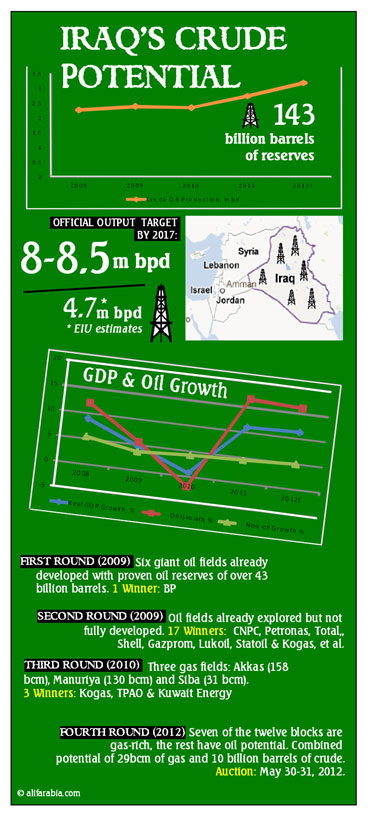
CONCLUSION
Iraq's return as an oil giant should see an equally robust rise in the standard of living of its citizens. The country - ravaged by wars and infrastructure neglect - needs oil revenues to rebuild the economy and turn the country into a strong and prosperous nation with job creating potential, rivalling that of Gulf states.
The central government needs to pull all the players together to ensure that becomes a reality. Its continued dispute with KRG robs the country of valuable FDI, job-creating opportunities and transfer of technical skills - that can hardly be the way to rebuild a nation.
© alifarabia.com 2012