The Middle East citizens' attitude and feelings towards the United States is well documented, but rarely do we get an insight into the minds of the average American citizen - not government officials - and it offers a very interesting insight into the American world view outside of Washington.
The popular perception is that Americans are oblivious to Mideast affairs and often group all the various and myriad operators, parties and camps that operate within the region as one homogenous group.
The University of Maryland's Anwar Sadat Chair and the Program on International Policy Attitudes gauged American public's first impressions of the tragic events in Egypt and Libya which led to the assassination of Christopher Stevens, the U.S. Ambassador to Tripoli.
The study revealed some instructive views: Despite the fury and anger within American media, the average U.S. citizen's view is remarkably rational and composed, for the most part.
"Most Americans believe that the recent violent attacks against the American embassies in Libya and Egypt are the work of extremist minorities, not majorities, but most are dissatisfied with the reactions of the Libyan and Egyptian governments," the study concluded after polling more than 750 Americans after the attacks on U.S. interests in Libya and Egypt.
While this appears to be a very small sample of a population of around 300 million people, and should be taken with a grain of salt, it does offer a window into a slice of American public opinion.
More crucially, Americans seem to side with their President's view that Israel attacking Iran would not yield positive results but could further imperial American interests.
"Most Americans believe that an Israeli strike against Iran's nuclear program would do little or nothing to slow down Iran's nuclear program, that it would lead to Iran striking American bases and draw the US into a war with Iran, drastically increase the price of oil and worsen America's military and strategic position in the Middle East," the report noted. "Still, a slight majority favours taking a neutral stance toward the possibility of Israel carrying out such a strike, though more favour discouraging Israel than encouraging from doing so."
The Obama administration's strategy to purse international sanctions against Iran seems to jive well with ordinary American's perceptions. They are also in sharp contrast to Mitt Romney's more belligerent stance and his claim that Mr. Obama has thrown "Israel under a bus".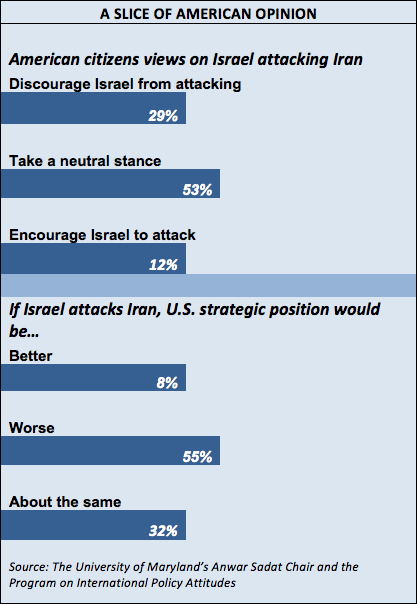
"Gratuitous swagger on Iran has long been a part of the Romney repertoire," said Suzanne Maloney, senior fellow at Brookings Institution's Saban Center for Middle East Policy. "He has likened the Islamic Republic with the Soviet Union's 'evil empire,' tossing in an analogy to Nazi Germany for good measure.
"Romney has suggested that his own election is the only means of preventing Tehran from acquiring a nuclear weapon and has disparaged the Obama Administration's diplomatic efforts on Iran as "a symbol of weakness and impotence." None of this provides serious policy alternatives, nor does it truly reveal how a Romney administration might actually approach the intractable issue of Iran."
However, President Romney might react differently from Candidate Romney in the cold hard realities of Middle East politics, and he may not be as hostile if he takes the pulse of American public opinion, who are concerned about an Israeli or American attack on Iran's alleged nuclear facilities.
Eight-six per cent of Americans believe an Israeli attack on Iran would raise oil prices and 70% feared the attack would draw the U.S. into a war with Iran.
"The expectation is also that such a strike would worsen "the US's military and strategic position in the Middle East," with 55% taking this view. Only 8% thought the US position would be improved, while 32% thought it would remain about the same," the report noted.
Interestingly, the respondents did favour some daylight between American and Israeli policies, which is in sharp contrast to Republican's view which favours standing shoulder-to-shoulder with Israel.
"The U.S. should think about its own interests and make a clear statement distancing itself from whatever Israel may choose to do, to reduce the chance that Iran will retaliate against U.S. targets," the study noted. "A modest majority of 52% found this convincing (very, 14%), while 43% found it unconvincing (very, 15%)."
Meanwhile, the war-weary respondents strongly opposed attacking Syria, but favoured increased economic sanctions, diplomatic pressure and imposing a no-fly zone, which worked effectively in Libya.
"The options of 'sending arms and supplies to anti-government groups' and 'bombing Syrian air defences; were both rejected by two-to-one margins. For sending arms and supplies 67% were opposed and only 22% in favour; there was no meaningful variation in support by party. For bombing Syrian air defenses, 68% opposed this idea and 21% supported it."
In the aftermath of the attack on U.S. embassies in Libya and Egypt, the respondents favoured reducing financial aid to Egypt, as they felt the Cairo government did not adequately criticize the attacks.
Forty-two per cent of respondents favoured decreasing aid to Egypt, while 29% favoured discontinuing it altogether.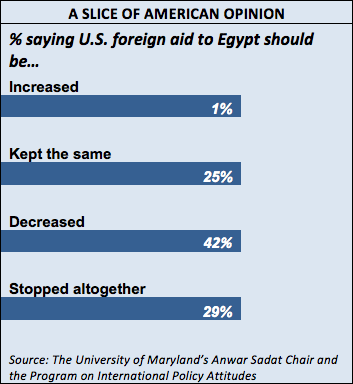
"When this finding is compared to two very similar questions asked in June 2012 by the Chicago Council on Global Affairs, it appears that the majority preferring lower aid to Egypt has grown significantly," the report noted. "In June, a lesser 52% wanted lower economic aid to Egypt, with 29% wanting to decrease it and 23% wanting to stop it."
Not surprisingly, majority of the respondents have a negative view of both Egypt and Libya, although they believe the attacks on U.S. interests were not supported by vast majorities of Libyans and Egyptians.
Finally, majority of respondents believe the clash between the West and Islam are less about incompatibility between the two ways of life, and more about regional and political interests. However, these majorities are declining when compared to previous surveys.
"A majority (51%) continues to think that the tensions between Islam and the West are more about conflicts of power and interests than of differences of religion and culture (43%)," the study concluded. "This is down, however, from one year ago, when 57% thought the tensions were more about power and interests and 38% more about religion and culture. It is noteworthy too that 56% of Republicans, compared with 36% of Democrats and 38% of independents, attribute the tensions to differences of religion and culture."
Americans were also deeply divided about their perception of Arabs, with 49% viewing them favourably and 47% negatively. In August 2011, 53% viewed Arabs favourably, there has been a decline in how Arab are perceived. The respondents were also deeply divided about their views on Muslims, with 48% viewing them favourably and another 48% perceiving them negatively.
© alifarabia.com 2012