Output growth at 21-month high
Non-oil producing private sector companies in the UAE recorded both higher output and new orders during February. Employment levels continued to rise and the rate of overall input price inflation picked up to the highest since August 2012.
The headline seasonally adjusted HSBC United Arab Emirates PMI™ - a composite indicator designed to provide a single-figure snapshot of the performance of the non-oil private sector - posted 55.4 in February, up slightly from January's 55.0 pointing to a further solid improvement of operating conditions in the UAE. The latest reading was the second-highest in 21 months.
February data signalled a solid increase in output at non-oil producing private sector companies in the UAE. The rate of expansion picked up from January and was the sharpest since May 2011. Panellists linked the rise to increased market demand and improving market conditions.
New orders rose at a marked rate during February. Around 34% of respondents signalled higher new work and less than 9% recorded a fall. New business from abroad also increased in the latest survey period, but at the weakest pace in five months.
The level of outstanding business in the UAE's non-oil producing private sector increased in February. While the latest reading marked the second successive accumulation, the rate of growth was only marginal and broadly unchanged from the previous month. Meanwhile, vendor performance continued to improve. There was some anecdotal evidence that the improvement in delivery times was driven by faster payments and long-term relationships with suppliers.
Non-oil producing private sector companies in the UAE recorded higher employment levels in February. Job creation has now been registered in each of the past 14 months. Increased business and the opening of new branches were factors behind the latest expansion of workforce numbers.
Average output prices rose for the third month running during February, and at the fastest pace in nine months. Companies linked the rise to higher raw material prices and increased market demand.
The latest survey data signalled a solid increase in input costs at non-oil producing private sector firms in the UAE. The rate of inflation picked up, and was the sharpest since August 2012. Both average purchase prices and average staff costs rose during February.
Purchasing activity in the UAE's non-oil producing private sector increased further in February. A rise in new orders was among the factors behind the increase. Concurrently, stocks of purchases rose at the sharpest rate since May 2011. Companies linked the increase to greater workloads.
Comment
Commenting on the UAE PMI™ survey, Simon Williams, Chief Economist for Middle East & North Africa at HSBC said:
"This is another strong reading that provides further evidence that the upswing in UAE economic activity is continuing to build momentum. The strong data for new orders is particularly encouraging, as are the signs in the survey that employment is rising as confidence and economic performance firms. The pick up in input costs captured in the February data is an early marker of rising inflationary pressures. But with price growth moderate, wages flat and backlogs of work unchanged, the country still looks to be at an early stage in the inflation cycle."
Key points
- Output increases at fastest pace since May 2011
- Further rise in employment levels
- Overall input price inflation accelerates
Historical Overview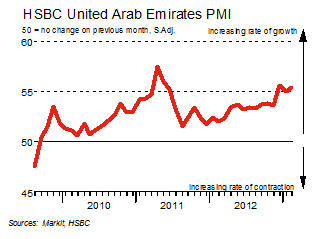
The HSBC Purchasing Managers' Index™ is based on data compiled from monthly replies to questionnaires sent to purchasing executives in approximately 400 private sector companies, which have been carefully selected to accurately represent the true structure of the United Arab Emirates economy, including manufacturing, services, construction and retail. The panel is stratified by Standard Industrial Classification (SIC) group, based on industry contribution to GDP. Survey responses reflect the change, if any, in the current month compared to the previous month based on data collected mid-month. For each of the indicators the 'Report' shows the percentage reporting each response, the net difference between the number of higher/better responses and lower/worse responses, and the 'diffusion' index. This index is the sum of the positive responses plus a half of those responding 'the same'.
The Purchasing Managers' Index™ (PMI™) is a composite index based on five of the individual indexes with the following weights: New Orders - 0.3, Output - 0.25, Employment - 0.2, Suppliers' Delivery Times - 0.15, Stock of Items Purchased - 0.1, with the Delivery Times index inverted so that it moves in a comparable direction.
Diffusion indexes have the properties of leading indicators and are convenient summary measures showing the prevailing direction of change. An index reading above 50 indicates an overall increase in that variable, below 50 an overall decrease.
Markit do not revise underlying survey data after first publication, but seasonal adjustment factors may be revised from time to time as appropriate which will affect the seasonally adjusted data series. Historical data relating to the underlying (unadjusted) numbers, first published seasonally adjusted series and subsequently revised data are available to subscribers from Markit. Please contact economics@markit.com.
HSBC:
HSBC is one of the world's largest banking and financial services organisations. With around 6,900 offices in both established and faster-growing markets, we aim to be where the growth is, connecting customers to opportunities, enabling businesses to thrive and economies to prosper, and ultimately helping people to fulfil their hopes and realise their ambitions.
We serve around 60 million customers through our four global businesses: Retail Banking and Wealth Management, Commercial Banking, Global Banking and Markets, and Global Private Banking. Our network covers 84 countries and territories in six geographical regions: Europe, Hong Kong, Rest of Asia-Pacific, Middle East and North Africa, North America and Latin America. Our aim is to be acknowledged as the world's leading international bank.
Listed on the London, Hong Kong, New York, Paris and Bermuda stock exchanges, shares in HSBC Holdings plc are held by over 221,000 shareholders in 134 countries and territories..
About Markit:
Markit is a leading, global financial information services company with over 2,800 employees. The company provides independent data, valuations and trade processing across all asset classes in order to enhance transparency, reduce risk and improve operational efficiency. Its client base includes the most significant institutional participants in the financial market place. For more information please see www.markit.com
About PMIs:
Purchasing Managers' Index™ (PMI™) surveys are now available for 32 countries and also for key regions including the Eurozone. They are the most closely-watched business surveys in the world, favoured by central banks, financial markets and business decision makers for their ability to provide up-to-date, accurate and often unique monthly indicators of economic trends. To learn more go to www.markit.com/economics
The intellectual property rights to the HSBC UAE PMI™ provided herein is owned by Markit Economics Limited. Any unauthorised use, including but not limited to copying, distributing, transmitting or otherwise of any data appearing is not permitted without Markit's prior consent. Markit shall not have any liability, duty or obligation for or relating to the content or information ("data") contained herein, any errors, inaccuracies, omissions or delays in the data, or for any actions taken in reliance thereon. In no event shall Markit be liable for any special, incidental, or consequential damages, arising out of the use of the data. Purchasing Managers' Index™ and PMI™ are trade marks of Markit Economics Limited, HSBC use the above marks under license. Markit and the Markit logo are registered trade marks of Markit Group Limited.
© Press Release 2013