With OPEC seemingly irrelevant, the GCC is trying to find a balance between responsible crude suppliers and their own domestic needs. But, as Deutsche Bank warns, their own high breakeven prices are making them even more vulnerable to oil price shocks than before.
Opec is in danger of becoming irrelevant, but it could well be that is just reluctant.
"Narrow self-interest on the part of some powerful member-countries prevented the Organisation from acting in a responsible manner, as even its own analysts had indicated it needed to do," says a note from Centre for Global Energy Studies, managed by Sheikh Yamami, who ran the Saudi oil minister in the 1970s and 1980s.
The Organisation of Oil-Exporting Countries (OPEC) was widely expected to raise output quotas in its most recent meeting, but failed to agree and eventually made no change, surprising pundits and markets.
Ironically, Saudi Arabia, which is the Opec kingpin, hurt the cartel's interest by announcing even before the group met that they will raise their own output by at least 500,000 regardless of what happens at the meeting.
This weakened Opec and hardened the stance of already hawkish producers such as Iraq, Venezuela. In all, seven of the 12 members opposed any increase in quota.
The Saudi oil minister Ali Al Naimi called it the "worst meeting" he ever attended.
More importantly, in the eyes of oil-consuming countries, OPEC has come across as an irresponsible custodian of the world's most important commodity.
Even before the ink had dried on Opec statement that there will be no new supply, the International Energy Agency (IEA) racheted up the pressure, with a statement of its own.
"We have noted with disappointment that OPEC members today were unable to agree on the need to make more oil available to the market," the IEA began. "Of course what really matters is actual supply, which should move in line with seasonally rising demand, and we urge key producers to respond accordingly.
Ongoing supply disruptions, as well as the fragile state of global economy, call for a prompt increase in supply on a competitive basis that will allow refiners to boost throughputs and meet rising seasonal demand, the EIA noted.
"Otherwise, a further tightening in the market and potential increases in prices risk undermining economic recovery, which is in the interests neither of producers or consumers."
Calls were also made for U.S. President Barack Obama to tap into the country's strategic oil reserve.
By consistently failing to take action, even when there is compelling evidence that it needs to do so, OPEC is making itself irrelevant as a force for stability in the oil market, notes CGES.
With little or no spare capacity, it could be argued that many of the OPEC member-countries have no positive role to play in any case.
Wall Street bank Goldman Sachs also noted the more important story was OPEC's level of spare capacity rather than its decision on output. "We expect OPEC will raise actual production levels in second-half 2011 and will need to move to operating at its (maximum) capacity limits in 2012."
That's the worry. The world's spare oil capacity stands at 4.4 million barrels per day, but 71% of that capacity is in Saudi Arabia.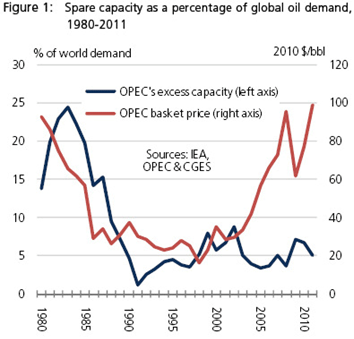
CGES argues that only Saudi Arabia has spare capacity by any significant amount "and they now need to send a clear signal to the market that that is what they intend to do. Then they need to do it."
And that is exactly what Saudi Arabia did over the weekend, announcing that it will unilaterally raise output, sending oil prices lower on the news.
Rising Breakeven Prices
Of course, don't expect Riyadh to go rushing to open the oil taps. Even as oil prices flirted with $120 per barrel levels in the year, Saudi Arabia maintained that the market was well supplied.
"Just send the customers, don't worry about the volumes," was about Al Naimi said when asked how much oil is Saudi Arabia willing to provide.
With OPEC seemingly looking irrelevant, Saudi Arabia must feel like Atlas with the weight of the world on its shoulders, which it must counterbalance with its own rising domestic needs.
And this is where Gulf states - which want to act as responsible global oil suppliers - need to walk a tightrope, especially as their own domestic spending is rising.
The average budget breakeven price in the Gulf states stands at a manageable $77-barrels, "but this masks a considerable range within the GCC, from a very comfortable USD45/b in Qatar, to USD82/b in Saudi Arabia, and USD103/b in Bahrain," notes Deutsche Bank in a new report.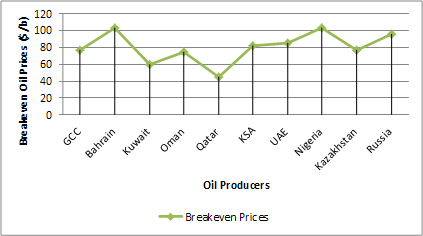
The German bank estimates that breakeven prices of oil producers have risen in tandem with rising oil prices.
"Our bottom line is that so long as oil prices remain close to current elevated levels (as we expect), the region's oil producers will be in a comfortable position. But the continued ratcheting up of breakeven prices in recent years has left them increasingly vulnerable to a correction in prices," notes Deutsche, hence their reluctance to raise oil output.
Deutsche Bank's estimate for Brent is $117.5 per barrel, slightly below to Goldman Sachs $120 per barrel.
The German bank estimates that a $10-per barrel increase in oil prices means that the GCC current account balances wick be $56-billion and $50-billion in fiscal balances, with the largest nominal impact in Saudi Arabia.
"Kuwait appears to benefit the most on fiscal front (at 5.3% of GDP) from higher oil prices, probably due to higher oil dependence of its government revenues (accounting for 93% of total versus GCC average at 82%). On the external side, Qatar's sensitivity is one of the highest (at 4.6% of GDP) on the back of its higher share of hydrocarbon exports in total and advancing production capacity."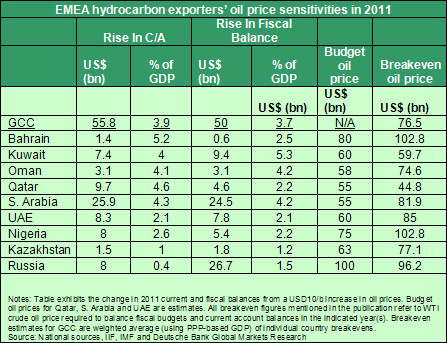
New Gulf Spending = $10 Per Barrel
The bank estimates that the recent spate of social spending has added $10 to the Gulf's breakeven prices, but more worryingly the breakeven prices have risen by $46 per barrel from 2006-2010, suggesting that Gulf countries - especially Bahrain, Saudi Arabia and the UAE are sensitive to oil prices.
The Gulf states' current account balance will reach an all-time high of $310-billion, despite a higher import bill, and a widening deficit in the income and net transfer accounts, with combined budget surplus of 13.1% of GDP in 20111, compared with 7%, and GDP growth of 6.1% in 2011, compared with 4.8% in 2010.
While the near term outlook for the Gulf looks favourable, they face a dilemma.
Over-dependence of oil has resulted in underdevelopment in non-energy sectors. But the states' efforts to fund non-hydrocarbons with petrodollars means they now need higher oil prices (and more investments in hydrocarbons).
As such, for each and every GCC country breakeven estimates have increased this year compared to 2010, notes Deutsche.
"Qatar has seen the largest rise (though it still has the lowest within the bloc) followed by Saudi Arabia and Oman; while Bahrain's breakeven already stands at an alarming over USD100/b. Overall, increasing oil sensitivity for GCC will likely be a source of risk, and although oil prices are expected to remain close to current elevated levels, a potential correction will likely be felt more than ever by the regional countries."
Luckily for the region and for other oil producers, the forecast is more demand for oil as the global economy recovers from its soft patch. But the breakeven buffers are getting thinner by the year, and it is not surprising that Opec does not want to see a repeat of the late nineties when they grossly over-estimated demand and increased their output quota, only to see oil prices fall to around $10. They would rather earn the short-term ire of oil consumers rather than take a long-term fiscal haircut.
© alifarabia.com 2011